Particularly in drawings of animals like lions etc, there’s such a diversion from what things actually look like in medieval depictions, but by the mid 1500s, suddenly artists are painting borderline photorealistic scenes with lots of people.
How did humanity go from drawing like middle schoolers to Da Vinci in only a handful of generations?
I'm going to answer your question in two parts here, and address first whether or not medieval panters could have painted in a naturalistic style. The answer is yes and no. To understand this, we have to go back to the emergence of what we now recognize as the prototype for medieval Christian art, Late Antique Roman art. Beginning just before the rise of Christianity, Roman art had moved away from the Hellenized Classical images we think of today is 'Roman'. There are several reasons for this that I won't get into here, but it's important to understand that the artists working at the time of this transition did not lose their ability to represent nature accurately, but instead began to favor narrative and symbolism over naturalism. This Classical style fell out of favor, not because of a lack of ability, but a shift in priorities.
As we move into the medieval period, we see heavily stylized figures that are no longer adhering to Classical styles. At its core, this is because the artists' intent was different. Medieval artists were painting almost exclusively religious scenes, many of which were being viewed by a largely illiterate population. In many ways, their art was meant as a tool of education, a picture book to teach the Bible. In doing this, it was no longer important that figures look "real", only that they be easily interpreted. Main characters had to be recognizable across all art forms and important symbols had to be prominent for comprehension. Early Christian artists were creating art to meet a new need, and as time progressed, this style and worldview solidified and exaggerated. As time went on, features of Classical art such as single-point perspective, advanced shading, and the Golden Ratio fell out of favor and became virtually lost to the European world. Medieval artists felt that they were painting divinity, and so did not need to observe the Earthly world for their art.
As for animals, medieval artists were hindered by several factors, the main one being what I mentioned above, as well as a lack of access to direct source material. Most medieval Europeans never left their home town, artists included. They relied on word-of-mouth stories from travellers and the sketches they brought back. Additionally, these animal images were often being used as symbols alongside a religious or royal image, not as a piece of art in their own right. Even in bestiaries where animals were the focus, the moral tales alongside them often took precedence.
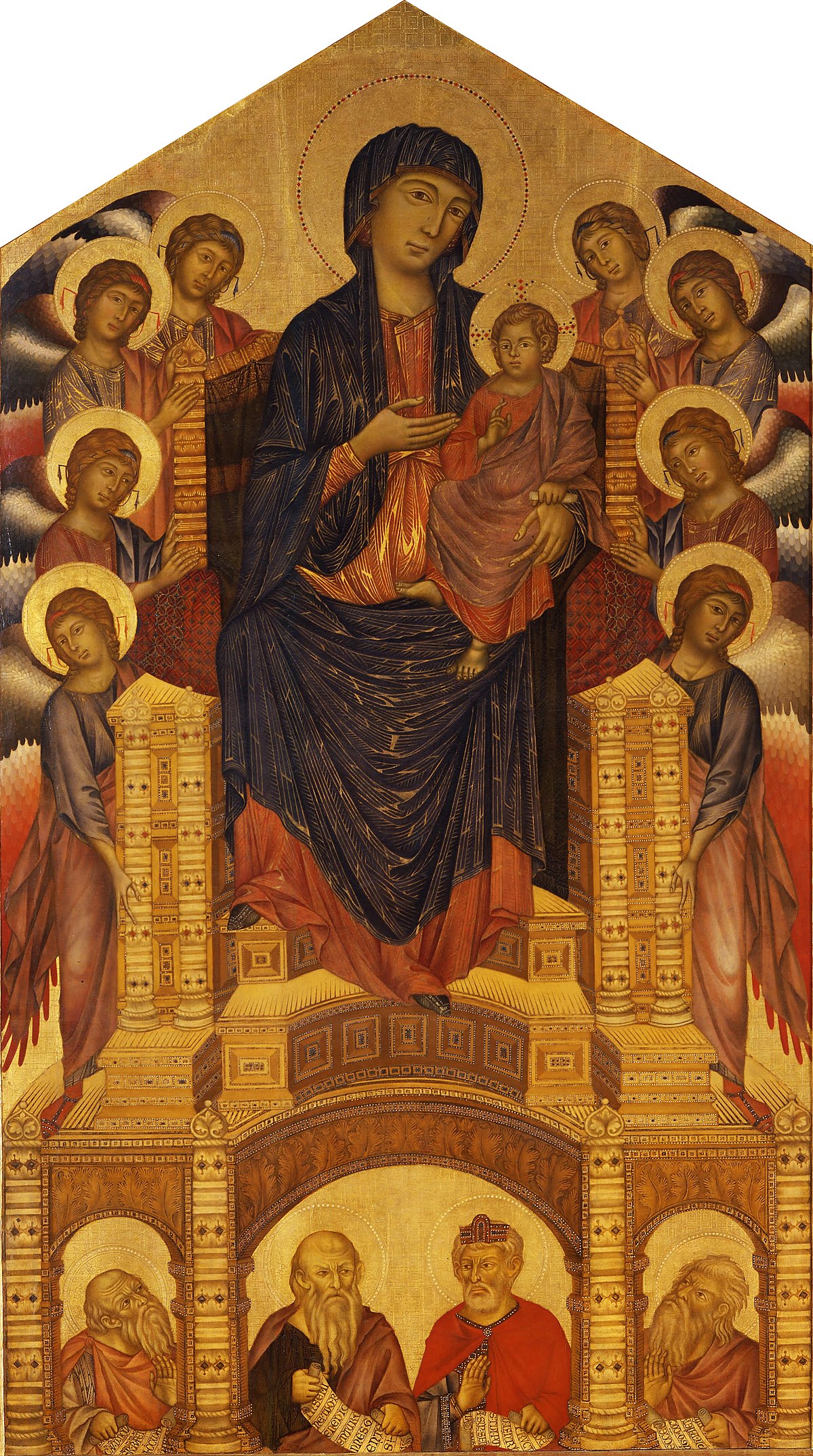
Now to address the second part of your question, how the medieval style became the Renaissance style. In the early 14th century, we enter a period known as the Proto-Renaissance. The period was spearheaded by the Florentine painter Giotto. Giotto was a student of the Gothic painter Cimabue, a master of the International Style (here is a famous example of his work). As you can see, Cimabue was utilizing a bit of shading and making an attempt at accurate perspective, but is still firmly rooted in the medieval style. Under Cimabue, Giotto learned the conventions of medieval painting, but he had a unique interest in the observation of the natural world. Taking the themes and values he had learned, Giotto began to incorporate real-time observations of the world around him and painted from life. The blending of natural representation and medieval Christian themes came out groundbreakingly different to the work of his contemporaries, the most famous example being his Lamentation of the Scrovegni Chapel. It's worlds different from Cimabue's Madonna and Child from before.
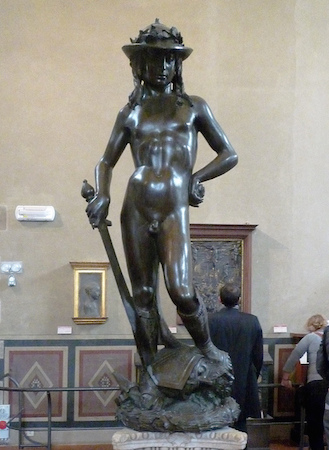
Giotto's radical new style fascinated the Florentines, and his influence is one of the main reasons Florence ended up as the center of the Italian Renaissance. Students flocked to Giotto to learn his methods, and he taught hundreds of pupils in his lifetime. Giotto and his students rejected the medieval and Byzantine model of elongation, distortion, and stylization in favor of shading, accurate rendering of proportion, and authentic emotion. In the 1420s, the painter Masaccio continued Giotto's legacy and became known as the first great Renaissance painter. Alongside this movement was the renewed interest in and discovery of Classical Roman sculpture. The early 15th century (the Quattrocento) brought artists such as Brunelleschi, Donatello, and Ghiberti who used these Roman works as inspiration for their own art. Ghiberti's Gates of Paradise of 1425 are one of the earliest works recognized as being fully in the Italian Renaissance style, and take direct inspiration from the Roman sarcophagi being unearthed in the region. At the same time, the first of the Renaissance masters, Donatello, sculpted his bronze of David in the Classical style. Many art historians credit him with bringing the all-important Classical contrapposto (the Greek s-curve) back to Italian art. The artist Paolo Uccello became obsessed with replicating single-point perspective in painting, and in 1450, he painted The Battle of San Romano, the first known use of accurate single-point perspective since before the Migration Period.
This new Classicizing art style begun by Giotto gained momentum through the second half of the 15th century and hit its stride fully in the 16th century (the Cinquecento). The period, the High Renaissance, was home to the other three Renaissance masters, Leonardo, Michelangelo, and Raphael, as well as other famous artists in the North such as Titian and Parmigianino.
I hope that helped!
Sources/Further Reading:
Muravskaya, Olga. "Christian Incentives of the Proto-Renaissance Traditions of European Culture." National Academy of Managerial Staff of Culture and Arts Herald 1 (2019).
Adams, Laurie Schneider. Italian Renaissance Art. Routledge, 2018.
https://www.amazon.com/Gardners-Through-Ages-Renaissance-Modern/dp/0155016199