How come people in the past could sculpt realistic statues but couldn't draw or paint? I mean stuff you see that looks like a child did it. Pictures of kings and gods and animals all over the world had bizarre stunted and anatomically wrong poses and arrangements. But they could and did make realistic statues? I thought drawing a model was the first step in sculpting? It just seems to me that roman, Egyptian, early European art all looks bad. But the same people made sculptures that were "photo-realistic"ish for lack of a better term.
Hi there!
First off, based on the wording of your question, I think you may be misunderstanding a few different periods and styles. Highly stylized ("cartoonish") images were popular across much of the ancient world, so I understand the confusion, but hopefully I can break it down for you. You specifically mention Roman, Egyptian, and medieval European art, so those are the examples I'll use. Keep in mind that I'm generalizing these styles a bit for the purposes of the question. There is far more nuance here than I can explain in one answer, but if you have any questions, please don't hesitate to let me know.
Ancient Egyptian art is known for its heavy stylization with mixed points of view and simple, bold outlines. For instance, here is an Old Kingdom painting. I assume this looks a lot like what you're thinking of in terms of Egyptian painting, and this general style was dominant for much of Ancient Egyptian history (with exceptions of course). While these images are beautifully done, they are functional. The Egyptian image canon was very set in the way human figures were depicted in painting. This set style allowed fast and consistent replication across scrolls, walls, sarcophagi, tablets, and many other flat surfaces that required religious or historical imagery. This style suited their purpose. Intricately rendered, hyperrealistic art wasn't a practical solution for a culture that adorned so many surfaces with art. Additionally, Egyptian art didn't serve a decorative function and was mainly utilitarian. It was used for religious and political/ideological purposes almost exclusively. Egyptian spirituality dictated that to render something artistically was to set it in stone. This led to a largely idealized and unrealistic style. Art was a world of its own, a kind of showcase or utopia, a universe away from the hardship of the natural world.
Where I'd imagine the confusion comes in is sculptures like this Old Kingdom Egyptian sculpture, Khafre Enthroned. We see a much more naturalistic style in this portrait sculpture of the Pharoah Khafre compared to the painting from before. That said, I wouldn't call it "photorealistic". It lacks the naturalism of Classical Greek and Roman sculpture, but it's a step up from the painting style. In general, I would argue this is due to the difference in function. Sculpture, for the most part, was part of the Egyptian funerary tradition. The Egyptians were a very death oriented culture and had intricate and elaborate traditions and rituals that went along with it. After a person died, the Egyptians believed that their soul, the ka, required a place to reside for eternity. The first choice would have been the body of the deceased, the mummy, but the Egyptians knew that many things could go wrong for the body and so sculpture became a failsafe. Many sculptures of high craftsmanship served this purpose, and were called ka statues. In the event that the mummy became damaged, stolen, or lost, the sculpture provided a home for the soul. Funerary sculptures could also be used as a surrogate body during rituals of animation, whereby a priest could ceremonially animate the sculpture in a ceremony called 'the opening of the mouth'. This gave the sculpture access to human senses. These religious rituals were incredibly important, and so required the highest caliber of art available, especially for the rich and royal. Of course, these funerary sculptures came in varying qualities, from the naturalistic and expensive to rougher wooden images for the lower class. Many of these non-pharaonic images actually mirror the painting style, appearing less stylistically sophisticated.
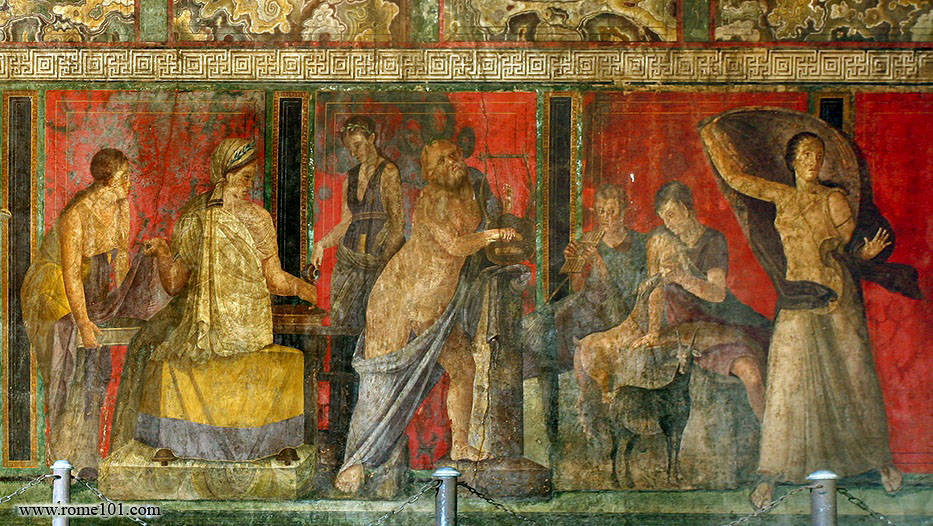
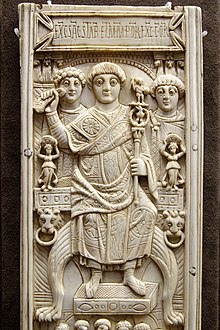
If we move on to Rome, I think you'll see where there's been a bit of an errant conflation. If we look at very early Roman art (really Etruscan) we see painting like this alongside sculpture like this. I would argue that these are rather equitable in style. This trend continues throughout Roman history. In the art of the Empire, we see this type of painting alongside this type of sculpture. In the Byzantine period after the fall of the Western Empire, we get sculpture like this and mosaics (more popular than paintings in this period) like this. I think in you may have been mixing up some dates, as the level of naturalism in the sculpture of Ancient Rome was usually reflected in the painting. I don't find there to be much discrepancy at all between the painting and sculpture of Rome.
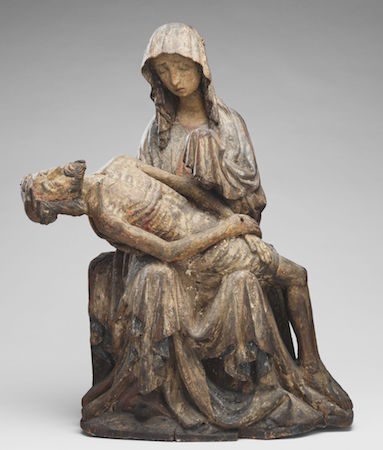
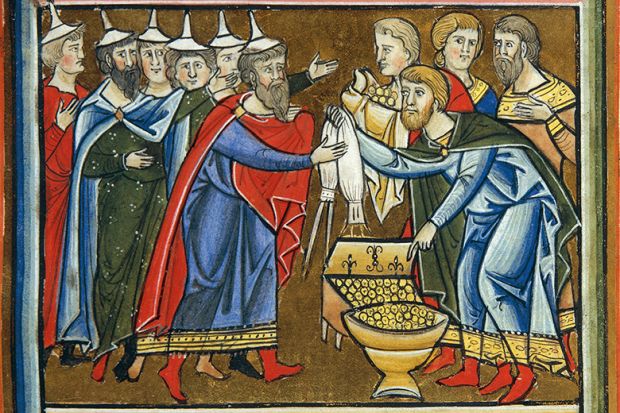
Finally, let's talk medieval art. I assume that's what you mean by early European. To respond briefly, medieval European artists did not make naturalistic ("realistic") sculpture. This part of your question doesn't have much of an answer, because the naturalistic style of Classical (and later Renaissance) Europe was not present in the medieval world. Medieval sculpture often looked like these figures from Chartres Cathedral or this Pieta. Painting, often found in manuscripts, is similar to this or this. High levels of realism were not important for medieval people. The purpose of medieval art was mainly as a teaching tool, a kind of picture book for illiterate masses. It needed to be easily identifiable, not perfectly natural, much in the way a children's cartoon might be.
If I could leave you with any thought, it would be to rethink your statement calling some of this art "bad". All art serves the needs of its culture, and sometimes that means a style we might not be personally drawn to. All of the works I mentioned served their purposes and their audience.
Further Reading/Sources:
Robins, Gay, and Ann S. Fowler. Proportion and Style in Ancient Egyptian Art. University of Texas Press, 1994.
Wilkinson, Richard H. Reading Egyptian Art: A Guide to Ancient Egyptian Painting and Sculpture. Thames and Hudson, 1992.
Ramage, Nancy H., and Andrew Ramage. "Roman Art: Romulus to Constantine." (1991).
Elsner, Jaś. Art and the Roman Viewer: The Transformation of Art from the Pagan World to Christianity. Cambridge: Cambridge University Press, 1995.
Kessler, Herbert L. "Seeing Medieval Art: Rethinking the Middle Ages." Paul (2004).
Davis-Weyer, Caecilia. Early Medieval Art, 300-1150: Sources and Documents. Vol. 17. University of Toronto Press, 1986.