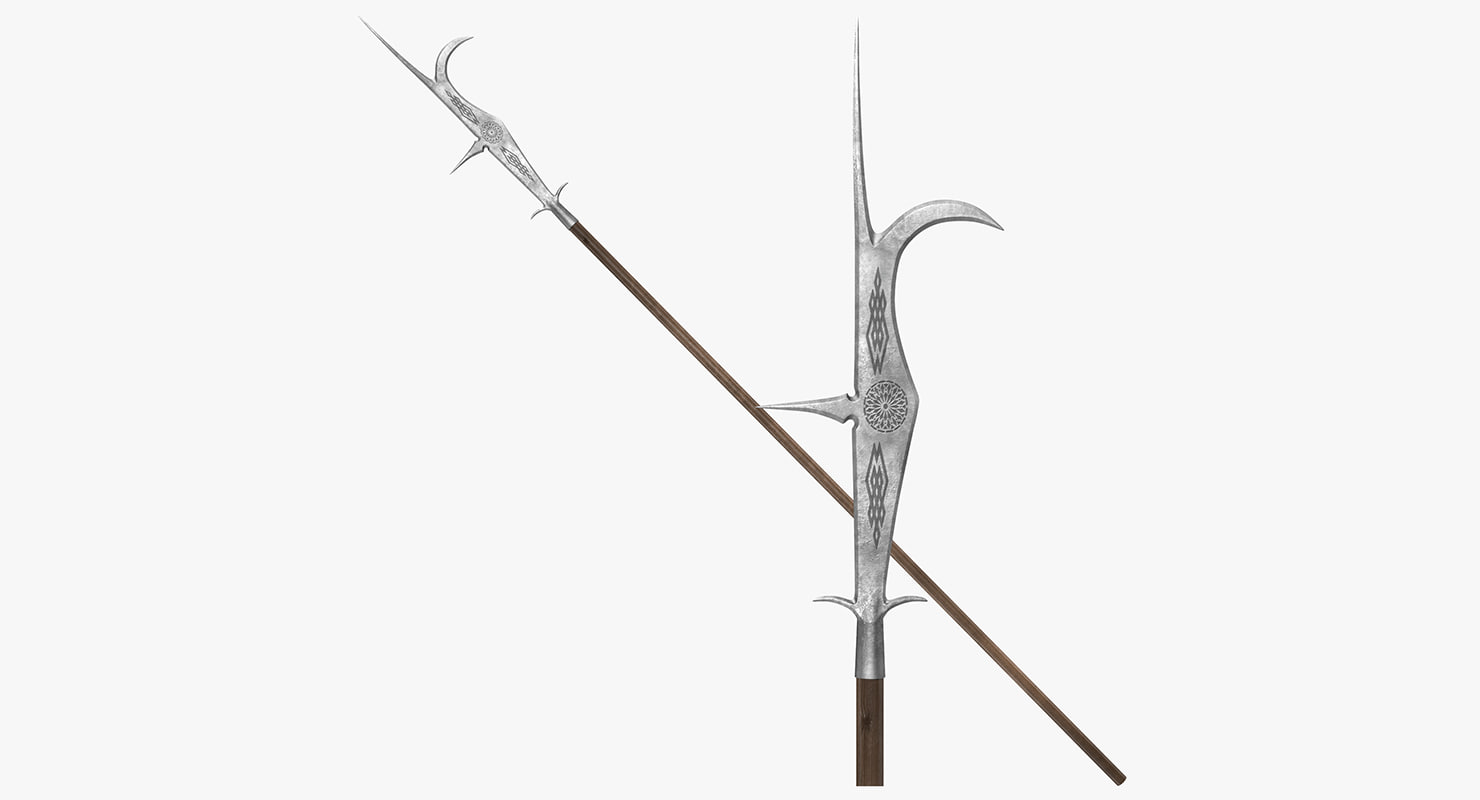
I could not find further references that would support Sir Guy Francis Laking's claim (in his A record of European armour and arms through seven centuries), so I decided to turn to the wonderful people in this subreddit who are more knowledgeable than I am.
I am basically curious about the following aspects regarding the guisarme:
How effective and widespread was it as a weapon and what was its purpose on the battlefield? In his book, Sir Guy Francis Laking says it came second only to the spear, so this makes me think it was a weapon in fairly common use.
What lead to the several shapes and forms of the various weapons that fall under "guisarme"? I know not a lot of people agree on what a guisarme actually is, so I'm lumping guisarmes/fauchard/glaive-guisarme under the same label for the purpose of this question. Why were there so many designs? Were they actually this intricate because such shapes were useful in combat, or was it more of a "ceremonial" look?
Were people in the ⅩⅢth century really advocating for a ban on guisarmes? During a discussion with another person, it came up that this could make sense if taking a knight off of his horse was too easy with recourse to such weapons. Did this "call to ban guisarmes" really happen and if so what were the reasons behind it?
Thanks in advance!
Part 1
Sorry for the delay in answering. Life, illness and the state of the world have kept me away for a bit. But I'm back, I have my sources spread open, my evening free and a killer soundtrack queued up (the latest Obsequiae album, which slays, FYI). So let's do this.
As you recognize, there's actually a number of questions here. I'm going to simplify them into two basic ones. First, what the heck is a guisarme (answering this will cover both your first and second points)? And second, did anyone try to ban them? Briefly, the answers to these questions are 'it's complicated' and 'probably not', but that is neither very informative nor very fun, so let's go deeper.
The first question is indeed the tricky one. Fortunately it's one that I have answered before but I have done more reading since and I wanted to expand my thoughts. So I'm going to block quote myself and add additional depth in between my paragraphs. In short, Guisarme or Gisarm or Gisern or Jusarme seems to be either a fairly specific Middle English term, or a very broad Middle French term (expanded from an original meaning that was basically synonymous with the term in English), and this is the cause of a lot of the ambiguity around the word in modern terminology for medieval weapons. Being in use for a long time, the term referred to a number of different things. As I wrote earlier:
First of all, terminology is hard. Which is to say, it can be difficult to match a name that is in an inventory or chronicle with a weapon that is depicted in an illumination or an artifact that survives in a museum. This is because when we are studying weapons that have fallen out of active use, they have similarly fallen out of our vocabulary. Conversely, people mentioning them in things like chronicles and inventories know what they meant and expected their contemporaries to know as well. A further complication is that when we talk about European polearms from say, 1000 to 1600 we are talking about a span of 600 years across an entire continent. Terms came to mean different things over time, even in the same language, and different nations had different words for the same weapons (the Italian Roncone is essentially an English Bill, though their designs differ in the particulars). You have seen the results of this confusion yourself in the varied descriptions of what a Guisarme is.
I have not myself seen definitive evidence for what sort of weapon is accurate described as a 'Guisarme'. In the Musee de le'Armee in Paris, they have a series of Italian bills from the late 15th and early 16th century (Ronca/Roncone, to use the Italian term) labelled as 'Guisarmes'. You can see the same in the Metropolitan Museum of Art. This is also the 'Guisarme' illustrated in many roleplaying books, like the (in)famous Polearm spread in the DnD rulebook. Does this reflect a genuine medieval French usage of 'Guidarme' for Bill? Or did 19th century collectors decide that 'this is a Guisarme'? The exhibit does not provide the evidence to judge. In any case these bills would be mounted on hafts around 6 feet long. Their heads would be a bit over 2 feet long and weight over 2 pounds, according to Waldman.
Since I wrote this, I read an illuminating article in the Royal Armouries Yearbook, "A 15th Century Weapons Dowry" which explains a lot about how this general French term came to be used so widely. In it, Guisarmes, spelled 'Jusarmes' - which is one one of four spelling variants in this answer). In this article, Kelly De Vries discusses how while Guisarme in its original use (going back to Catalan sources from 977) referred to a kind of axe with a broad, crescent-shaped head (see below for more on that usage in English), by the 15th century it came to refer to other kinds of polarm. "From that time until the 15th century, gisarmes seem to have been the primary name by which several different French staff weapons were known. And, by the time of the marriage between James II and Mary of Guelders, gisarmes had generally lost their axe-shaped head, replacing this with long, pointed single edged blade; the 1489 Catholicon parvum, a French-Latin dictionary, defined the gisarme as 'glaive-edged from one side to the other like a sword' (as quoted in Gay, 1887:805) Still, as Victor Gay insists, one must be cautious in assigning the term to a specific type of late medieval staff weapon. 'The attentive examination of numerous documents where the weapon [gisarme] is mentioned does not allow us to suppose that all were one and the same object' (Gay, 1887:804)." - At least, not in the French sources of the later mater Ages. Interestingly, in a footnote De Vries specifically dismisses George Snook's very specific definition of a Guisarme (which resembles the image you linked, an Italian bill I'd call either a 'bill' or a 'Roncone' if I wanted to be fancy) as being without evidence - and I would agree with him there. In particular, note that the definition used describes what we might often call a 'glaive' in modern English (based on the middle English Gleyfe) - a knife on a stick, what Waldman might call a 'Cousse' (based on usage in other languages). Like I said. Terminology is hard.