I am unsure why all the comments have been deleted, there were some really interesting and informative responses
The origin of the tricolor as we know it today gains its modern connotations of republicanism and democracy from the birth of the French revolution, and much of the credit for its widespread use comes from France as a whole and Napoleon's actions specifically.
However, the very first example of intentional design likely comes from the Netherlands, or rather the flag of the first revolt of the Dutch in the 16th century. Originally used by Prince William of the House of Orange-Nassau, it eventually became the basis for the new republic and later monarchy, well before the French revolution. There has also before this been examples of colour striped designs in coat of arms, notably that of Babenberg of Austria, later used in the flag of Austria. By legend, the origin of this comes from a bloody battle: the only stripe of the Duke of Babenberg's silver armour left clean of blood from being covered by his belt.
But moving on to the origin of the modern tricolor, three vertical bands of three different colours and specifically the *tricolore* of France. It has its roots in Paris, as red and blue were the Parisian coat of arms and the fervour of revolution used rosettes in these colours to identify you as friend or militiaman of the revolution, giving rise to widespread use as the symbol of the revolution in the rest of the country. When the new national police was formed, it used red, blue, and white, in its rosette, possibly the first combination of these colours. The reason for the use of white is disputed, but its generally accepted to represent the monarchy at a time when wholesale abolition of the monarchy was not a given. Or it was a simple representation of an ancient colour of France.
In any case, the once widespread adoption was established in France, and the powers of Europe as we all know did not look kindly on what was brewing in France and promptly declared war to restore the monarchy. It took six coalitions to briefly restore monarchical power and a seventh to do so again, but in all that time Napoleon Bonaparte was carving out new client states in conquered territory. And in many of these territories he did bestow a new flag in the visage of the French flag. Here is a list, but notable examples include the Cisalpine and Cispadane republics whose colours later grew as a symbol of the unification of Italy and was subsequently adopted as the flag of Italy. Other examples were not tricolors but were nonetheless simplified striped flags that were previously semi-sovereign states of the Holy Roman Empire, or were created wholecloth from new lands such as Westphalia.
But in other cases there was not direct imposition but inspiration. Later, in Germany the modern flag was developed from their own revolution in 1848, though the origins are not clear. Napoleons occupation of German territories was contributory however: The Lützow Free Corps were a Prussian military unit comprised of German men from all over Prussian territory. They used these colours against Napoleon, but their heroic myth in the cultural psyche became associated with nationalism in Germany, and so did their uniform colours of black (a cheap dye for their volunteer army uniform), red and gold (for accessories like buttons).
Once root had taken hold in Europe, it spread throughout much of the world. However, it is not the rule of origin. There are exceptions. The Dutch flag is one, the Austrian another. The flag of Venezuela and those inspired by it (Colombia, Ecuador) found its origin in the late 1700s, when German philosophiser Von Goethe had a conversation with Venezuelan revolutionary Francisco de Miranda. (quote from wikipedia)
"First he explained to me the way the iris transforms light into the three primary colors […] then he proved to me why yellow is the warmest, noble and closest to [white] light; why blue is that mix of excitement and serenity, a distance that evokes shadows; and why red is the exaltation of yellow and blue, the synthesis, the vanishing of light into shadow.
This became the basis of the Venezuelan flag, as Miranda was the harbinger of Simón Bolívar, who did eventually liberate much of South America.
In former colonies in Africa, especially of French origin, most gained independence long after the establishment of French republicanism and well into the origin of modern democracy in Europe. In these countries, many held referendums and semi-public contest, such as Nigeria. In other cases, flags were brought into existence after liberation from Nazi Germany. But in both cases, by then the tricolor was well established as a symbol of a free nation. Its reduction, the bicolor flag, has also existed since medieval Europe in the form of coat of arms and banners, and some states use the colours of historical coat of arms with such a design for their modern flag, such as Czechia.
Nowadays, this is less of a question of history, and more of a question of art..
Historically, until the Renaissance many flags were a lot more symbolic. They could be the coat of arms of a ruling family, a historical figure or something else important to that nation. For centuries, England had various complex flags that represented both the county and it's ruling family, often divided up into quarters.
However, history moved towards being more about the state than the individual. At the same time, art was evolving across Europe. The Italian Renaissance had led to a huge overhaul of artistic techniques as ancient methods were combined with new to create far better artwork. This included a number of observations of how best to present art, such as focal points and layout.
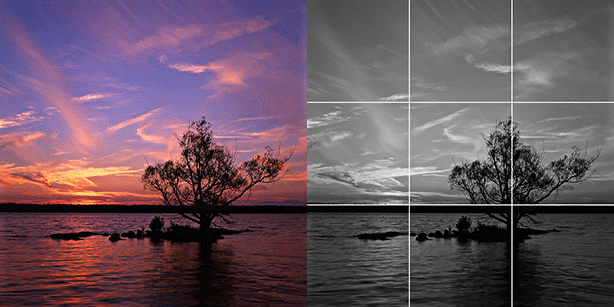
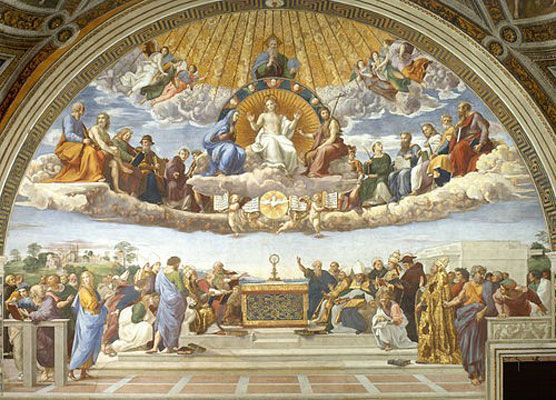
Now, this is where we have to have a discussion about art. There is something called 'the rule of thirds' in art and photography. It dictates that to make a composition look it's best, it should be split into a grid of 9 even blocks, and the subjects of the composition should be placed along the lines of that grid, to best align them. Then, the background should be aligned with the framing of the image being so that either 2/3 of the boxes are filled with one type of background (usually the sky or a backdrop), and a third filled with another, or all three horizontal rows contain a different backdrop, such as a meadow at the bottom, mountains in the center, and the sky at the top. This Giffrom Wikipedia shows a good composition. The tree and foliage are on one horizontal and one vertical axis of the grid. The landscape around them is perfectly separated, with the lower third of the image being sea, the horizon crossing the same line as the subject of the photograph, and then the upper two thirds being dedicated towards the sky. This leaves the subject of the art looking centered, even though it is not, and nothing in the piece feels wasted. For some reason, it is naturally appealing to the human eye. This sort of design first started to appear in Renaissance artworks, and was often used to create bold imposing backdrops while the main subjects of the piece remained the focus. Raphael was a strong user of this style (although sometimes to allow for the illusion of depth in art figures would have to be moved to a more central position, as if the upper boxes of the grid had been pushed together). This piece shows the rule of thirds being used to mark the differences between God, Jesus, Mary and the apostles, and the common man. Each part occurs as if laid out on a grid, and contains a blank space between that adheres to the rule, creating something both impressive and appealing. Another Raphael piece that follows this guidance is the Fire in the Borgo , where we can see that the characters in the artwork are actually arranged in a grid pattern, leaving blank spaces around the outside and center. The backdrop also fits the rule, as well as adding perspective, with the bottom third showing a town square that seems closer than the upper two thirds, which contain buildings in the background.
Now, this is where the flags come in. After the Renaissance, many flags of new and changing nations were designed by artists who had studied the works of Raphael and his contemporaries, and were aware of the rule of thirds. Many flags thus became tricolours, as they were naturally more pleasing to the eye. The French flag for example is red, white and blue, with the colours divided into thirds as vertical bars. The flag of Germany also follows the rule of thirds, with colours instead following the grid horizontally. The rule of thirds also applies to the colours used, not just the grid composition. There's something unknown to science that the human brain just likes about seeing or getting three of something. There is a similar 'rule of threes' in literature, where many believe having three of something (characters, like 'an Englishman, an Irishman and a Scotsman', or adjectives 'tall, dark and handsome') reads better and is more appealing.
The UK flag and the US flag stand out for being tricolours that don't seem to adhere to the rule of threes, because these flags actually follow the earlier style of having a much more specific meaning. The Union Flag is famously a merger of the flags of England, Scotland and Northern Ireland, all of which have only two colours. All 3 flags represent a patron saint: the red cross on white field of St George for England; the white saltire on blue field of St Andrew for Scotland; and the red saltire on white field of St Patrick for Northern Ireland. Combined together we get the Union Flag, which is essentially a tricolour by chance, as the three constituent flags only feature the colours red, white and blue. It's worth noting that the Welsh flag is not represented in the Union Flag. Whether this is because adding green to the flag would break the rule of thirds and make it look worse is unknown though.
Similarly the US flag also represents something specific. The stars on a blue field in the upper left denote the number of states in the Union. The 13 red and white stripes represent the original 13 colonies that rebelled against the British. They now say that the colours represent different things too, but it is likely that when the flag was first adopted these were borrowed from the British and French flags due to the new nations close ties to both. It was a quick way to give this young nation a sense of power and 'worth'.
And that's it really. The rule of thirds and the use of three colours is a thing just because it looks good. Three colours in a grid of some sort should make most flags instantly recognisable. The countries that don't use these rules will usually have some other significance behind their choice of flag, such as with the UK or US, and even then many will have three (or fewer) colours. The flag of Nepal for example, is the world's only non-quadrilateral flag, so cannot be divided into an even grid. But it still contains only three colours, because it just appeals to the human eye for some reason.
Reference: the first known written reference to 'the rule of thirds' comes from John Thomas Smith's 1797 book 'Remarks on Rural Scenery'. As can be seen here . However, Smith talks about another unknown writing by Sir Joshua Reynolds from 1783 in which Reynolds discusses the balance and division of light and dark and how it can make a composition better, showing that the rule of thirds (though perhaps not named such until this point) was a well-known concept before then.
It is also worth noting that colours 'come' in threes. The primary colours that can be used to create every other colour in existence number three: red, yellow and blue. They can each combine with another to create another three: purple, orange and green. From these two sets of three colours every other colour can be made, with the exception of black and white (which as anyone who thinks they know a lot about art will tell you, are shades, not colours). There's a weird correlation between the number three, art, and human perception. There are people who have dedicated their lives to figuring out why that strange correlation is there, but few have come further than simply learning "That's just how it is".