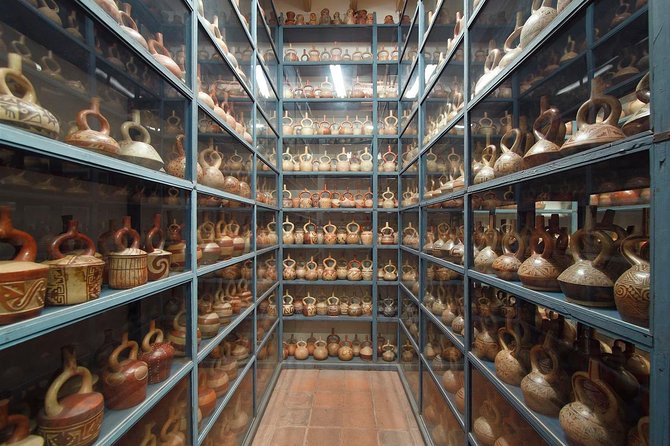
Thought I would try here before going to r/museumpros. I read an article recently about all the items kept in a museums collection but not displayed. In some cases (depending on the size of the institution) they can number in the thousands.
Has a museum ever attempted to expand to the level of being able to display everything in their collection? Especially, large institutions the size of The Smithsonian or The British Museum. If not, other than cost is there a reason to not? I would think it would bring a level of prestige countries would strive to attain- especially in a historical since like Nazi Germany.
The practice you're thinking of is "open storage" or "visible storage"... or "open study:" instead of locking up all a museum's objects , why not put them in accessible glass cases for all to see?
Well it's not that simple.
For major museums, we're not just talking thousands of objects. The Field Museum in Chicago has 233,224 objects just in its anthropology collections. These are packed into sliding shelves to save space in the labyrinthine basements; and that's not including the plentiful canoes and stone sarcophagi that don't fit anywhere nicely. If every object fit on half a sheet of paper, the collection would still cover over an entire football field. And that's just a tenth the size of The Met's two million objects.
Space is a perennial problem for museums. The British Museum is actually building an entirely new facility in a different city to allow for increased access to its collections. The small site museums I've worked with in Bolivia have started requesting that grants for further archaeological research or museum improvement to include funds earmarked for new storage spaces. While open storage does allow for a higher density of objects in exhibit spaces, it requires several times more space as traditional storage.
Now, it's much more feasible for small, local museums to display full collections. Lacking decent storage space, many do so by necessity. The practical problems of open storage, however, occur at any scale:
Metals, fibers, wood, feathers, paper, and many other materials used in art objects need particular environments for optimal preservation. This can expensive or impossible in exhibition cases.
Many museum collections are primarily for research. Between cumbersome display cases and inaccessibility during visitor hours, moving objects in and out of open storage for study is a hassle.
Open storage is a nightmare for designers, whose job it is to make sure objects are well lit and easily visible, the space is accessible to all, and the general experience is visually appealing.
If you've got enough money and space to overcome these, however, you can put together darn good open storage installation.
Since the University of British Columbia Museum of Anthropology (UBCMOA) pioneered the concept in the '70s, there have been several successful iterations The most notable might be the Henry R. Luce Center at The Met, where a sizeable percent of the American art collection is displayed with minimal tags. My personal favorite is the Museo Larco in Lima, Peru, which comes incredibly close to having every object on display.
But there's a larger question for us public historians: does open storage actually work?
I have no doubt that you personally would get a lot out of most any open storage installation. But most people don't visit Reddit history forums. Museums are often the only exposure people get to academic history outside of a classroom. Its crucial that the experience is educational, but not didactic, challenging, but not overwhelming. Above all, it must be familiar and legible to audiences without perpetuating traditional notions of authority.
The latter is why open collections were initially considered a powerful democratizing force. Museums have long been the quintessential institution of enshrining and reproducing the knowledge that keeps the Ivory Tower inaccessible. Deconstructing that means not just reconsidering the content that is presented in museums, but who gets to choose that content.
Michael E. Ames, director of the UBCMOA when it introduced its open study areas in 1976, called his project "de-schooling" the museum. He was concerned with what he saw as an increasing entitlement among museum professionals to flaunt their expertise, alongside the diminishing importance of museums in a digitizing world. In his own words:
The relevance of museums in comtemporary society, it is suggested, is likely to be determined by the degree to which they are democratized; that is to say, the extent to which there is increasing and more widespread participation in decision-making regarding administration, educational programming, and collection management in museums, and increased opportunities for independent thought and action in cultural matters.
As a university-based, student-oriented museum, the MOA was able to accomplish this mission quite successfully. The mission continues today with its Multiversity Galleries. The initial iteration prioritized access over display value and provided "resource centers" with small catalogs and, later, digital displays that gave more context for the artifacts. In 1981, the Glenbow Museum in Calgary completed a highly anticipated prototype open study center that expanded the UCBMOA model into a full-on library-esque space...