I'll give an example to what i mean : Bill is an 11th century knight, Bill is trained to use a lot of weapons, axes, spears, swords, bows, you name it. Is Bill trained to be better at specific type of weapons ? And i don't mean like he prefers an axe, so he is more used to using an axe rather than a sword, i don't mean that. What i mean is, is Bill TRAINED to use a specific type of weapon more than the other, so he's trained to use longswords and crossbows more than anything else, so he can be better at what other knights lack ? Or was it just like whatever he chooses ? That may sound like a weird and stupid question but i'm really curious.
The notion of "training" in a regimented, predictable, cohesive manner is a very modern one that would have been considered alien to people in the medieval and early modern periods. Knightly duties and skills were practiced personally, culturally encouraged and reinforced, and promoted by high profile public events like tournaments and other games. It would be better understood as a kind of apprenticeship within a culture that constantly shored up its own value system through peerage and expectation.
Knighthood was also a social duty unlike any modern equivalent. You were born into a class which saw military service as a default. While never entirely reflecting reality, the widespread belief in the three estates model meant that noble men were part of the second estate, the bellitores, whose job it was - for themselves, their peers, their social betters and inferiors, and for God - was to fight. Feudal obligations could be variable and complex and fealty was often negotiable and subject to competition or interpretation, but in essence your literal earthly duty, decreed by God and reinforced by a critical social structure, was to fight. So you "trained" on your own in the same way that kids everywhere through all time "train;" they play. You'd probably start learning to wrestle, first, then maybe start playing with sticks as a stand-in for swords, and as you get older and progress from page to squire, you might start working with a hired tutor who can build on your intuitive skills and give you a more complex understanding of the use of weapons and the training of your body.
By the time you were a teen you'd likely start competing in tournaments or participating in ad-hoc competitions and martial games whenever chance afforded. These would offer the opportunity to show off, gain some recognition for your skill or honor, and even earn money by capturing and ransoming competitors. In short, you "train" by doing, and the more you do, the more experience you gain.
By the mid 15th century and on into the 16th, martial sports had become complex affairs that involved a high degree of skill and a huge variance in type; in German-speaking lands, the two types of jousts, the Rennen and Gestech even involved different types of armor and weapons, and each of those had several sub-types, and these jousts would co-exist at games that also involved melees (sometimes with men using wooden batons and wearing wicker armor), and foot combats (in which men would use polearms, swords, and daggers).
We know from memoirs like that of Gotz vin Berlichingen, a knight active from 1495 to the 1560s, that understanding the use of lance, sword, crossbow, and gunpowder, as well as the ability to ride and wrestle, was fundamental to their role in battle. There are several examples, early on in his autobiography, of fights that involve the use of the lance, crossbow, and sword in short succession, even to the point of throwing an unspanned crossbow at the neck of an opponent, or grappling at the reins of an opponent's horse - something unlikely to have been rigorously or specifically trained, just done because you could, and because it would give you an advantage.
Gotz, by the way, never once mentions "training," but instead characterizes his growth as a man of martial prowess through tutelage under older, more experienced men like Paulus von Absberg and Neidhart von Thungen. In short, he would have gained experience and knowledge by on-the-job training, as well as friendly competition.
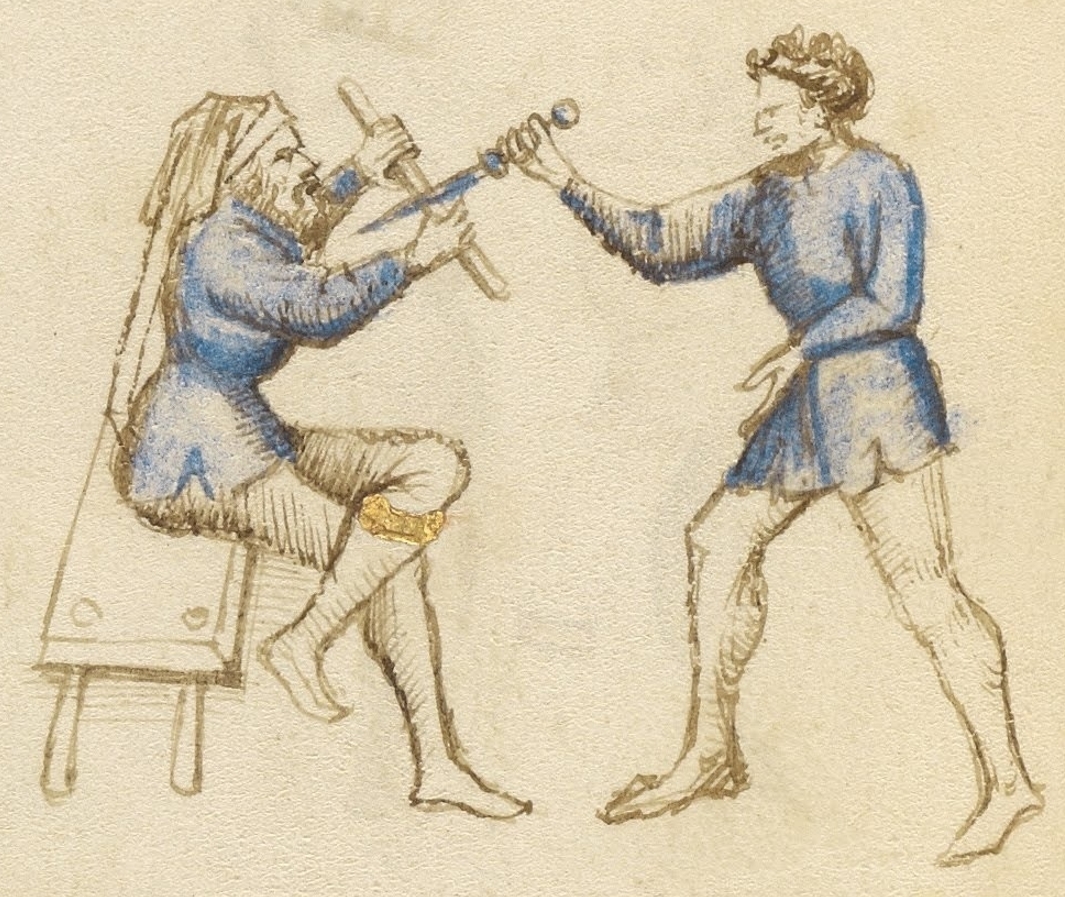
We also know from fencing treatises of the time that the sword was only one weapon described alongside many others. Our earliest knightly treatise, written by Fiore Dei Liberi toward the end of the 14th century, describes combat with the sword, dagger, wrestling, the use of the lance and sword on horseback, and the use of polearms on foot. Expertise in one weapon transfers fairly well over into the others, as the martial principles were unified throughout. Once you know how to use your body and how to understand advantage and disadvantage in an altercation, you can apply them to anything you have, including sticks, or hats, or other improvised weapons. German-language treatises from around the same period (slightly later) emphasize the same broad utility.
In short, it was a knights social duty to be fluent with all the useful martial weapons then in use. While some might be emphasized - and for knights that was almost undoubtedly the lance - it was expected that you'd be able to use almost anything, because you'd spend a lot of your free time in competitive or non-competitive play that emphasized martial skills.
As I understand it there's no monograph that covers the notion of training specifically, but a few sources here might help you more broadly understand the knightly culture.
The Tournament and its Role in the Court Culture of Emperor Maximilian I (1459-1519) by Natalie Anderson.
Martial Arts of renaissance Europe by Sydney Anglo
Recreation in the Renaissance by A. Arcangeli
The Autobiography of Gotz von Berlichingen. There's an alright translation out there by Dierk Rottgardt, but untranslated versions are available for free on google books.
Fiore's wiktenauer page linked above.