We often read about the dismal circumstances in Western Europe during the Dark Ages. That people had no idea about the origins of crumbling Roman cities, and assumed that giants must have built them with magic, thousands of years earlier.
How come people lived in mud and shit and total ignorance, if only 1500km away there was a full-blown Roman Empire in Byzantium, retaining all of its advanced civilisation? Surely there were travellers both from Byzantium and from Western Europe visiting each other?
I think I’ve read about barbarian kings or their envoys visiting the Emperor in Byzantium to pay tribute. Surely they saw the advanced city and the technical marvels? Did no one think to bring some of that knowledge home and do something with it?
Your question is based on a biased definition and imagery of the Dark Ages.
First of all, why is it called Dark Ages? This term comes from 14th century italian scholar Petrach who used it to refer to the Early Medieval period, as it had a lack of written sources compared to later periods. Later on, scholars used the term to refer to the whole medieval period, as a way to make them look more enlightened and less ''Barbaric''.
So, truly, Dark Age is a term that refers to early Middle Ages (like the Migration period and viking Age for Northern Europe, and the Saeculum Obscurum in southern Europe.
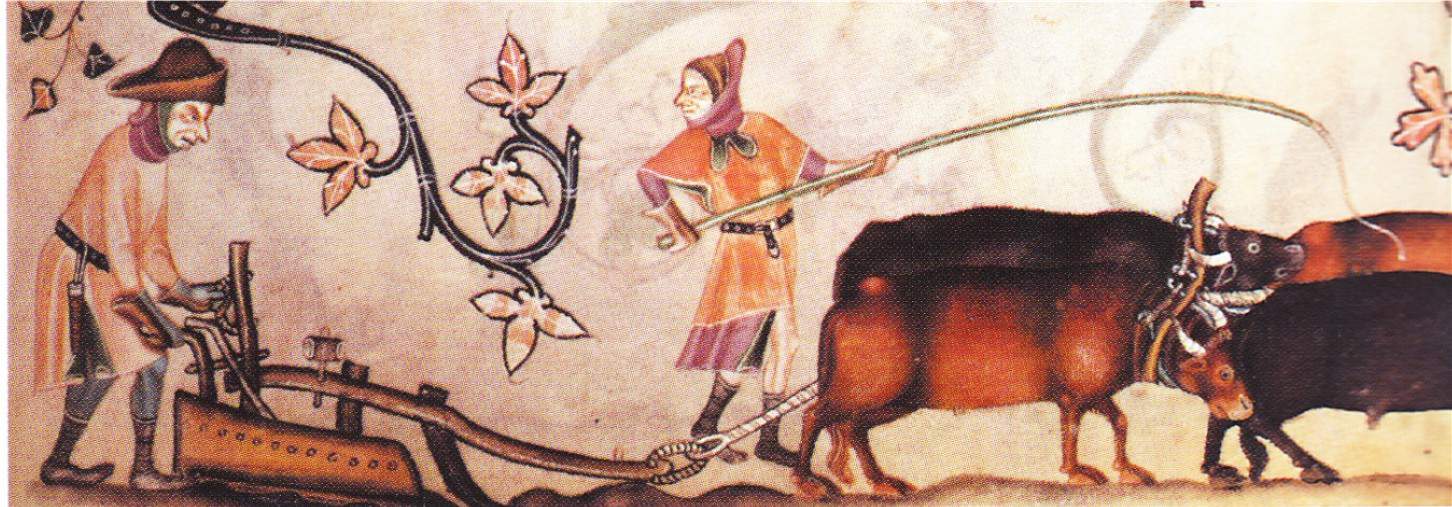
Does that means that people ''lived in mud and shit and total ignorance''? Absolutely not. While it is true we have a lack of written sources from that period, that only is compared to later periods. As a matter of fact, we have plenty of written sources and manuscript who can, through text and miniatures, show us that this was a period where people had complex knowledge in different fields such as Agriculture, Construction, craftmanship, etc.
Nowhere is it shown that people ever lived in ''mud and shit''. Contemporary depictions show that even for those who lived by the fields would still be dressed cleanly with richly colored clothings.
I think I’ve read about barbarian kings or their envoys visiting the Emperor in Byzantium to pay tribute.
You most likely are referring to Kievan Rus and Varangians (Eastern European scandinavians). While it is true that they did went to Byzantium (notably to serve as Varangian Guards), Byzantium culture was culturally too different from them or sometimes not adapted to other cultures and climates.
TL;DR: People weren't like in Monthy Python.
That people had no idea about the origins of crumbling Roman cities, and assumed that giants must have built them with magic, thousands of years earlier.
This is a woeful misinterpretation of a single poem from The Exeter Book. Known as The Ruin, the poem is thought to be about the ruins of the Aqua Sulis complex in modern-day Bath. For some reason, pop-history frequently assumes that medieval writers were incapable to using allegory or symbolism and that everything they wrote was intended to be read entirely at face value. This excerpt:
Wrætlic is þes wealstan, wyrde gebræcon;
burgstede burston, brosnað enta geweorc.
Which mentions 'giants building it' is clearly metaphorical for the scale of the building, not genuine belief. The Early Medieval English were, in fact, extremely aware of who the Romans were, and fostered close relationships with European powers and the Pope in particular. Alfred of Wessex especially is thought to have been a keen student of Roman history, an interest which evidence suggests he also passed onto his daughter Æthelflæd. It's worth noting that, at the time that The Exeter Book was written, "England" had been Christian for around some 4 centuries, and had been building in stone for some time. Indeed, the late ninth and early tenth centuries sees the restoration of the Roman defences at London, and the complete reconstruction of the Roman city at Chester and significant urban improvements to Gloucester.
Knowledge was rarely "lost"; what was frequently lost instead was the logistical capability to undertake large-scale stone construction projects until larger, more bureaucratic centralised states start appearing. To whit:
How come people lived in mud and shit and total ignorance
is false. The Ruin actually answers the question that it's caused in this verse:
Crungon walo wide, cwoman woldagas, swylt eall fornom secgrofra wera;
wurdon hyra wigsteal westen staþolas, brosnade burgsteall. Betend crungon hergas to hrusan.
Or, rather:
Far and wide the slain perished, days of pestilence came,
Death took all the brave men away; their places of war became deserted places,
the city decayed. The rebuilders perished,the armies to earth. And so these buildings grow desolate,
The Romans didn't teach skills like architecture through a literate corpus. Architecture 'textbooks' were largely theoretical works rather than instructional tools; skills were taught via practical apprenticeships and on-site experience. According to Gildas' de Excidio Britanniæ, when the Roman legions pulled back from Britain, they took all the trained architects with them, which as you can imagine, would have had a significant impact on the ability of the Romano-British to even learn the architectural skills to build de novo. Gildas also recounts a particularly virulent plague which swept through Britain in the opening years of the sixth century which had a devastating effect on urban centres, and contributed significantly to post-Roman population collapse and the large-scale abandonment of the cities and the maintenance of their buildings. These were skills that would have to be relearned over time from architects coming to Britain from continental Europe. It's worth noticing, of course, that the Eastern Empire remained a (relatively) contiguous centralised state throughout the Early Medieval Period, compared to the multitude of post-Roman successor states which proliferated across Western Europe, and as a result had a far greater economic and logistical capability. With that in mind, the larger Western European polities like Carolingian Francia were more than capable of feats of Romanesque architecture that could easily rival the Romans.
I think I’ve read about barbarian kings or their envoys visiting the Emperor in Byzantium to pay tribute. Surely they saw the advanced city and the technical marvels?
What technical marvels would these be? Classical literature was still widely maintained during the period.