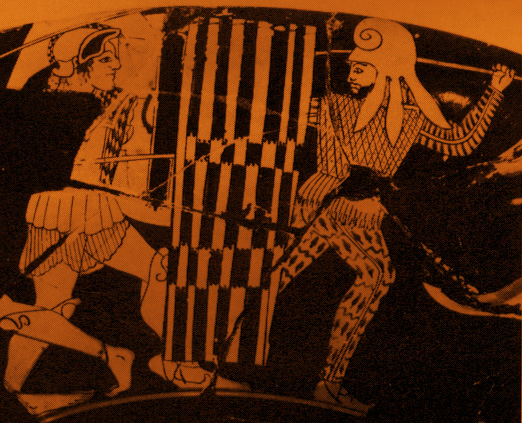
I've been doing a lot of research (Dunno why, quarantine induced cabin fever maybe) into the Achaemenid Persian Military (Specifically ethnic Persian/Median Infantry) as the Greeks faced them at Marathon, Thermopylae, Mycale and mostly at Plataea. I've been trying to get a picture of what a typical Persian Infantry formation would actually look like.
Books by Sekunda and Farroukh (Persian Army and Shadows in the Desert, respectively) loosely give the idea that the front soldier in a Persian battle line would carry a large wicker tower shield, and the nine soldiers behind him would be armed with bows and serve as archers shooting from behind the makeshift wall of shields by this single line. But I wanted to ask how realistic is this actually? Maybe I am mistaken, but it doesn't seem to me that the Achaemenid Persian infantry could have the staying power it showed during the Greek wars if it had a single line of spearmen and archers behind the rest. At Marathon, Herodotus mentions that the Greek center (That faced the ethnic Persian troops) was aligned 4 ranks deep and was broken (or almost broken?) by the Persian center, which was only defeated after the victorious Greek double enveloped them. At Plataeia, Herodotus records the Persian troops fighting against the Spartans for a long time, even if he does say they were unarmored (As a side note, some historians seem to take the word Herodotus' used to mean "unshielded" and others say it's more likely to translate as "unarmored" , what do you think?) He mentions the same of the Persian soldiers on the beach of Mycale. Was Herodotus just saying it was a long fight for dramatic effect? Or was the word he used to describe the shield barricade a poetic reference to an actually deeper line of spearmen in front of the archer ranks?
Also, I can find only one contemporary (Or at least near contemporary, I don't know the date) ancient pictoral source that actually shows this wicker tower shield, and it's on a Greek vase: https://www.ancientbattles.com/Persians/Spara.jpg
Meanwhile, there are hundreds of depictions of Achaemenid soldiers on Persian reliefs in Persepolis, but I can't find a single one depicting that large tower shield. There are plenty of soldiers carrying Shields, but they seem to be the so-called "Dipylon" Shields, shaped like a violin or a circle with holes cut out of the ends. There also seem to be many Persian soldiers carrying bows and spears, or just spears. I understand that these may be the Persian royal guard (Apple bearers? Herodotus seems to mention two royal guard units of 1,000 men each, and then a separate unit he dubs "The Immortals" of 10,000, which is also confusing. Are these actual royal guards? or just the standing Army of Persia, and the "Apple Bearers" are the royal guards?) Herodotus also mentions that the Persian Cavalry was equipped like the infantry (except had metal helmets or something) but I doubt a cavalryman would carry a large wicker pavise.
I am rambling. In short, I want to know what you think of the depiction of the Achaemenid Persian Infantry formation. Do you think it's likely that there is one "spara" or shieldbearer and the other nine behind him are archer/spearmen without shields? Is it more likely that there were actually more conventional separate and deeper spear and archer units? Could it be more like serrated rows, a line of shieldbearers protecting a line of archers repeated? As in:
This seems to be similar to the Assyrian pictoral evidence of their infantry, and I would think more effective if the purpose of the shield bear is to protect the archer. And if battle is joined, the shieldbearers in the back could move to the front to strengthen the line.
Sorry for the long post, just wanted to get someother perspectives.
Aside from a 1992 book by Duncan Head, two good resources on Achaemenid infantry are these blog posts and the attached PhD thesis / book: Achaemenid Shields are a Puzzle and Provisions, Loin-Girdling, and Battle Gear. I just want to drill down on two specific points.
Herodotus never says how deep any group of infantry were, the first surviving battle descriptions with that detail are by Thucydides. The guess that the Athenian centre at Marathon was 4 deep is just a guess, because depths from 4 to 12 are common in Greek stories about wars 432 to 330 BCE and because Herodotus says that the Athenians were "thin" in the centre. But we hear of depths as thin as two and as deep as 50 in those later writers, and Herodotus' Greeks don't fight the exact same way as Thucydides' Greeks. No ancient writer says how deep any part of either army at Marathon was.
In some cultures, like New Kingdom Egypt or Plantagenet England, its typical to have separate units of spearmen and bowmen. But in Iron Age Mesopotamia, it was normal for the same men to carry spear and bow. We don't see spearmen in the Assyrian sculptures from the 9th century BCE, just archers, they seem to have formed units of spearmen with shields after losing battles against spearmen from Urartu in the 8th century. In Mesopotamia, having the same men carry both bow and spear was the conventional arrangement, and separate units deployed separately on the battlefield was the experiment.