Did Hittite kings have multiple wives or take concubines? How were royal Hittite marriages brokered? Was there a formal harem or was it more of a mistress type of situation?
(1/2) My apologies for the belated response! I'm always excited for Hittite questions, and yours is a very interesting one indeed.
Hittite succession
Hittite royal succession, outlined most clearly in the Telepinu edict quoted below, was patrilineal. Eligibility for the throne also depended on the status of a prince’s mother, however, for Hittite kings - like their Assyrian, Babylonian, and Egyptian counterparts - were not monogamous. Only one women held the position of MUNUS.LUGAL ("queen") at a time, but the king engaged in sexual relations with the DAM.MEŠ, "(secondary) wives," and EŠERTI, "concubines," in addition to his wife. Establishing oneself as the (chief) wife of the king was therefore the surest means of becoming the mother of the next king.
Only a son (who is) a prince of the first rank shall become king. If there is no first rank prince, he who is a second rank son, he shall become king. But if there is no prince (among the ranks of) heir(s), then they shall take an in-marrying (son-in-law) for a daughter of first rank, and he shall become king.
Being the offspring of a concubine did not prevent one from ascending to the throne. The mother of Muršili III (also known as Urḫi-Teššub) was a concubine of Muwatalli II rather than his wife, a factor cited by Mašturi of the Seḫa River Land as a reason for his support for Ḫattušili III, the brother of Muwatalli II and uncle of Muršili III.
But when Muwatalli died, then Urḫi-Teššup, son of Muwatalli, became king. [My father] wrested the kingship away from Urḫi-Teššub. Mašturi committed treachery. Although it was Muwatalli who had taken him up and had made him his brother-in-law, afterwards Mašturi did not protect his son Urḫi-Teššub, but went over to my father, thinking: “Will I protect even a bastard? Why should I act on behalf of the son of a bastard?”
In cases like this where the queen did not produce an heir, there would have been a jockeying for power between royal women, each aiming to improve her husband’s or son’s chances of succession and thereby gain power for themselves.
Concubines
References to secondary wives and their children are exceedingly rare in Hittite texts, and virtually all references to concubines (^MUNUS NAPTARTI) refer to secondary wives and their children in a general sense rather than to specific individuals. For example, Muwatalli II pledges in his treaty with Alakšandu of Wiluša (Greek Ilion/Troy) to support the designated heir of Alakšandu regardless of the mother to whom he was born.
In regard to the [son] of yours whom you designate for kingship - [whether he is by] your wife or by your concubine...
Unfortunately, little more can be said about royal concubines.
Queens: duties and obligations
In contrast to the mostly passive queens of Egypt, it was not uncommon for Hittite queens to take an active role in politics. Alliances between the kings of the great powers of the Late Bronze Age (Assyria, Babylonia, Ḫatti, Egypt) were sealed by diplomatic marriages, and it was one of the duties of Hittite queens to educate and select princesses to be sent abroad for marriage to foreign kings and princes. Queens also arranged marriages between foreign princesses and Hittite princes.
Hittite queens were present for the signing of treaties, and the Egyptian version of the Egyptian-Hittite peace treaty notes that the cuneiform tablet was sealed by both the Hittite king and the Hittite queen.
That which is in the middle of this silver tablet: on its front side is a figure in the likeness of Seth embracing the likeness of the great chief of Ḫatti, surrounded by the following:
"The seal of Seth, the ruler of the heavens; the seal of the treaty which Ḫattušili, the great chief of Ḫatti, the hero, the son of Muršili the hero, the great chief of Ḫatti, the hero, made."
That which is in the midst of the surrounding design is the seal of Seth, the ruler of the heavens. That which is in the middle on its other side is a figure, in the likeness of [the Sun Goddess] of Ḫatti, embracing the figure of the queen of Ḫatti, surrounded by the following words:
“The seal of the Sun Goddess of the city of Arinna, the lady of the land; the seal of Puduḫepa, the queen of the land of Ḫatti, the daughter of the land of Kizzuwatna.”
Like their husbands, queens received tribute from vassals and gifts from allied rulers. In one letter sent to the city of Ugarit in Syria, Puduḫepa chastised the Ugaritic king Niqmaddu for not visiting her or providing gifts.
But to me you have not come … and your messenger-party you have not sent to me. Now, according to what you should set aside for me — a quantity of gold..., you for your part have not remitted it to me; (only) to the King have you remitted gold…
From seal impressions, we know that Hittite queens were active in economic activities as well. Seals were required for supervising the inventory and storage of goods in the palace, and Puduḫepa owned several different seals.
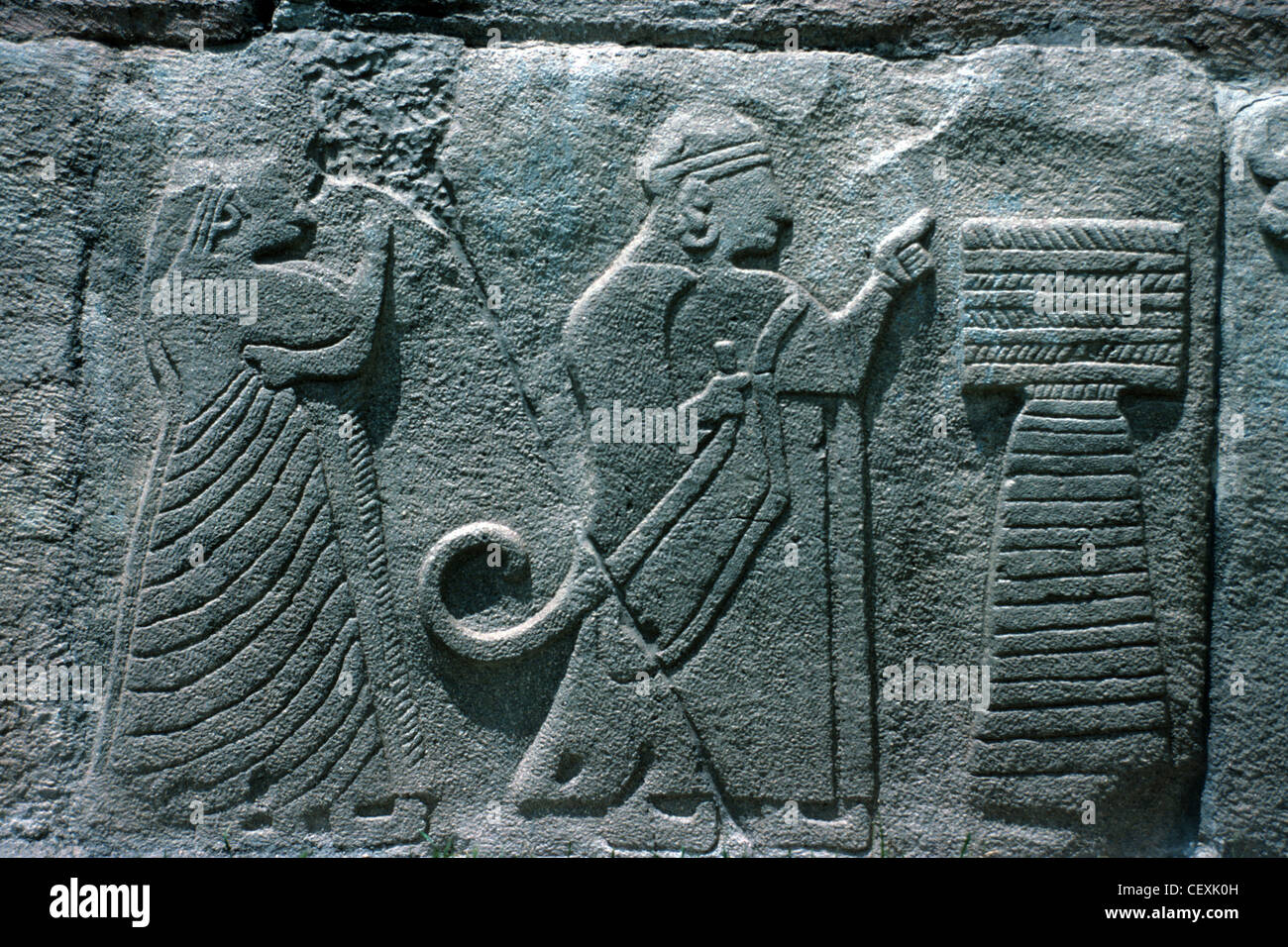
The most important role of the Hittite queen, however, was to carry out ceremonial duties. There are several depictions of the Hittite queen worshiping before the gods, such as the portrayal of Puduhepa libating before the Sun Goddess at Fraktin and an unidentified queen worshiping behind her husband at Alaca Höyük. The Hittite king and queen jointly sponsored festivals to worship the gods, who brought fertility to Anatolia and made agriculture possible.