I’m not sure if this question belongs here so admins remove it if it doesn’t. I’ve spent a lot of isolation educating myself on slavery as I felt it was the appropriate thing to do. However as always with my historical deep dives I always find things I didn’t necessarily want to find or weren’t my objective in the first place. The two of these that have taken me most by surprise is the Barbary slave trade and the oppression of native Liberians by African Americans after the abolition of slavery in the US. I feel like these things are not spoken about or taught enough in fact no one I’ve spoken to even knew of the Barbary slave trade and were all shocked to hear of the oppression of Liberians. How do I teach my friends about these subjects in the same way they’ve taught me about the atlantic slave trade without seeming like some crazy white supremacist?
If you wish to teach people about these topics without sounding racist, it really shouldn't be terribly hard. These examples stand as excellent illustrations of the dangers of cultural and religious supremacism. But I'm going to focus on the Barbary pirates because my knowledge of Subsaharan Africa is severely limited.
Barbary slavery honestly sounds like a weird example of a racial topic. Forgive me if I'm wrong, but it sounds like you could be falling into the common trap of viewing 'Africa' as a single homogeneous block?
To this day the population of North Africa is overwhelmingly concentrated along the coast (for example, about 90% of Algerians live in the northern third of the country). Separated from the rest of Africa by the still-formidable Sahara desert, since antiquity the region was functionally part of the Mediterranean world. Today the region is regarded as part of the 'Greater Middle East', and its constituent states are members of the Arab League.
'Barbary' refers to the Berbers (more properly 'Amazigh'), the indigenous people of North Africa. The Berber people are very ethnically diverse, and some (such as the Saharan Tuaregs) can appear as dark as Subsaharan Africans. Northern Berbers in particular can (to an outsider like myself) look outwardly similar to Arabs, though friends and colleagues from the region have told me that locals can tell the difference and that there is discrimination.
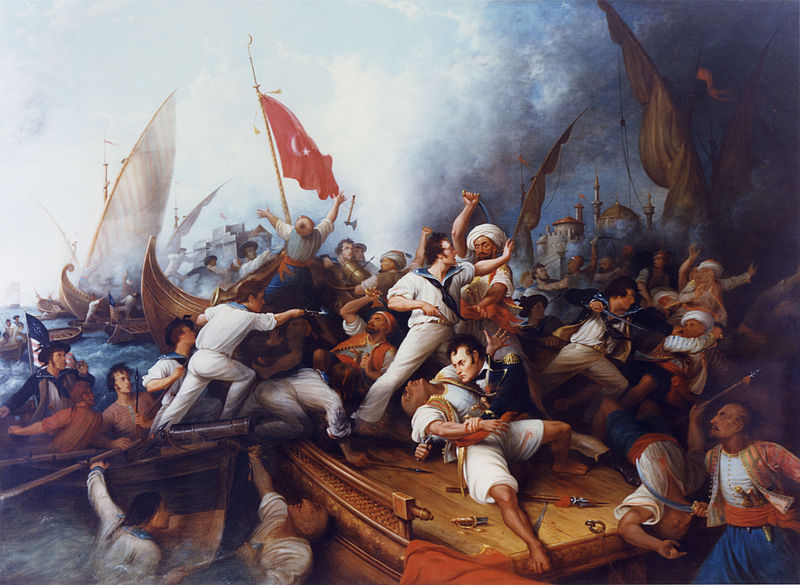
Furthermore, the 'Barbary Coast' was a European abstraction, not a nation. It consisted of several provinces of the Turkish Ottoman Empire, as well as the independent Arab Kingdom of Morocco. By this point in time the region had been variously settled by Berbers, Greeks, Phoenecians, Romans, Arabs, Spaniards, and Turks, all of whom intermingled over the centuries. The crews of the Barbary pirate ships were drawn from this ethnocultural stew. In contemporary depictions such as the 1817 Algiers: Being a Complete Picture of the Barbary States, or the 1804 Decatur Boarding the Tripolitan Gunboat, the pirates appear quite typically Ottoman in dress and style.
Slavery was a prominent part of the Ottoman Empire, and Ottoman slaves could end up 'employed' in anything from backbreaking labour (and possible drowning) as galley slaves, or sexual slavery (some sultans were born to slave mothers), or combat as an elite Janissary soldier, household servitude, or even administration and bureaucracy (often as a eunuch). Like in classical Europe, a slave's final fate was determined by their skills, gender, and age, as well as the inclinations (or whims) of their master.
Ottoman slavery was primarily religious in character, with most slaves being captured in raids either on infidel ships or coastal villages. Again, pre-colonial European slavery followed the same pattern; most slaves originally came from Eastern European pagan tribes. Paganism was among the earliest and most prominent arguments used to justify the large-scale enslavement of West Africans on colonial plantations, and the gradual Christianisation of the slaves was one of the major factors that later turned British public opinion against the slave trade. Like in Europe, the Arabs and later Ottoman Turks shunned the enslavement of co-believers, and conversion could be a ticket to freedom if you were lucky and your master had moral qualms.
Furthermore, I think it should be noted that the Barbary pirates also conducted slave raids in West Africa, for identical reasons. Being non-Muslims, tribal West Africans were just as fair game as Christians for Barbary slave raiders. These raids never reached the almost industrial scale of the Atlantic slave trade, but they did happen.
In short, the Barbary pirates were not some example of black-on-white reverse slavery. They did live on the African continent, but it was along the northern coast, which is separated from 'Black Africa' by the Sahara. Barbary crews would have been essentially white - a mix of Arabs, Berbers, and Turks. Barbary slavery operated in a broadly similar way to pre-colonial European slavery: their targets were chosen based on religion, and included West Africans.
EDIT: Image links, because everybody likes pictures!
Looks like you got your question answered but I want to pass along this answer to a similar question. The "Barbary Slave Trade" is often used as a placeholder for the larger idea that schools, especially American schools, withhold information about times in which White adults and children were taken advantage of or otherwise disempowered. In my answers, I explain why it is some things aren't taught in schools and it's not because people are deliberately concealing the information.