Death, being something that is universally key to existence, is ubiquitous in folklore and religion. It is common in Western tradition for abstract concept to be personified, and these can play active roles in legends and mythology.
There are three categories of personifications associated with death, and although they may seem related (and in fact they can overlap), they are distinct. The first includes personifications of death itself, seen most famously in Western traditions as Hades, Satan, but also the Scandinavian hag named Hel. One of the Four Horsemen of the Apocalypse is named "Death," and this is also a personification of death itself. These seem akin to the grim reaper, but there is an important distinction (see below!).
A second category of personification are heralds of death - a famous example is the Irish banshee who wails in anticipation of death. It might seem that this, too, is related to the grim reaper, but the banshee calls out in anticipation of death. She is not death itself, nor does she perform the important function that grim reaper is best known for. Namely:
The grim reaper is what we can call a psychopomp, an entity that escorts the newly dead to the realm of the afterlife. This is an extremely specialized role, an entity that neither warns of nor does it host the dead in the world of the afterlife. In Europe, the psychopomp is often perceived of as male, although in Scandinavia, it is often a women - sometimes an old woman with a broom (lots of people will die) or a rake (only some people will die). The idea of the Valkyrie was also a psychopomp, escorting the battle dead to the after world. These examples of female psychopomps are not typical in Europe, where the entity is usually thought of as male. Indeed, even in Scandinavia, it appears that Odin may have performed the function as a psychopomp, and we must keep in mind that when it comes to folk belief systems, there are no hard and fast rules, and things can manifest in wildly different and sometimes contradictory ways.
In Classical art, the psychopomp is often seen as Hermes (or similar entities), an attractive young male (compare Bard Pitt in "Met Joe Black"). In later European tradition, the psychopomp began to take on more grisly attributes, appearing as a corpse or as a skeleton with or without some withered flesh attached and often (but not always) clothed in black rags or cloak.
It is always difficult to tell how, when and why various motifs become associated with entities in folklore and folk art. The Grim Reaper appears to have been coalescing in a form that we would recognize today by the late fourteenth century, and it is tempting to look to the Black Death as a factor in promoting the particularly morbid personification of the psychopomp. The image of the scythe is particularly important in iconography because its message is clear: like the plants harvested in the field, all of which fall with the cut of the scythe, so, too, everyone will be cut down by death. An hourglass also became associated with the Grim Reaper - a symbol of the limit set to everyone's life.
How these artistic motifs came and went is not something I am prepared to discuss, but I would caution anyone who would point to any particular example as the origin of these motifs: we might be able to identify the earliest examples in art and/or literature, but I doubt that would be the origin: the origin of popular motifs like these is probably to have been in unrecorded folk tradition before they manifested in primary sources for us to consider.
There is some discussion of the Breton/Cornish (and consequently, Norman French) tradition of the Ankou, a skeletal psychopomp with a scythe. Is this a particularly old version of this? Perhaps. Could this be the point of origin of the Grim Reaper? Again, perhaps, but there is no way of knowing. No one is too sure when the Ankou became part of this remote tradition, and there is no trail where we can demonstrate diffusion - except with the Norman French connection, although that, too, is purely speculation.
edited to mention Brad Pitt, because why should one miss an opportunity to mention Brad Pitt?
I'll speak as to how he was viewed in Greece. Before Charon, there were the brothers Ypnos and Thanatos. They were depicted as young bearded men with swords and wings on their shoulders, who either remove the sould with their sword or cut hair of the deceased, since cutting the hair meant death. They also carried a scale to adjust the life duration of a person or balance their deeds. Both brothers are depicted together, like winds, guiding souls to Hades. In one vase they are even depicted the opposite. Ypnos has sweet and mellow characteristics, while Thanatos is grim and depressed and both carry the dead in such a way that he can not feel their presence at all. Other depictions or even statues of Thanatos exist.
According to Homer and Hesiod, the notion that Charon is the executor of Hades orders and soul guide to the Underworld is unknown. This was more a folk belief. According to them, souls reached their away alone or with the guidance of Hermes. First time Charon is mentioned as a guide is in the 6th century BC in a lost epic titled "Minyas", attributed to the poet Prodikus of Focaea. It is a scene from this epic that inspired the painter Polygnotos to draw this scene at Delphi as an elderly guide who guides the souls of young Telidas and Cleoboia. It is from this mural that inspired further traditions of Ancient Greek about Charon.
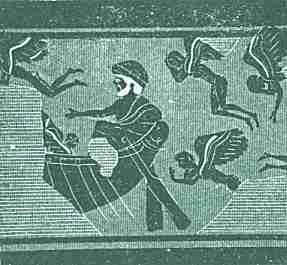
Charon is usually depicted as a strong old man with blonde hair and burning eyes and black and dirty clothes from the muds of Acheron river. Though in art he was depicted as a more calm and melancholic person, being friend with the dead. Charon's best depiction is this one
http://www.apologitis.com/gr/ancient/eik/adis_xaron.jpg
dressed as a sailor of the Pireaus fleet he is with Hermes guides a dead women and the souls, the idols of the dead fly around them.
In more modern traditions Charon was imagined as a black rider in a horse where everything around him turns black and takes the souls to the underworld. This image became so popular that it replaces Ancient Greek Hades and later even Thanatos.
translated from here:
http://elhalflashbacks.blogspot.com/2016/06/blog-post_14.html