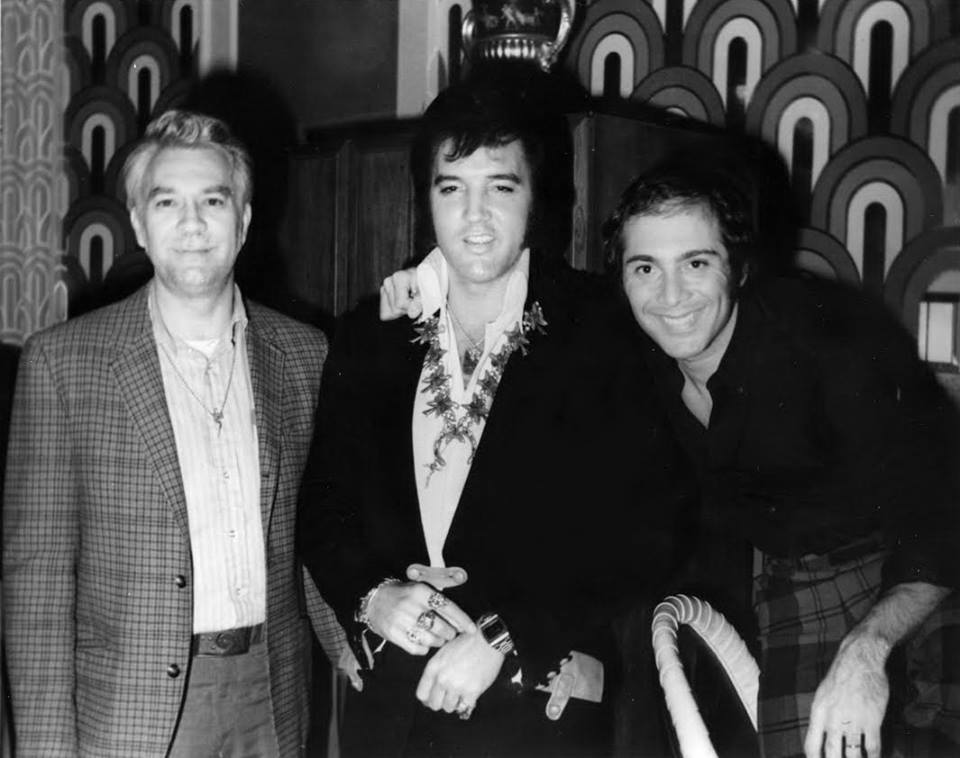
Here is the photograph, it features Elvis in the middle, watch on his left wrist (he appears to be gesturing toward it with his right index finger), with singer Paul Anka and legendary engineer Bill Porter. It was taken on August 5, 1972. If it's not a digital watch... what is it?
Elvis Presley was a watch aficionado, and most famously he owned a 14k white gold Hamilton "Ventura" that he bought himself -- the first watch using a battery -- which he wore during the 1961 movie Blue Hawaii. He gifted it to his father several years later.
Other watches from Presley's collection include a Rolex King Midas (which he got as a gift after 6 days of concerts at the Astrodome) and a Tiffany Omega (a gift from RCA for selling 75 million records).
He also bought watches to give as gifts, including a set of Baume & Mercier 14k yellow gold watches in 1969 when he performed with the Imperials at Las Vegas, and a set of 30 Gold Omega TC1 digital watches he gave to friends and family.
...
While the LED (light-emitting diode) was invented at Texas Instruments back in 1962, it took some work at minaturization before it could deubt in watch form. In 1970 when the Hamilton Pulsar first was shown to journalists they had to keep changing the watch batteries, which lasted only a few minutes. The battery would also leak. According to Richard Walton, who worked on the project:
It became a badge of honor to have this red mark on your wrist because it meant at one time you wore one of the prototypes.
This problem was sort-of solved by 1972 (it still only displayed the time when a button was pushed, to conserve power). The watch was debuted at a price of $2100 (more expensive than a gold Rolex at the time!); Elvis Presley bought one for himself (as can be seen in the picture you linked). Briefly, the Pulsar was a hot fad among the rich and influential. Senator Wallace Bennet wanted to be the first senator to have one but discovered to his chagrin in a meeting that Senator Mike Mansfield already had one on. Presidents Nixon and Ford both had one. The Shah of Iran had a standing order for each new model.
All this time engineers were at work on LCD watches, which pulled much less power than LED, and made their own debut in 1973. The LCD display allowed the time to be displayed continuously rather than requiring a button.
As far as all-digital watches in general go: the fad was quite briefly lived, with multiple companies were trying to cash in. By 1976 the race to the bottom hit $20 with the debut of the Texas Instruments TI-500, and then TI's cheapest watches went down to $10 by spring of 1977. By then, the idea of a digital display as a luxury in itself was well and truly dead.
...
Gross, B. (2018). The TVs of Tomorrow: How RCA’s Flat-Screen Dreams Led to the First LCDs. University of Chicago Press.
Smith, A. (2019). They Create Worlds: The Story of the People and Companies That Shaped the Video Game Industry, Vol. I: 1971-1982. CRC Press.
Stephens, C., & Dennis, M. (2000). Engineering time: inventing the electronic wristwatch. The British Journal for the History of Science, 477-497.
Trueb, L., Ramm, G., & Wenzig, P. (2013) Electrifying the Wristwatch. Schiffer.
Here's a 1970 announcement for the Pulsar in the Europa Star and a 1972 news story on release.
The Blue Hawaii watch sold at auction in 2015 for $38,400.