Hi everyone,
I have been working on my family lineage for some time now and have made some breakthroughs - one of them being that I am a direct descendant of Pope Innocent VIII, Bishop of Rome in the 1400's. I have come across this speculation while learning more about him:
"Ruggero Marino , a writer and historian, said the 1492 journey was a return visit. He said this emerged from study of an early 16th-century Ottoman map, which showed that Columbus found America in 1485, during the reign of Pope Innocent VIII. Mr. Marino said there was corroborative proof in an inscription on the tomb of Innocent VIII, in St Peter's Basilica, which reads "Novi orbis sua aevo inventi gloria", meaning that during his pontificate "the glory of the discovery of the New World" took place. Innocent VIII died at the end of July 1492, before Columbus set sail and three months before he landed at the Bahamas. "The inscription either anticipates Columbus's success or else refers to an earlier journey," Mr. Marino said. The accepted version is that Columbus was dispatched in 1492 by King Ferdinand and Queen Isabella, but Signor Marino said that the venture was originally financed by Innocent VIII and the Medici banking dynasty to which the Pope was related."
Here is the link to the source I got this info from: https://www.ruggeromarino-cristoforocolombo.com/papa-innocenzo-viii.html
I am wondering if there are any other sources / any historians on here that can speak to this in any way. Thanks in advance!
Another day, another theory of pre-Columbus discovery of America. This time it was discovered by ... Columbus himself, just earlier? Interesting.
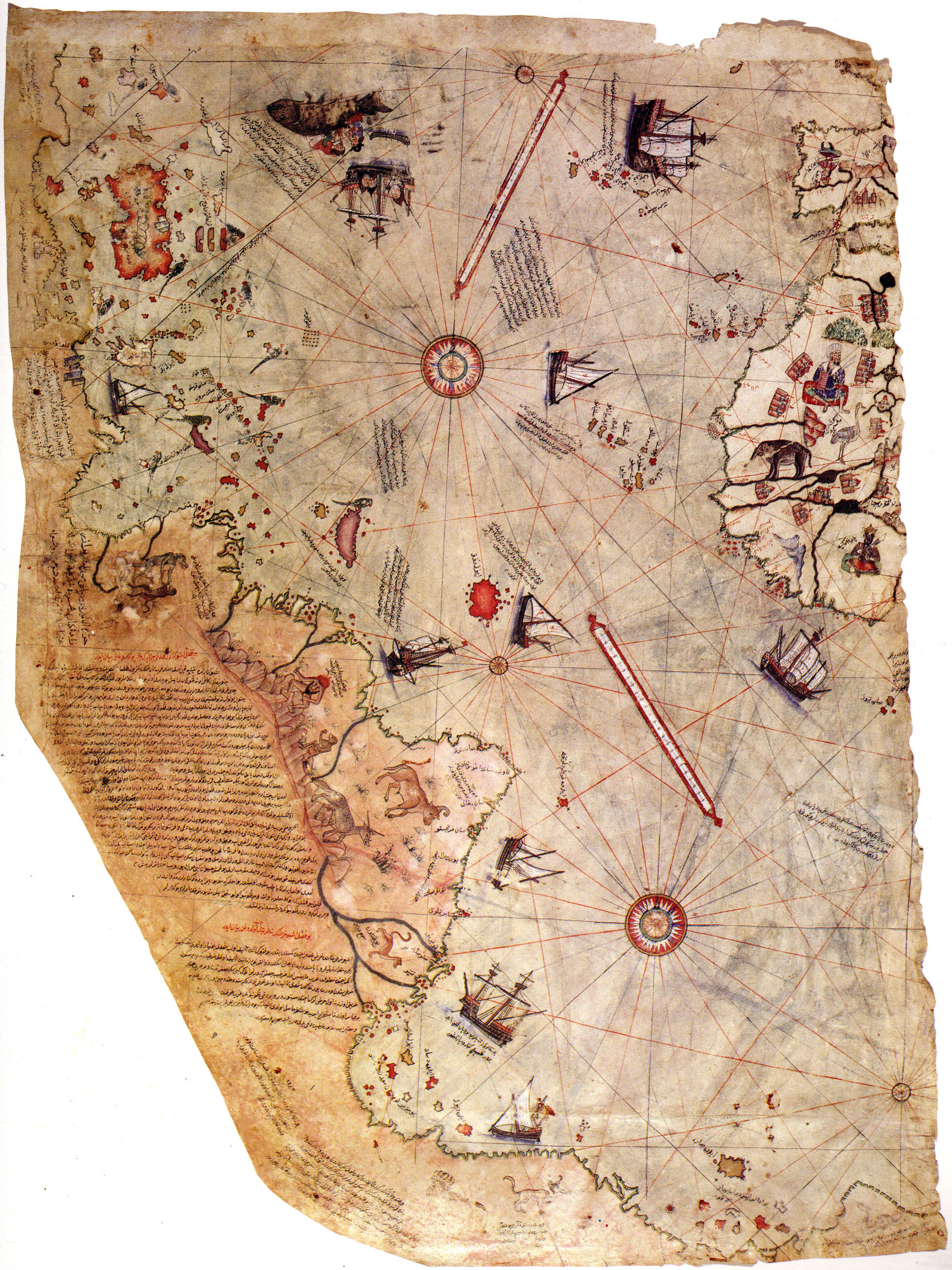
Well, the main thing I want to focus is that (according to the link) date of 1485 is proposed by an inscription on Piri Reis map of 1513. Piri Reis map is a favorite among newer theories probably because of the 'exotic' origin and also likely the fact that it is in Arabic and as such difficult to check by oneself.
Anyway, the link claims Piri Reis map has it written that Columbus made a journey in (arabic) year of 890 which matches 1485-86, which is strange, as other sources give the inscription as saying year of 896 which matches 1491-1492, the right year. I am using the book The Piri Reis Map of 1513 by GC McIntosh which is very authoritative. I am not really familiar with what might cause the difference in reading different years, maybe the lettering is ineligible or something. Someone who can read Arabic can double check on the actual map.
Until then I am going to post the translation of the entire inscription from The Piri Reis Map of 1513 , page 70
These coasts are called the coasts of Antilia. They were discovered in the year 896 of the Arabian calendar. It is reported that a Genoese infidel named Qulünbü [Colonbo, i.e., Columbus] discovered these places. It is said a book came into the hands of the said Qulúnbü and he found said in this book that at the end of the Western Sea there were shores and islands and minerals of every kind, and a mountain of precious stones. This man, having studied this book thoroughly, ex-plained these matters in detail to the eminent men of Genoa and said: "Come, give me two ships, I will go and find these places." They said: "Oh, foolish man, the end and boundary of the world is to be found in the west. It is full of the mist of darkness." The above mentioned Qulünbú seeing that no help was forthcoming from the Genoese, made inquires, and went to the king of Spain, and told his story in detail. He too answered like the Genoese. In the end, Qulúnbü talked to the king for a long time and, finally, the king of Spain gave him two ships, saw that they were well equipped, and said: "Oh, Qulünbü, if it happens as you say, let us make you kapudan [admiral] over that land." Having said this, he sent the said Qulünbü to the Western Sea.
So, we see a lot in this description, but I want to point out some things, beyond just the year. For example the inscription is clear that Columbus sailed for 'King of Spain' and not for the Pope in some secret mission as the rest of the link implies. From that, and other things, it is clear for me that the inscription refers to the actual Columbus 1492 expedition and not some 'other', earlier or later, expedition. Next, the inscription gets many thing incorrect albeit in a minor way, which may easily occur by passing the story by mouth. Columbus sailed with three ships, not two - although only two returned. I am not aware of him being refused by Genoese (although it might have happened), but instead it was more famously Portuguese. Overall, it is clear that this inscription offers very little concrete information to be considered a reliable source for Columbus. Even if it clearly claimed year of 1485 - which again it doesn't - the other incorrect info it provides would make it worthless when trying to estimate the overall reliability. Which when you think about it isn't surprising as it is an Ottoman map from 1513, twenty years afterwards...
With the Piri Reis map claim of year 1485 dismantled, I don't think the theory has any other legs to stand on? I will summon /u/TywinDeVillena , as he may have more information on Columbus whereabouts in 1485. As far as I am aware in 1485 his proposal was rejected by the Portuguese panel evaluating his ideas, after which he left Portugal for Spain and in 1486-87 he was again pitching his proposal to the Spanish who rebuffed him in Salamanca in 1486-87. I see no way he could have made a voyage in that time.
As for pope Innocent VIII and his inscription, I can offer no real explanation, but I also don't think it needs much. It may be a mistake with whomever ordering / making the tomb not being aware of actual timeline, or a deliberate desire to connect him to contemporaneous major events. For his relation to discoveries I can say in his time the Portuguese were exploring the southern edge of Africa with Diogo Cao reaching past Kongo, and finally with Bartolomeu Dias actually rounding the Cape of Good Hope in 1488. And the already mentioned fact that Columbus left just a few days after his death, may brought the inscription. I wouldn't know.
But the Piri Reis link is completely bogus.
As for the financing of Columbus' expedition, we have detailed accounts to nearly the last maravedí. Let me explain the mechanics of it all:
Luis de Santángel, chief accountant of Aragón, anticipated 1,140,000 maravedís from the treasury of the Holy Brotherhood (think of it as the Guardia Civil or the Carabinieri) on May the 2nd 1492.
Come May the 5th of 1492, and he receives a document from Hernando de Talavera allowing Santángel to be reimbursed from the treasury of the Bull of the Holy Crusade of the Bishopric of Badajoz. Santángel gets his money back a few days later.
Columbus raised another 500,000 maravedís from Martín Alonso Pinzón, Vicente Yáñez Pinzón, and Francisco Martín Pinzón. Yes, the famous Pinzón brothers.
He also borrowed some extra capital from Italian financers in Seville: 180,000 maravedís from Giannotto Berardi (as declared in his last will, where mentions that Columbus owes him that amount), and some other amount along the lines of 300,000 maravedís from the Genovese banker Francesco Pinelli.
Total cost of the expedition: around 2,000,000 maravedís disimbursed by Luis de Santángel, Giannotto Berardi, Francesco Pinelli, and the Pinzón brothers.