Hello,
I am interested to learn about how the implementation of the modern Turkish alphabet affected the lives of every day citizens. Was there significant opposition from those who were already literate in the Arabic script? How long did it take before a majority were able to understand the new alphabet? Did some continue to definently use the old script decades later??
I look forward to your answers and thank you in advance.
For some intellectuals, especially those more 'classically' educated with Arabic and Persian, the new alphabet surely created problems. We do not have much documentation from them, but it is easy to imagine how difficult it must be for them to adjust themselves to the new fact. However, their case was certainly a very small minority when compared with many intellectuals and everyday citizens alike.
The new alphabet came into effect on the first day of 1929, though newspapers and journals were published in both old and new alphabet for some time in a transitional period. In public, no publications could be published in the old alphabet, especially those intended for children. That said, it was not entirely uncommon for the state officials or others to keep their private notes or emergency letters in the old alphabet: some of these even made their way into the state archives. Old habits they die hard, after all. The most ironical part is probably that İsmet Pasha (İnönü), who feared negative consequences of the reform and opposed it at the beginning, never used the old letters again once the reform became the law (Lewis, p. 38). Whereas those who advocated for it could and did use it in private letters occasionally. This is an excellent proof of İsmet Pasha's character, to show the kind of man he was, but that is the subject of another comment.
As for everyday citizens, the picture is more complicated. It is still a subject of debate what percentage of Ottoman citizens could read Ottoman Turkish. It is important to remember that before and after the reform, the language used by your ordinary Turk (barring from later inventions and recent loan-words from English obviously) was far closer to that emerged after the reforms than the classical Ottoman Turkish, especially in written form or spoken among the elites in Istanbul. Add to this the fact that even the most optimistic guess about the literacy rate in the Ottoman Empire is 10%, and that includes non-Muslims to depart in years to come, dwellers of large cities like İstanbul and İzmir and naturally the more intellectual types. At any rate, it is quite clear that the vast majority of everyday citizens did not know how to read Ottoman Turkish. They may know how to read the Holy Quran to some degree but as anyone who knows Arabic and tries to read Ottoman Turkish, those two are still very different. To read Ottoman Turkish, you need Turkish grammar, some Arabic-Persian vocabulary (depends on the type and time of publication of course) and sound Persian alphabet (but in Ottoman style with a few additions) reading skills. Most people did not have these. Furthermore, among those who knew, the knowledge of a Western language was not that uncommon either. So an intellectual whose Ottoman was excellent probably knew some French and therefore was already familiar with the Latin alphabet. The Turkish alphabet is, of course, no copy of the French or any other Latin alphabet, but for these people, it was no strange thing.
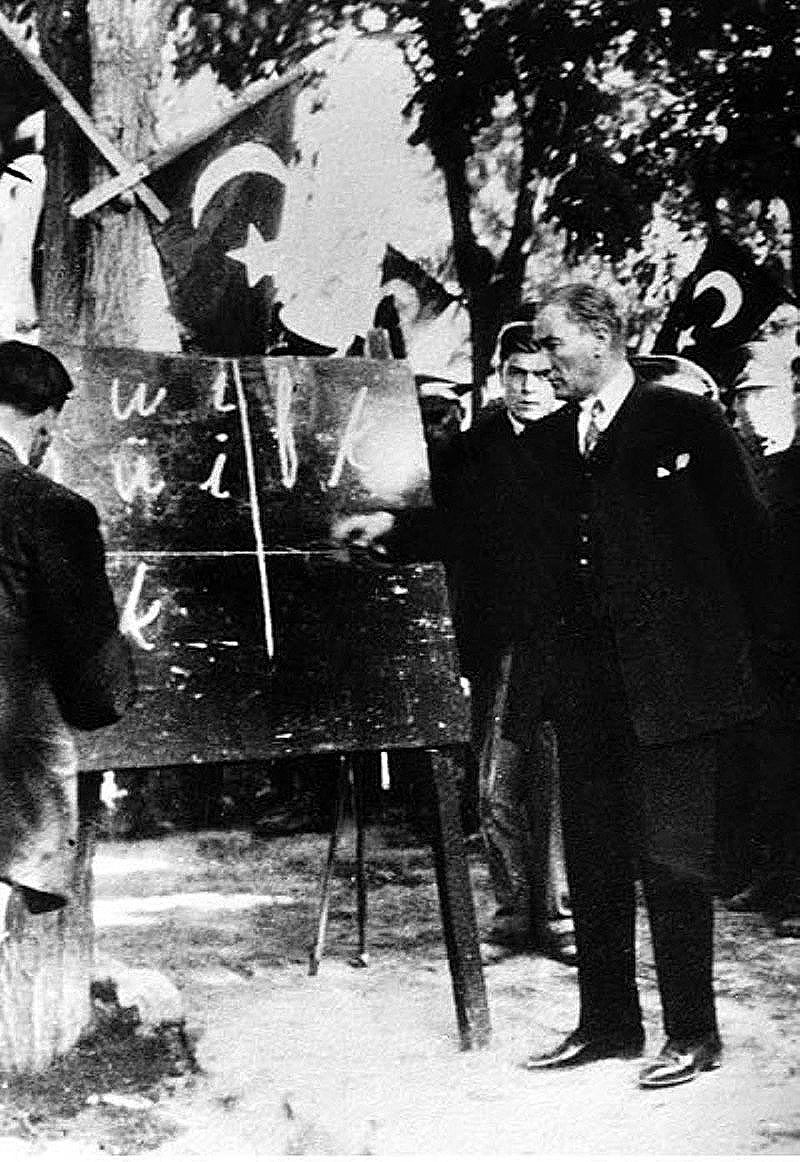
So, in short, for the vast majority, in practice, the change did not amount to much in terms of adjustments. Typically, they did not know the old alphabet anyway. A very significant part of the reason for the alphabet reform was precisely this fact. As Geoffrey Lewis brilliantly summarises and as anyone who reads Ottoman Turkish will attest, the language is pretty hard to decipher even once you have mastered it. The same word can be read as gül (rose), gol (goal), göl (lake) kol (arm), kül (ash), to give just a particularly notorious example. The exact same sentence could be read as 'Mehmed Pasha died' and 'Mehmed became Pasha' (Lewis, p. 28). The examples can be enumerated. This seems to have provided a significant obstacle to making literacy more common in the Empire. As early as the mid-19th century, there were proposals to reform the old alphabet. During the WW1, Enver Pasha of the Committee of Union and Progress created a simplified alphabet called 'Enveriye' to facilitate communications during wartime. The letters were still the same but the way they were conjoined was radically changed in this new alphabet. Let alone teaching this to everyday people, even those who already knew Ottoman Turkish found it difficult to adjust to it, especially during a war, so it was basically a child born dead. It was the radical Westernisation of Kemalists that cut the Gordian knot and replaced the old alphabet completely with a new one. As for when the everyday people began to understand the new alphabet... Again, the statistics are quite complicated with no consensus. We know it was not a leap of from 5% to 95% in ten years. However, there was a steady and continuous increase in literacy from 1930s to 1970s. Lewis states that the literacy rate was 9% in 1924 and 65% in 1965 and attributes this in part to the new alphabet. There were campaigns and public training to introduce and teach the new alphabet from the onset of the reform, though of course training in every village in every province could not be organised. Here is Atatürk himself during one of those early campaign sessions, introducing the new Turkish alphabet.
A final note. Sometimes the language reform and the alphabet reform are confused with each other. However, they are not the same. The former did go into some excesses especially in 1935, when for each Arabic or Persian loan-word being replaced by a newly-derived 'Turkic' term. This did create some problems in comprehension among everyday people and intellectuals alike. It was basically inventing a whole new vocabulary, announcing the meaning of these words (as well as the old words they replaced) in newspapers, and expecting (though, unlike the alphabet not enforcing directly) publications to use them rather than the old words. Because of this, the radical version of it was dropped soon (when Atatürk was still alive, that soon) though in lighter versions it continued well into 1980s, if not into our modern-day in specific fields like terminology in philosophy. This was to complement the alphabet reform but they are not one and the same.
The source and recommendation for this is Geoffrey Lewis, The Turkish Language Reform: A Catastrophic Success (Oxford: Oxford University Press, 1999). Especially Chapter 2 on 'Turkish Alphabet' is excellent on succinctly providing information on previous reform attempts and the rationale behind them, the way the Kemalist reform took place (and why it happened so quickly), debates during it, and the literacy figures provided above.
I hope this helps!