My grandfather served as Pharmacists Mate, 2nd Class, US Navy during WWII. The family story is that his entire high school class went to the Navy office together in 1942 (or '43, I can't remember) and enlisted upon graduating to enlist before they were drafted and told where to serve. He eventually wound up in Boston and was allegedly attached to a group of Marines to be deployed to Europe. His mother became very sick and he was issued a leave to attend to the farm. When he returned his group had deployed, at which point he remained in Boston. The family story continues that he was considered for the Pacific but instead remained in Boston, where he met Grandma, then was released after the war and returned home having never been deployed.
Is that a possibility? Any glaring holes in the story? Why would he have stayed in Boston without further assignment? Were there a lot of men that enlisted but never deployed in WWII or is that unusual? Any resources or additional information on where/what a western Tennessee man enlisted in the Navy would have gone/done is much appreciated. Thanks!
I would ask him for details but he was gone before I had the good sense to ask him about his life's story, which I will forever regret.
Filtered 3 generations and 75 years later. The broad arcs of the story are certainly possible.
From a Navy Enlisted man to spend his war in Boston as a member of the Hospital Corps isnt shocking. The nearly 200k Officers and Men of the Navy's Hospital Corps operated everywhere the fleet did. By 1945 that meant 114 separate Naval Hospitals, Base Hospitals and Clinics, mobile Hospitals and Convalescent facilities and Ships in forward areas, along with serving aboard warships of all sizes, and attending to USMC medical care. For a MUCH deeper reading, the post war official narrative of the USN Medical Dept in WW2 is online free to read: https://www.ibiblio.org/hyperwar/USN/USN-Medical/
After Basic Training, and possibly colocated with it, he would have gone through A School(his real job training) at one of the Naval Hospitals at: Bainbridge, Md.; Farragut, Idaho; Great Lakes, Ill.; Portsmouth, Va.; and San Diego, Calif. You might be interested in this, some Hospital Corps recruiting literature from mid WW2 so something he absolutely might have read: https://www.ibiblio.org/hyperwar/USN/ref/Corpsman/index.html#field
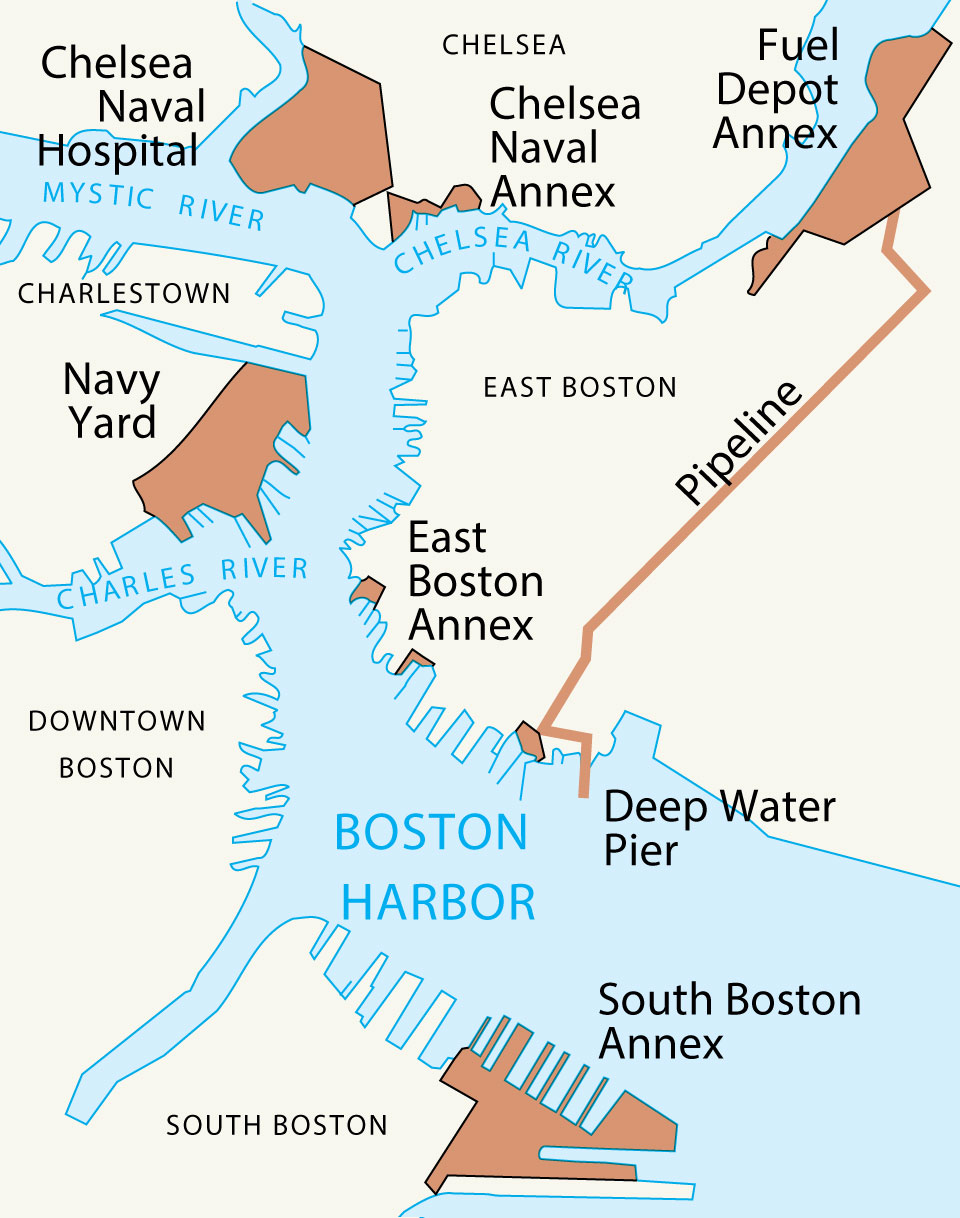
Boston then had a major USN presence during the war, that includes shore facilities for repair and fitting out of warships, actual shipbuilding(which the Navy used to do in addition to paying private yards), and recruiting and normal office work. But also relevant in Chelsea Naval Hospital, one of the oldest medical shore establishments in the Navy. The facility was the 3rd site for medical care of sailors selected by Congress and with the Navy purchasing the land in the early 1820's. It was definitely one of the smaller ones in the system, but still on VJ-Day it had a patient census of nearly 700. So between that and smaller clinics at other shore facilities in Boston there would have been more than enough chances a young Corpsman spends his war there. Map of Naval facilities in Boston in WW2: https://www.nps.gov/articles/images/BOSTmap6-Converted_2.jpg
As for how common to NEVER leave the US during the war within the Navy? Well uncommon, but also not impossible. The Navy itself pegs the number at 87% of personnel who served during WW2 that at one point or another served overseas in some capacity. Leaving of course 13% who didnt! https://www.history.navy.mil/research/library/online-reading-room/title-list-alphabetically/u/us-navy-personnel-in-world-war-ii-service-and-casualty-statistics.html
The USMC portion and getting left behind is a bit more nebulous and fishy. In large part because after 1941 Marines never served in any large numbers in Europe.