In books and films about these time periods, there are often descriptions/depictions of wealthy/upper-class women playing the piano as a symbol of their "accomplishment." I don't think I've ever come across any mention of a woman playing any other type of instrument in these eras. Was the piano the only socially acceptable instrument for women of this class to play, and if so, why?
While the piano (and previously, the harpsichord) was by far the most popular instrument among women, they did have a few other options, such as the harp and guitar. By the late Victorian era, most instruments came to be played by both genders.
As you assumed, “well-bred” women were expected to know how to play instruments and even sing along as part of their broader education, which included learning needlework, dancing, painting, and having a basic command of languages such as French and Italian.
When it came to instruments themselves, there were several reasons why the “woman’s” boiled down to the piano. Wind instruments such as the flute or trumpet had phallic implications and were deemed inappropriate for a woman to use. Most string instruments were inherently masculine (more on this later), plus the posture required to play the violin or cello was considered unattractive and awkward for a woman. The piano, on the other hand, did not require women to blow into a “phallic” instrument or alter their posture in any bizarre sort of way — it instead kept them in a proper, erect form, something that was aesthetically pleasing.
The harp and guitar were other acceptable instruments for women. Female harpists even feature in some of Jane Austen’s works. Mary Crawford in Mansfield Park is an accomplished musician, and her harp “rather added to her beauty, wit, and good-humour . . . [both herself and the harp] placed near a window . . . was enough to catch any man's heart.” The harp in general allowed for a woman to show off her beauty and grace, and consequently became a fierce rival of the piano.
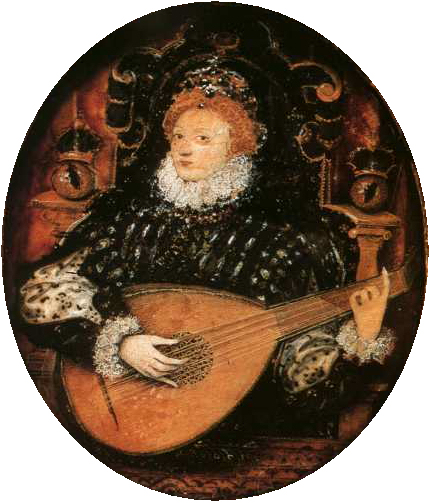
The guitar, like the harp, called attention to the graceful movements of a woman’s hands and fingers. A late 1770s handbook titled Complete Instruction for the Guitar states that “the Guitar is an Instrument which from its delicacy of tone & gracefull manner of holding for Performance, has ever recommended to the use of the Ladies.” Again, the guitar’s soft sounds and the woman’s ability to remain attractive while performing were praised. This instrument, like the piano, has long been associated with femininity. Previously, it was the lute that was popular - Queen Elizabeth I even holds one in a miniature portrait!
As for ‘masculine’ instruments (violins, violas, cellos, etc.) — they simply didn’t complement a woman’s appearance. This seems silly today, but the image of a woman’s tucked-in chin and prominent elbow jerking about was frowned upon during the Georgian and early Victorian eras. This didn’t mean women never played the violin, they were simply discouraged from doing so. Plus, those who did were subject to criticism. In Joseph Doane’s 1794 Directory of Musicians, he lists only two female violinists, one of whom was a certain Louise Gautherot. Though several newspapers praised her wonderful performances, Gautherot was equally denounced for her “masculine efforts” and it was even suggested that she should only play in darkened rooms. Thus, the vigorous and expressive act of playing a violin was only fit for men. Similarly, the cello, with its large size and low pitch, was also associated with masculinity.
Overall, musical skills were a testament to a woman’s status within polite society. They were not expected to master the instrument — just learn enough to please guests and appear ‘accomplished.’ But due to strict gender divisions and adherence to propriety at the time, they were mostly limited to the harp, guitar, or piano, which in the 18th and 19th centuries came to be viewed as feminine instruments. By the end of the Victorian era, however, (when the feminist movement picked up steam & women’s university education was expanding) the idea of tying gender to certain instruments slowly fell apart, and women violinists, flautists, cellists etc. began to appear, both in the professional and domestic sense.
Sources:
Gillett, Paula. 2016. Musical Women in England, 1870-1914: Encroaching on all Man's Privileges. Palgrave Macmillan.
Ritchie, Leslie. 2016. Women Writing Music in Late Eighteenth-Century England: Social Harmony in Literature and Performance. Routledge.
Ylivuori, Soile. 2018. Women and Politeness in Eighteenth-Century England: Bodies, Identities, and Power. Routledge.