Of course the Italians love football, and most would've been glad to hold such a showpiece event. But were there ever any reservations expressed by art historians and conservationists as to the potential for trouble by inviting in thousands of rowdy soccer fans to a country full of fragile historical sites? Did Italian authorities ever take into consideration any contingency plans for protecting historical sites from potential damage by hooligans/riotous fans?
Not really, no.
Italy had already successfully hosted the European Cup in 1980, right as football hooliganism gained momentum, and had been hosting visiting teams in club competitions since the 1950s. Thus Italian sporting authorities were no strangers to the dangers of rowdy fans at football events. In fact, through the 1980s Italian football had contended with its own problems tied to hooliganism, while Italian traveling fans had found themselves victims of incidents tied to unrest at football venues, notably at the 1985 European (Club) Cup at Heysel Stadium in Brussels, where the final between Juventus and Liverpool took place (the 39 deaths as a result of the violence led to a six-year ban of English clubs in European football). In short, authorities and the media were well aware of the risks, but ultimately unbothered by them.
Discussions and controversy tied to hosting the 1990 World Cup were mostly focused on the cost of the event, the method of assigning of lucrative public contracts to modernize stadiums, and the immateriality of promised parallel interventions in transport and communication infrastructure. In the parliamentary inquest on the state of preparation for the World Cup in April 1990, the head of the Organizing Committee acknowledged desires to spread out visiting fans in the name of safety, but equal amount of emphasis was placed on containing costs, with the notable point that cities cited as most loudly complaining about their exclusion (Perugia, Ascoli, Reggio Calabria, and Trieste) were all Communist Party strongholds, a party that while on the brink of collapse, in 1990 nonetheless represented the main political opposition to the governing coalition.
The emphasis on “Sporting Tradition” in venue selection was explicitly mentioned as having a positive effect of bringing attention to Palermo, Cagliari, and Genova, all three cities selected as venues and cited as being outside of typical tourist circuits; especially for the latter two, which were not without their proud and storied histories, but whom were probably more well-known as working-class cities at that point. Authorities envisioned that fans visiting these cities for the World Cup would also visit and enjoy their historic sites, rather than desecrate them. Indeed, Italian authorities were more worried about the behavior of local fans, and clubs were prohibited from offering preferential channels to their fan groups to buy tickets for World Cup matches taking place in their stadiums. To further keep fans mellow, alcohol sale outside of stadiums was also prohibited. It’s worth pointing out the expense tied to World Cup tickets, which coupled with the expenses tied to travel (remember, this is a time before redeemable rewards points and low-cost airlines) meant authorities could expect foreign attendees to be more refined and less troublesome than more typical road fans.
Thus while the structural safety of stadiums was often called into question (many having been constructed in the 1920s and 1930s, with rushed restructuring jobs in the lead-up to the event resulting in 24 tragic and preventable death across all worksites) no real urgent discussion was held on safety around the stadiums. Evidently, the safety protocols honed by the Italian police, already experienced in dealing with local football fans, were deemed sufficient.
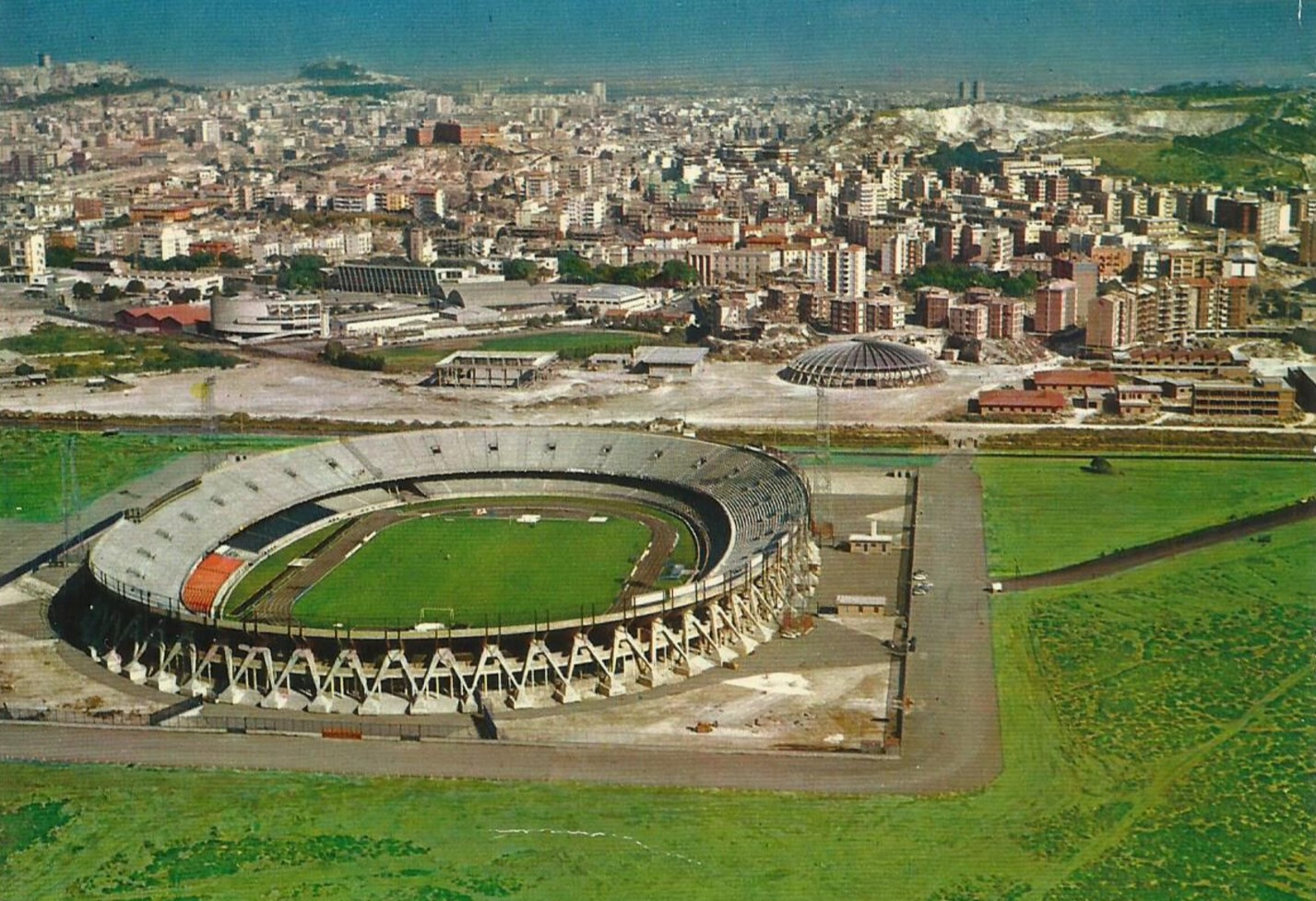
A final consideration has to do with the location of the stadiums themselves. Many Italian cities have strict building codes designed to safeguard of historic city centers (the Italian phrase, “Centro Storico” is not synonymous with, “Centro Città,” as the oldest parts of a given city might only partially overlap with the city’s central business district, which could even be qualified as “Centro Direzionale” in instances when is a long ways away from the historic center). The strict building codes, and the city councils that enforced them, meant that that stadiums were almost always built far from historic landmarks, and sometimes far from the city center itself! The stadium in Cagliari, built after the local club's title-winning season in 1970 and restructured for the World Cup, for example, is far on the edge of the city against a backdrop of modern housing developments, nowhere near the historic center. You can see what it looked like when being restructured for the World Cup in this picture. While some stadiums like that in Genoa were built in denser neighborhoods, authorities were not concerned with disruption to the surrounding buildings, consisting of modern working-class housing blocks (in fact, the largest worry tied to the Genoese stadium was tied to alleged building code violations for being too close to the local penitentiary). Likewise, authorities were unconcerned with stadiums like the San Siro, also built in a low-density neighborhood characterized by modern housing blocks and detached homes.