"[The Vikings] went on pirate raids, sometimes as far as the frontiers of the Chinese empire on the Caspian Sea; in the ninth and tenth centuries the Chinese outriders were surprised to meet men who were tall, red - haired and blue - eyed."
That's all the book I'm reading says on the topic. What is it referencing? I don't recall China reaching the Caspian.
I've traced your quote to Michael Pye's Edge of the World (2015). It seems like a good and interesting book, and Pye does have credentials as a historian, but this particular passage is almost certainly in error (and notably lacks a footnote). In 751, Muslim and Turkish forces met in a single small battle at a place called Taraz (aka Talas), now in modern Kazakhstan. According to Hugh Kennedy:
In 747 and 749 the Prince of Tukhāristan appealed for Chinese help against bandits in Gilgit, near the headwaters of the Indus, an area where Muslim armies never penetrated, along a route to China sometimes used by Soghdian traders. The Chinese governor of Kucha sent a Korean officer to deal with the problem. In a series of amazing campaigns, he crossed the mountains along the precipitous route of what is now the Karakorum highway and defeated the rebels. He was then called in by the king of Farghāna to help in a local dispute with the neighbouring king of Shāsh. The Chinese forces ended up by taking Shāsh and the king fled to seek help from the Abbasid governor Abū Muslim, who had established himself at Samarqand. He sent a force under one of his lieutenants, Ziyād b. Sālih. The Chinese with their Farghāna allies and some Turks met the Muslim armies near Taraz in July 751. It was the first and last time Arab and Chinese armies came into direct confrontation. The Arabs were victorious but sadly we have no more details of this conflict. (The Great Arab Conquests, 2007, p. 294)
So much for the Chinese empire. But who was in the region around the Caspian? The region was populated by a loose collection of peoples that geographers in the neighboring Islamic world generally called Turks and Slavs. They weren't terribly clear on the matter, and in big works like al-Tabari's History (40 volumes in English translation), the same groups were sometimes classified in multiple ways.
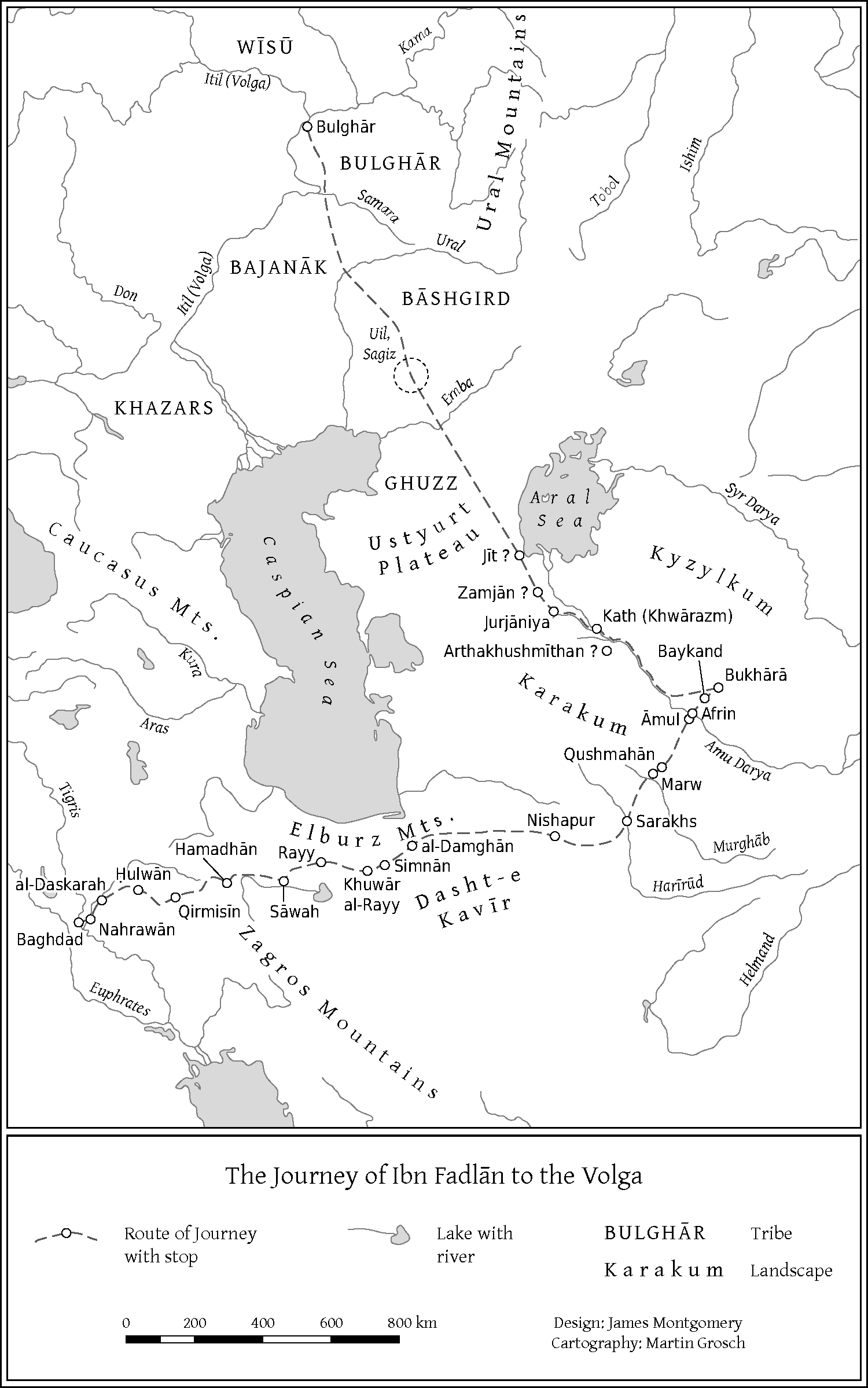
From a Middle Eastern perspective, the most important of these was the Khazars, a group living just north of Caucasus Mountains where the Volga met the Caspian. The Khazars were united under a khagan and at some point converted to Judaism. Other important groups included the Ghuzz (Turks) between the Caspian and the Aral Sea, as well as the Bulghars (Slavs?) located on the Volga north of the Khazar khaganate.
In 921, an Arabic embassy departed Baghdad for the Bulghars to sponsor fortifications and promote the spread of Islam. I suspect that economic motives might have also been involved, since a relationship with the Bulghars would allow Arabic traders to circumvent Khazar middlemen. At any rate, the embassy wasn't very successful, and one of the officials—Ahmad ibn Fadlan—wrote a kind of letter as if to justify his failures. At the end of the letter (at least at the end of the sections that survive), Ibn Fadlan wrote a bit about the Rus. Insofar as Ibn Fadlan was concerned, these people lived on the edge of the world, and he wrote some fantastic stories about them (like the ship burial of a chieftain) which are the primary reason most people look at his work. These people may or may not reflect wider aspects of the Norse-speaking (aka "Viking") world. (Thorir Jonsson Hraundal has made his critical analysis of these passages available online.)
Ibn Fadlan's letter is also a great source for studying the Caspian region in the early 900s. Here's a map that accompanies the most recent scholarly edition of the text. You can find a few of the groups I've mentioned, as well as a few others that Ibn Fadlan documented, but the Chinese are notably absent.