I've read a couple different scans online of English translations of Antonio Pigafetta's account (and some other of the accounts of the Magellan-Elcano voyage). I just today got myself this copy of the 1994 translation by RA Skelton, who writes in a note that "cingha" refers to: "The dragon, emblem of China." But I have not seen the word cingha elsewhere and a quick google search turns up nothing.
The passage in question reads:
All the kings and lords of Greater India and Upper India obey this king, and for a sign that they are his true vassals each of them has in the middle of his square a beast graved in marble, handsomer and bolder than a lion, and it is called Cingha. And this Cingha is the seal of the king of China. And all those who go to China must have his engraved beast impressed on wax [or?] on an elephant's tooth, otherwise they could not enter his port.
[after a couple sentences on punishment of disobedient lords it continues...]
This king does not permit himself to be seen by anyone. And when he wishes to see his people, he rides through the palace on a peacock made by great mastery and craft (a thing very rich), and he is accompanied by six of his principal women attired like him. So he goes until he enters a serpent called Nagha, also made by artifice, and as rich a thing as one could see, which is in the largest court of his palace. And the king enters it, and his women, that he be not recognized among them. And so he sees all his people through a great glass which is in the chest of the serpent, where he and his women can be seen, but he cannot be recognized.
I also find it interesting to see the naga also mentioned. As I understand it, naga is a word spread from India to China with Buddhist lore, and is featured in both Buddhist and Hindu tradition as a powerful serpent creature associated with the sea. And sometimes it is interchangeable with the Long/龍 in China.
About his source, Pigafetta writes,
All these things and many others were told to us by a Moor, who said that he had seen them.
It can be read here in the last 3 pages of the free preview on google books: https://books.google.com/books?id=sclFZPrPVhsC&printsec=frontcover#v=onepage&q&f=false
Here are a couple old books on Chinese dragons which I have read and which I do not recall using any word similar to cingha
Hayes, L. Newton. (1923). The Chinese Dragon
https://archive.org/stream/chinesedragon00hayeuoft#page/40/mode/2up
Marinus, Willem de Visser. (1918). The dragon in China and Japan
https://archive.org/stream/cu31924021444728#page/n51
Is there a word resembling "cingha" that referred to the Chinese dragon? Maybe a word from South Asia or Southeast Asia?
Are the said practices involving the Chinese seal true (reported elsewhere)?
"Cingha" is probably Malay singa (from Sanskrit simha). Chinese seals, especially important seals, were typically topped by an animal. The most common seal animal is the dragon:
but other animals were used, too. In particular, the lion, in the form of the foo dog or foo lion, was very common on Ming seals:
and a lion like this is plausible from both Pigafetta's description and being called "singa". The Chinese lion is relatively un-lion-like, and it's quite reasonable for Pigafetta to not identify it as a lion, especially since European lion seals were usually more realistic:
Other animals also appear on Ming seals, including the dragon:
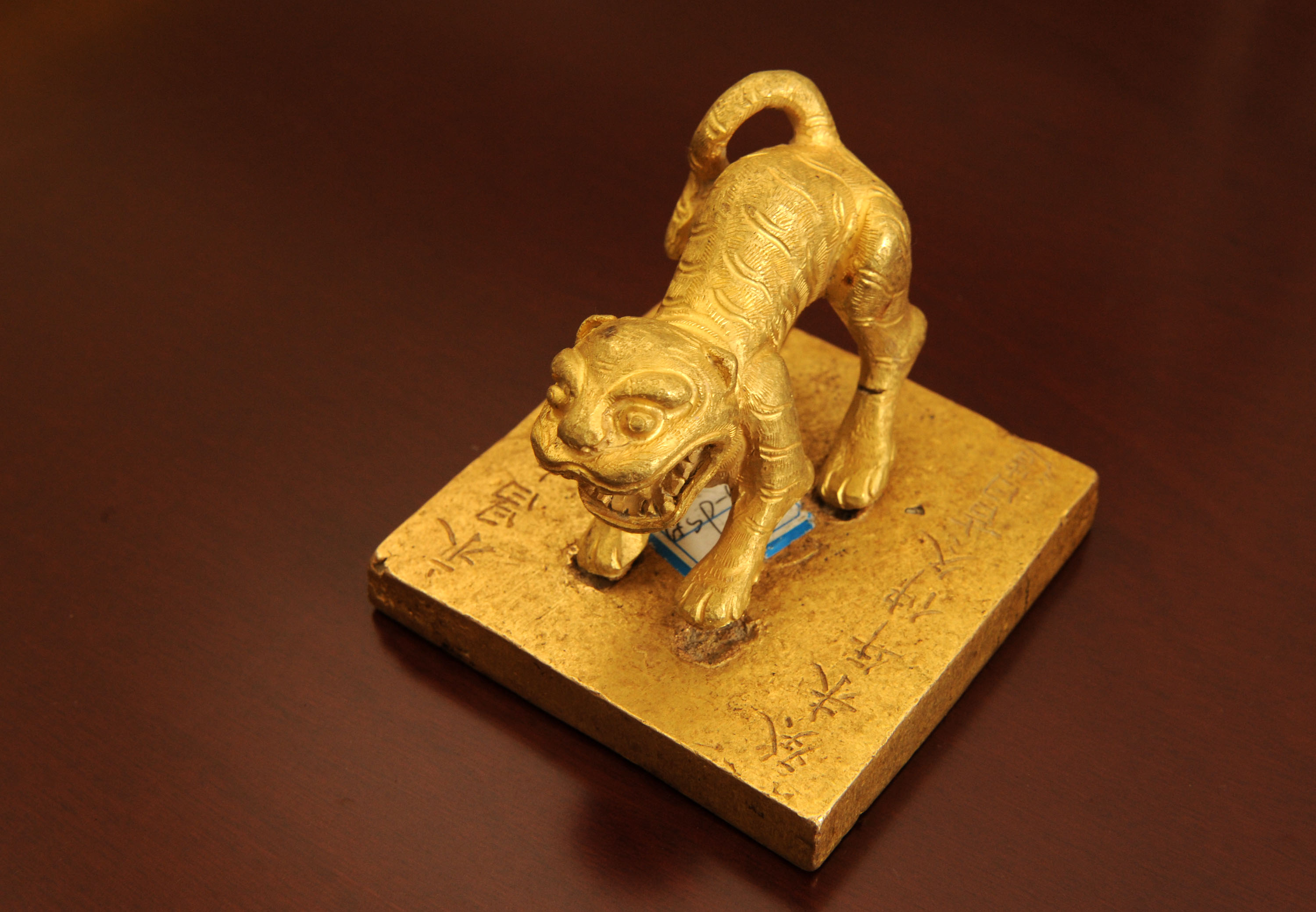
and tiger:
but these would be called something other than "singa". The dragon would probably be called "naga".
While the lion (foo dog, foo lion) is very common on Ming seals, the dragon was the most used seal animal in most other dynasties. The main exception I know of appears to be the Han, where the duck(!) appears to be common:
Some seal animals are difficult to identify, such as this Chinese-made Korean seal:
which combines characteristics of both lion and dragon, being a scaly lion.