Today:
AskHistorians is filled with questions seeking an answer. Saturday Spotlight is for answers seeking a question! It’s a place to post your original and in-depth investigation of a focused historical topic.
Posts here will be held to the same high standard as regular answers, and should mention sources or recommended reading. If you’d like to share shorter findings or discuss work in progress, Thursday Reading & Research or Friday Free-for-All are great places to do that.
So if you’re tired of waiting for someone to ask about how imperialism led to “Surfin’ Safari;” if you’ve given up hope of getting to share your complete history of the Bichon Frise in art and drama; this is your chance to shine!
Week 145
The month of August 1919 – amidst the steady advance of the electoral reform, which was expected to represent the passing of the torch from the old liberal world to the new, “democratic” forces of the nation, and the early stages of the first electoral campaign of “modern” Italy – saw, in the pages of the Popolo d'Italia, and within the city of Milan, a resurgence of polemic exchanges between Mussolini and the socialist leadership, with his counterpart at the Avanti!, Giacinto Menotti Serrati, on the forefront. The once great expectations for the definition of the “Adriatic question” and especially of the matter of Fiume, had – week after week – turned into a general sentiment of dissatisfaction and resentment towards Italy's “former” Allies, tempered by a good measure of practical indifference, consequence of the much more urgent concerns over the economical struggles, persistent supplies shortages and inflation, which made even the once enthusiastic voices about the imminent definition of a new international order fade in a now remote and distant silence. The new order especially, far from accommodating for the many demands raised and conceived during the long months of the war, was – once again – a matter of urgently reigniting national production, international trade, and restoring the treasury of the State.
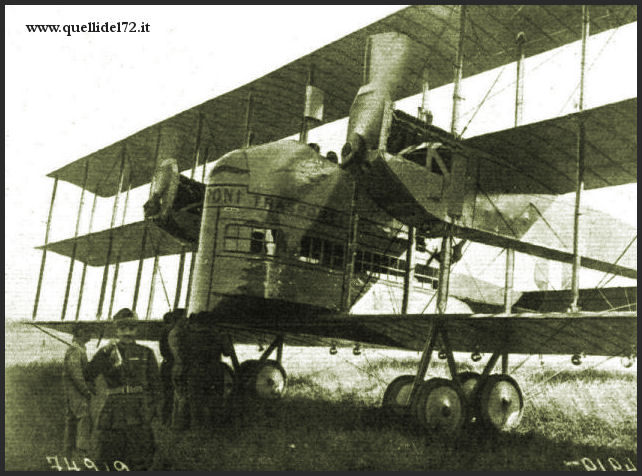
In the meantime, the city of Milan was preparing to mourn the loss of the seventeen (passengers and crew) of the so called “Milan-Venice raid”; a modified triplane Caproni, model Ca.48, one of the first intended for commercial flights, which crashed after suffering a mechanical failure in the skies over Verona during the late afternoon of August 2^nd 1919, half way into its return trip to Milan. The event, which was meant to represent one of the highlights of the great “aviation festival” ongoing in Taliedo (a district of Milan, famous for its, now old, aviation field), had garnered a significant following among the Milanese press (the Popolo d'Italia itself had provided extensive and enthusiastic coverage, as they did with all aviation-related matters, and was supposed to send a member of their redaction as well) with some notable public personalities among the victims, contributing to the dramatic impact of what is generally regarded as the first “commercial flight tragedy” in the history of Italian aviation. The fact that the plane had fractured very close to the city, and at such an altitude to be clearly visible from the ground during its final moments, added a further layer of horror to the tragic circumstances.
The funerary service of the fourteen victims whose bodies had been returned to the city of Milan took place, in a stately form – “thanks to the generous and commendable initiative of the mayor, at the expenses of the municipality” - on the 5^th of August, the carriages departing from the Central Station at 5.30 pm, making their way through the center of the city and then to the Monumentale. According to the Popolo d'Italia, the participation to the “solemn service in honor of the arditi del cielo” was expected to be “of quite massive proportions”. Followed a detailed breakdown of the composition of the funerary procession
The troops will lead the way; the Associations with their flags will follow. Then the funeral wreaths and the fourteen carts. After the last cart, the relatives of the victims, then the authorities, the delegations, and last the crowd.
Invitation to the arditi...
All the arditi members of the association should meet today at 16 o'clock […] to participate and bring a floral wreath to the solemn funerals of the victims of the sky.
... and to the fascists
All the fascists are committed to participate to the funerals of the victims of the aviation tragedy of Verona, meeting at 5.00 pm at the Central Station.
A few days earlier, possibly in order to compensate in part for the foreseeable advertisement slump of Summer months, and possibly in order to account for one of the many episodes of “financial difficulties” which his newspaper had been experiencing throughout the course of its existence, “due to its more and more promising development”, which caused a consequent “geometric increase” of production costs, Mussolini had launched a campaign directly addressed to current subscribers.
As long as the printing paper, which used to cost Lire 34 per quintal, costs, like today, 140-160 Lire, we can't keep a balance between revenue and expenses. [August 3^rd 1919 – in Popolo d'Italia]
The short note accompanying the request for contribution had obviously caught the eye of the socialist press, being reproduced on the Avanti! with a short commentary calling out Mussolini:
“That newspaper of sorts which used to preach revolutionary war, and which now serves as a bastion for the industrialists, sucking their cash gratitude, after the general strike and after its anti-Bolshevik campaign, sends the following “circular” to its friends” […]
“Yesterday [it] saved, or pretended to save, the bourgeoisie from the Bolshevik revolution; and now it's asking for its due.” […]
These polemics were never especially brilliant, or insightful, and usually revolved entirely around the exchange of accusations of remarkably little consequence and substance (to the point where it's not always easy to make sense of the particular terminology used). Mussolini accused “Pagnacca” - the “snitch”, a nickname he had either rediscovered, or made up, for Serrati, due to certain dubious accusations of being an informant dating back to the latter's time in Switzerland and to his controversies with the anarchist expats – of being an “international spy”, a “character, openly and internationally accused of being a murderer”; and Serrati – aiming at both Mussolini's role as a “shill” for the “industrial bourgeoisie” and at his pretense as a duelist – likened him to that “Ferruccio Macola”, the conservative who had killed the radical “democrat”, Felice Cavallotti in a notorious duel at the end of the previous century.
Mussolini rejected once again the accusations of acting as “a bastion of the industrialists”, listing his repeated support for measures such as
a) decimation of all wealth; b) revision of war supply contracts; c) confiscation of war extra-profits
Also – he insisted – the “industrialists' checks” frequently found their way into the Avanti! as well, either openly by means of advertisement, or covertly, by means of private donations.
I have never ran the anti-Bolshevik campaign from a bourgeois perspective, because, after all, plenty of bourgeois sympathize for the Leninist tyranny. […]
Had I wanted to speculate on the “moment”, fill my coffers and collect a million or some in exchange for the “de-proletarization” of what continues to be the poorest and most proletarian newspaper in Italy, I would not have waited until after the general strike, but I would have sent out my appeal immediately after April 15^th as a direct response to the subscription called for by the Pus […] I would have, easily, surpassed it.
Outside of the particularities of the exchanges between Mussolini and the socialist leadership of the time – those with Serrati and with the old intransigent group being especially acrimonious – there is something noteworthy in the consistent return of that moment, the day of April 15^th 1919, with the victorious “battle of via dei Mercanti” and, then, the sack and fire of the Avanti! buildings in Milan, at the end of an articulate series of manifestations and counter-manifestations pitting socialist and “national” groups against each other.
(1/3)
The Egyptian king as a character in ancient Egyptian literature
Egypt was one of the first societies to develop a centralized kingship, and the king was at the heart of Egyptian society, overseeing all aspects of military, economic, and religious activity. It therefore comes as no surprise that the king frequently played a prominent role in Egyptian literature. The monumental inscriptions on temples, striking in their large scale and impressive smiting and battle reliefs, have been most prominent in studies of Egyptian kingship, but Egyptian kings appear in tales as well. These literary kings include both “historical” kings and fictional or anonymous kings. A diachronic study of kings as characters in Egyptian literature reveals that the Königsnovelle, which presents the king as a decisive leader or champion, continues from the Middle Kingdom to the Late Period with slight modifications. In Egyptian tales, however, the character of the king gradually changes over time; from the Middle Kingdom to the Late Period, the king begins to develop incompetence, vice, and an antagonism toward the protagonist. Moreover, there is a shift from presenting named, “historical” kings to anonymous or fictional kings.
Egyptian literature of the Old Kingdom, at least as it survives today, is limited to funerary texts and a limited number of monumental inscriptions. One of the earliest examples of the Königsnovelle is the building inscription of Senusret I, preserved in the Berlin leather roll 3029. In this account, the king declares his intention of building a temple for his “father” Atum. The king is unquestionably at the center of the tale; it is the king who makes the announcement, appoints an architect, and oversees the stringing ceremony for the newly laid out construction site. Moreover, it is in the audience hall of the king that most of the account takes place, and the account carefully notes the regnal year, month, and day of the deed.
Indeed, the king monopolizes the action of the story to such an extent that the only additional characters in the account other than his royal seal-bearer are his nameless “royal companions,” who obsequiously express adulation for his wisdom and piety. “It is very good that you will make your monument,” they declare, and “the people cannot succeed without you!” The text uses this anonymous chorus to emphasize the positive character of the king. The account could simply have recorded the construction of the temple in a non-literary, straightforward fashion, as one finds in the Hittite annals. “Behind the city [of Nesa], I built a house of the Storm God of Heaven and a house of our god,” Anitta informs the reader matter-of-factly before moving on to other events. By framing the event within the context of a narrative, however, the reader gains considerable insight into Senusret’s character, or, more accurately, the character of the king that the narrator wanted the reader to see. Senusret provides the reader with boasts about his character, such as that he “lorded in the egg” and was “nursed to be a conquerer” by the god. The king’s decree demonstrates his decisiveness, and the adulation of the royal companions demonstrates that he is popular among his subjects. These elements of the king’s character - decisiveness, wisdom, piety, and favorable actions toward his subjects - are elements that can be traced in Egyptian literature over time.
The Semna stela of Senusret III presents a similarly heroic view of the king, but here the text emphasizes the military aspects rather than religious aspects of kingship. Senusret III notes that he extended the boundary in Nubia further south than any of his ancestors, and once again his decisiveness is emphasized. “I am a king who speaks and acts,” he notes, and “what my heart plans is done by my arm.” The Egyptologist Toby Wilkinson has referred to the text as a mix of “propaganda and coercion” and compared it to the “terrifying” statues demonstrating royal power and authority dating to the reign of Senusret III. In the Semna stela, the king is the narrator and sole protagonist of the account, and the stela focuses on his deeds, such as capturing the women and killing the cattle of foreigners. Moreover, the king contrasts the valor coming from attacking the Nubians with the shiftiness and cowardice of the wretched Nubians. By providing Nubians as characters demonstrating negative courage and decisiveness, Senusret III reinforces the positive view of his own character. The last part of the inscription, which urges his son to maintain the boundary, reinforces the idea that the Egyptian king alone is responsible for protecting and preserving the country.
A rather similar view of the king can be seen in Egyptian literature of the Middle Kingdom. Because most Middle Egyptian tales focus on characters other than the king, however, he plays a more peripheral and ambiguous role. When encountering Ammunenshi in the Levant, Sinuhe lapses into flowery praise of Senusret. “He is a god without peer,” he fervently assures the Asiatic ruler, and “he is lord of knowledge, wise planer, skilled leader.” Although the medium is different, the hymn of praise is strikingly similar to that of monumental inscriptions like the Semna stela, and indeed one motif, the king conquering while still in the egg, is repeated in both texts. Sinuhe can be viewed as a vehicle for the expression of the character of the king; by lauding the king in such a descriptive fashion, he fleshes out the characterization of Senusret I and transforms him from an anonymous actor into a key character in the story. Even Ammunenshi should be viewed as little more than a foil to the Egyptian king; the ruler of Retenu notes that Amenemhat I was as feared in the Levant as Sekhmet in a year of plague, and generous though Ammunenshi is, Sinuhe rejects his hospitality in favor of his homeland the moment Senusret invites him to return. Although Senusret appears only briefly and at the end of the tale, he is a much more fully developed character than his Asiatic counterpart through Sinuhe’s hymn of praise and the correspondence with his erstwhile subject.
In contrast to the monumental inscriptions, one sees hints of an alternate view of the king in the tale. Sinuhe blames his flight from Egypt on his heart and claims he fled for no particular reason, but it seems he acted out of fear of being associated with the king’s death and potential punishment at the hands of Senusret I. From this perspective, the king can be viewed as an opponent to Sinuhe, someone so terrifying that fear of punishment drove a prominent official out of his homeland. The king quickly establishes himself as a beneficent character in the tale, however. Inviting Sinuhe back to Egypt, he transforms him back into an Egyptian and provides a tomb and burial goods for Sinuhe.
The king plays a more prominent role in the tales of Papyrus Westcar. In the frame story, Khufu is entertained by his sons telling him stories of the feats of magicians in the past, and like the Berlin leather roll, the story is set in the king’s audience hall. P. Westcar incorporates the actions of past kings into the tales of the magicians. In one of the preserved tales, Nebka is impressed when he sees how the wax crocodile of the magician held a man who had slept with his wife captive for seven days, and he orders that the adulterous wife be burned alive and thrown into the river. Although Nebka is a less prominent character than the cuckolded magician in the story, his actions establish him as a judicious ruler capable of meting out harsh but (according to Egyptian moral standards) appropriate punishment. Snefru is likewise presented in a positive light in the third tale; when the girl dropped her pendant and petulantly refused to keep rowing, the king ordered his magician to retrieve it rather than force the girl to keep rowing or punish her for her audacity. Khufu is not presented quite as positively; when informed of a magician who can reanimate decapitated beings, he ordered that a prisoner be brought for a demonstration, a suggestion to which the magician Djedi vehemently objected, who performed the miracle on a goose instead. Although the text is set in the Old Kingdom, the story was composed during the Middle Kingdom, and Papyrus Westcar dates to the Second Intermediate Period, long after the reign of Khufu. Embedding historical characters within a narrative lends them predictability, as an Egyptian likely had a preexisting view of the prominent kings of the past.