Edit:
To the people PMing me: No, this isn't a result of Japan's negative birth rate, as it predates that development by decades.
It was a condition engineered by the government after World War 2 - before then, most Japanese would buy "used" homes like anyone else. During Japan's boom times, almost every economic asset in the country was at one point torn down and rebuilt - entire steel plants would be destroyed and reconstructed for only a 10% increase in output. The government actively encouraged this because it allowed the newest technologies to be introduced in every sector on a regular basis, and did it through tax incentives and by decreasing the interest rate. The first involved two policies:
Japanese tax law calculated the value of land and any construction atop that land separately,
New constructions were allowed to rapidly depreciate for tax purposes.
These changes to tax law were meant to overcome the "tax penalty" associated with improving land. In most countries, if you improve a house, you pay more tax - now and forever. In Japan, each building has a "useful life", after which point you pay no tax. Year by year throughout this life, tax payments decrease. This system obviously favors new constructions - unlike in most countries, you pay significantly less tax on the building after a few years.
The second method to encourage the "raze-rebuild" cycle both in residential homes and industry was "overloaning". Devised by the Finance Ministry during the postwar reconstruction, overloaning is Japan's never-ending stimulus. While most countries try to control inflation by controlling the money supply, the Bank of Japan has liberally issued on demand for city banks since the late 1940s. Japan preferred to avoid inflation by "destroying money" on the back end instead of controlling supply - this was done through taxes, which are much higher than in most developed countries. This system provides an almost unlimited stream of credit at consistently low rates.
These two policies essentially made "raze and rebuild" inevitable - capital was always available at low rates, so even a minor jump in price would justify tearing down and rebuilding a house. Because of this, the construction industry quickly adjusted to increased demand for homes through prefabrication - in most countries, the production of houses isn't a fully "industrialized" process because there isn't the demand to justify assembly lines for housing parts. In a few countries experiencing high rates of new construction (Japan included), costs are surprisingly low because of extensive use of prefabrication and economies of scale.
These factors all combined to make new houses a cultural norm by the 1960s, especially because each "generation" of Japanese homes until the 1990s offered considerable improvements over the last. Critically, the land under Japanese homes does not depreciate, the home itself does. In a sense, this is true in any country (homes, factually, become outdated and degrade over time), except in most countries:
The value of the land and the value of the home are not separated for tax purposes.
Interest rates are higher, capital is less available for "razing and rebuilding" - as a result, homes are more often "rounded out" instead of rebuilt, with outdated components like asbestos drywall being selectively replaced.
There are few tax incentives that encourage improvements - if you raise your property value, you pay more taxes, forever.
Because of the previous 3, production of housing parts is inefficient and construction costs are much higher.
As in any market, the value of "used" goods is inversely proportional to the quantity and price of new goods produced. In Japan, where new homes are being built in great numbers, the market value of old homes drops quickly.
Sources:
Kubo, Tomoko. Transformation of the Housing Market in Tokyo since the Late 1990s: Housing Purchases by Single-person Households.
Johnson, Chalmers. MITI and the Japanese Boom.
Ito, Takatoshi. Public Policy and Housing in Japan.
Zhang, Beibei. Housing Development in Post-war Japan: Historical Trajectory, Logic of Change, and the Vacancy Crisis.
The sound of the Gion shōja bells echoes the impermanence of all things; the color of the sōla flowers reveals the truth that the prosperous must decline. The proud do not endure, they are like a dream on a spring night; the mighty fall at last, they are as dust before the wind.
According to a recent think tank's estimate, in Japan, house value goes to 0 in roughly 15 years; a more relaxed recent estimate put it at 23 years.
Generally in Japan, in urban areas buildings don't have the value, land does. For older property, land might be 80 to 90% of the value. This means in times of boom (like the 1980s, where some real estate septupled in price), you might have land price increasing so fast the house upon it is almost a side note. This led to (and still leads to) scenarios where a home-owner would temporarily move off land, have the original home destroyed, and a new one built in its place which they would move back to.
/u/Cal_Ibre's economic answer strikes what I think is the "initial cause", but there are a three other factors I identify below that allowed the market to become a vicious cycle.
ONE
The quote at the top is from McCullough's translation of The Tale of the Heike Clan (from the Japanese medieval period), a strong representative of the Buddhist notion of ephemerality (mujo), and the more recent concept of mono no aware, a sense of the sadness of things due to impermanence.
The idea of mono no aware was first isolated by the 18th-century literary theorist Motoori Norinaga regarding The Tale of Genji, an even older work; the idea formed a cornerstone of Japanese aesthetics. Another common example is that of cherry blossom trees: the blossoms fall soon after appearing, making them an exemplar of impermanence.
In terms of housing, this makes Japanese culture more accepting of housing being temporary.
I wouldn't overrate this attribute, though. For example, while there are Shinto shrines (notably Naikū and Gekū) that are destroyed and rebuilt every 20 years (and are often used as another mono no aware example), this is out of an estimated 80,000 shrines in Japan, and there are also very old shrines like Izumo-taisha (over 1000 years old, rebuilt mostly in present form in 1744).
TWO
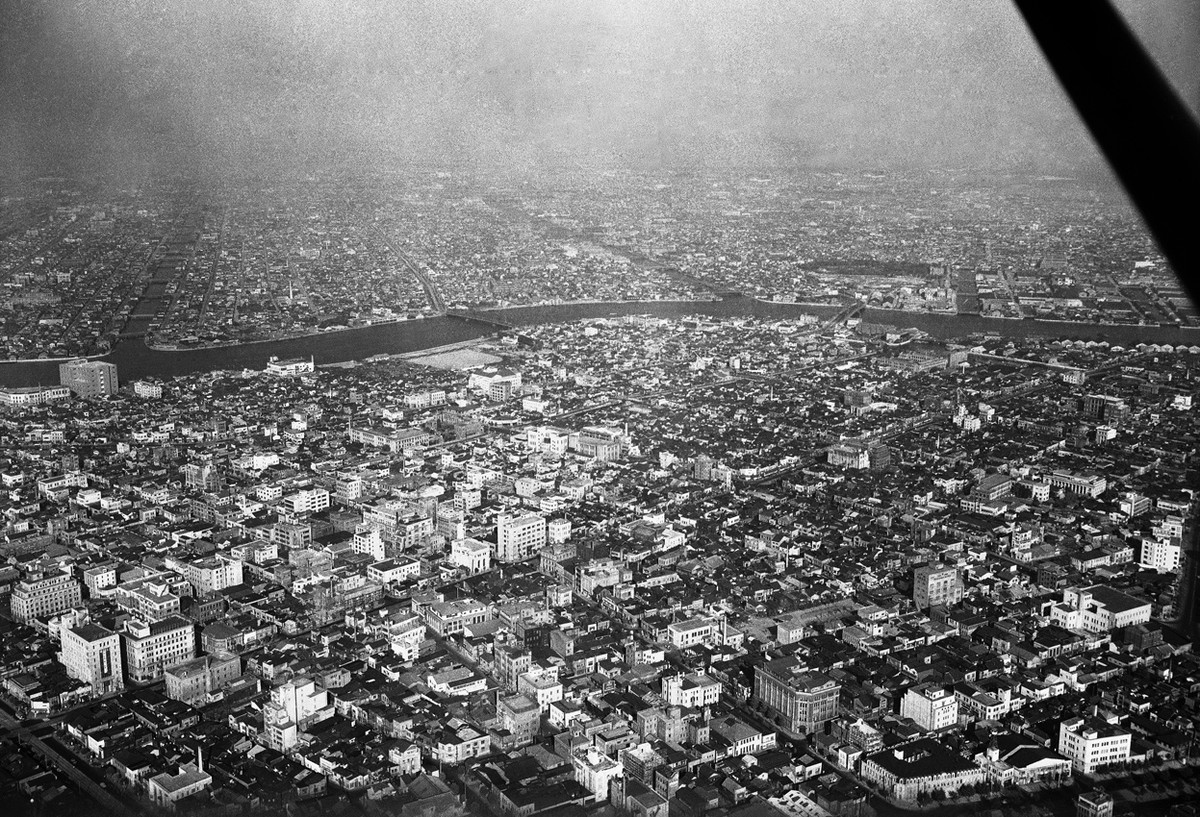
World War II obliterated much of the housing in Japan. Here is an aerial photo of Tokyo after firebombing, where an estimated 1 million people were made homeless.
This, plus a population boom post-war in Tokyo itself, meant a great deal of new housing was needed. Here is an aerial photo of Tokyo in 1955, to compare.
In the early years after the war, the government was busy reconstituting critical services, so housing was dealt with locally. Significantly, financial services focused on larger industries, making it difficult to get mortgages, so there was a great many small rental units.
This led to occasionally shoddy housing quality, which created a reputation of houses as being temporary.
Eventually, in 1955, the Japanese Housing Corporation was founded, and built a lot of public housing called "danchi" that were supposedly "new" and "modern" with "scientifically" created apartments. To give an idea what that means, the concept arose at this time of the dining-kitchen, putting the dining room and kitchen in the same room to save space, but there was concern about a dirty sink being visible to people eating. The designer Hamaguchi Miho came up with a stainless-steel sink that looked like furniture so it wouldn't need to be hidden.
These apartments starting going out of favor in the 1960s via general cultural tastes, and started by the late 1970s to get bad reputations. Many have now been demolished and rebuilt.
In 1951, the government stated collective housing should last 150 years; the case of the danchi shows this idea didn't last.
THREE
Japan is a nation of earthquakes, with an estimated 1500 per year, and 20% of the world's earthquakes of magnitude 6.0 or more are in Japan.
This led to both devastating tragedies and changes in building standards, each coming after a major earthquake. Standards were introduced in 1924 (minimum thickness for wooden beams, reinforced concrete requiring braces) and changed again in 1950 (load bearing walls, extra framework for wooden structures), 1971 (wooden structures need reinforced concrete), 1981 (an upping of magnitude resistance after the 1978 Miyagi Earthquake which was at 7.4), and 2000 (regulations requiring testing braces, foundations, and beams of a structure).
The changes in regulations led to some houses and apartments becoming dated and extremely expensive to put up to code. It was easier to tear down, and of course, in the case of earthquakes, sometimes nature did the tearing down prematurely.
...
Fedman, D., & Karacas, C. (2012). A cartographic fade to black: mapping the destruction of urban Japan during World War II. Journal of Historical Geography, 38(3), 306-328.
Pandey, R. (1999). Traditions of War Literature in Medieval Japan: a Study of the Heike Monogatari. In The Russo-Japanese War in Cultural Perspective, 1904–05 (pp. 41-59). Palgrave Macmillan, London.
Fujimori Terunobu & Fujitsuka Mitsumasa. (2017). Japan's Wooden Heritage: A Journey Through a Thousand Years of Architecture. 出版文化産業振興財団.
Koo, R., & Sasaki, M. (2008). Obstacles to affluence: thoughts on Japanese housing. NRI Papers, 137(12), 1-14.
Waswo, A. (2002). Housing in Postwar Japan: A Social History. Routledge: Psychology Press.
White Paper, Disaster Management in Japan. (2015). Cabinet Office, Japan.