Hello
Did the polynesians have a written language? Are there texts, or etchings proving this? Or were they a completely oral tradition based culture?
I can't speak for all Polynesian lanuages, but will pipe up on behalf of Te Reo (New Zealand Maori); Maori represent one of the youngest branches of Polynesian civilisation, so I believe that Te Reo can be a reasonable representative of the Polynesian 'state of the art' at time of European contact.
We had no written language prior to the arrival of missionaries, and earlier European records of Maori words are haphazardly approximated - in fairness, the spelling of English words only started to undergo serious standardisation in the 1750s-1810s, so it's not like this was done out of malice. Spelling was just less precise at the time.
Anyway, missionaries represented the main cultural bridge between Maori and Pakeha for over a generation, and some worked as much as anthropologists as they did preachers, genuinely learning and documenting the culture they had been sent to eradicate and replace - we can nevertheless thank these men for the earliest written records of traditional customs and beliefs.
During the 1810s, they began to make serious attempts to introduce literacy to their native charges. Now for reference, the Nga Puhi of Northland were in 1814 the first iwi to allow the establishment of a permanent mission on their land, and in general had the closest interactions with the colonists, albeit more for political than religious reasons. In 1815 the first Te Reo book, A korao no New Zealand, was written by the missionary Thomas Kendall, a personal friend of the infamous Nga Puhi chieftain Hongi Hika. Two years later, Cambridge professor of linguistics Dr. Samuel Lee arrived and worked with several prominent Nga Puhi, Hongi Hika included, to establish a formal alphabet - he published the First Grammar and Vocabulary of the New Zealand Language in 1820. This foundation was further revised by the Missionary Society, with the modern form being finalised by 1830.
Although writing has been alien to Maori society before this point, its value was readily recognised, and by the 1820s literacy had begun to spread internally, with Maori teaching the alphabet to one another using flax and charcoal, or even drawings in the sand. This was helped along by the further spread of missionary activity. Christian schools were popular as a means for children to learn English and form ties with the Pakeha community, which was the sole source of radical new technologies such as steel; the early-to-mid-19th-century was characterised by a (both metaphorical and viciously literal) arms race, with the tribes scrambling to amass superior European tools, weapons, and knowledge, and wreaking bloody havoc on any rivals that failed to do so.
Te Reo has mutated somewhat over time, as all languages do, but the alphabet - which was based on the northern Nga Puhi dialect - has remained constant since the mid-19th-century. The residue of this can be seen in some lingering idiosyncrasies, most notably the phenomes 'wh' (e.g. 'whanau' is 'fa-now') or 'nga' ('ngati' is 'nah-tee').
So that's where the written language comes from. To move on to the second bit of your question, about whether the traditions were purely oral... well, it's sorta complicated. Yes, but also no, in a way.
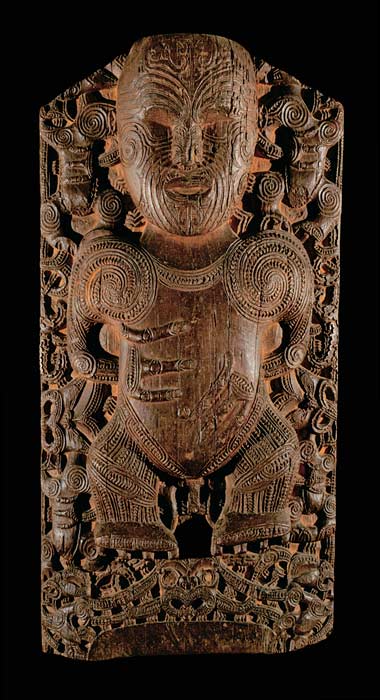
We had carved symbols, such as the geometic Kowhaiwhai patterns, some of which carried specific associations. In some cases Neolithic pictographs eventually simplified and codified into logorams, such as Chinese, so one might argue that enough isolation might have eventually seen the emergence of a native Te Reo writing system. We'll never know.
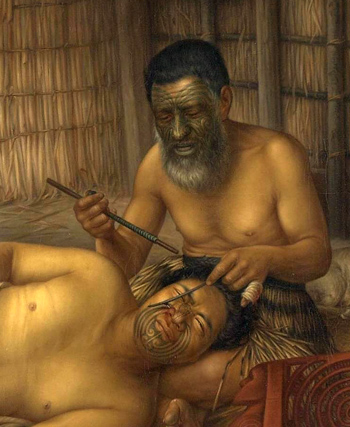
Another example would be Ta Moko, the traditional tattoos which are most commonly associated with the face. Though Moko were unique and highly personal, even sacred, there were common elements that were recognised throughout society - after all, what good is it to have a record of your accomplishments literally chiselled into your face if nobody can tell what the patterns mean?
Severed heads were often collected after battles, where their Moko could be seen and identified, and moko feature prominently in the otherwise fairly abstract depictions of human figures in traditional Maori artwork.(Although this is pure anecdote, my uncle claims to be able to recognise and recite every ancestral face on this marae; I've never taken him up on the boast, and would have no way of knowing if he was telling the truth anyway, since by definition there are no permanent records of the pre-literate period and a lot of the things we 'know' are tall tales inflated by centuries of retelling)
Unfortunately (not unlike with most European pagan traditions) the exact meanings and significance of the different symbols have been lost, with modern revivalists essentially making [sometimes-]educated guesses - we at least have the benefit of an unbroken oral tradition, fallible as it may be.
I know that symbology is a far cry from what we'd think of as a true written system, but in fairness Te Reo was and is a metaphorical language that requires a certain amount of abstract thought: 'Iwi' can mean 'tribe', 'bones', or 'strength', depending on context, while 'waka' can be either your extended ancestral clan or a literal canoe. Etc. There may not have been a formal alphabet in place for representing specific phenomes, or even specific words as in Chinese, but there were specific visual patterns and symbols - carved into wood and faces - that carried intrinsic meaning to onlookers. Whether that is enough to constitute 'reading' and 'writing' is up to you.
I guess to TL;DR this whole thang... Maori culture did not have a formal system of writing prior to the arrival of European missionaries - although the nobility of one iwi were consulted, we basically ended up adopting the Latin alphabet. Prior to this, culture was indeed overwhelmingly oral. However, the patterns and symbols used in tattoos and carvings carried some intrinsic meaning, which could be seen and 'read' at a glance, though these exact historical meanings are more-or-less lost today.







#/media/File:Maori_war_canoe,_drawing_by_Alexander_Sporing.jpg)
#/media/File:Maori_canoe_(waka)_in_the_Otago_Museum,_2016-01-29.jpg)