It's somewhat circular logic to consider the borders post-1945 as a "core area" for German speakers, as those borders imposed what the modern day German-speaking area is. We're looking at at least two millennia of migration, settlement and resettlement, assimilation (and the question of German identity) so there's not one singular answer.
Very roughly, we can look at
- the original core of German-speaking Europe until ~900 CE
- internal and external settlements in eastern Central Europe 1000-1400 CE
- settlements in Southeastern Europe in the context of the Habsburg-Turkish conflict, largely 18th century
- settlements in Russia late 18th century
N.b. that I'm linking to a lot of Wikipedia maps mainly due to the accessibility on the site.
Before the High Middle Ages / Origin of Old (High) German
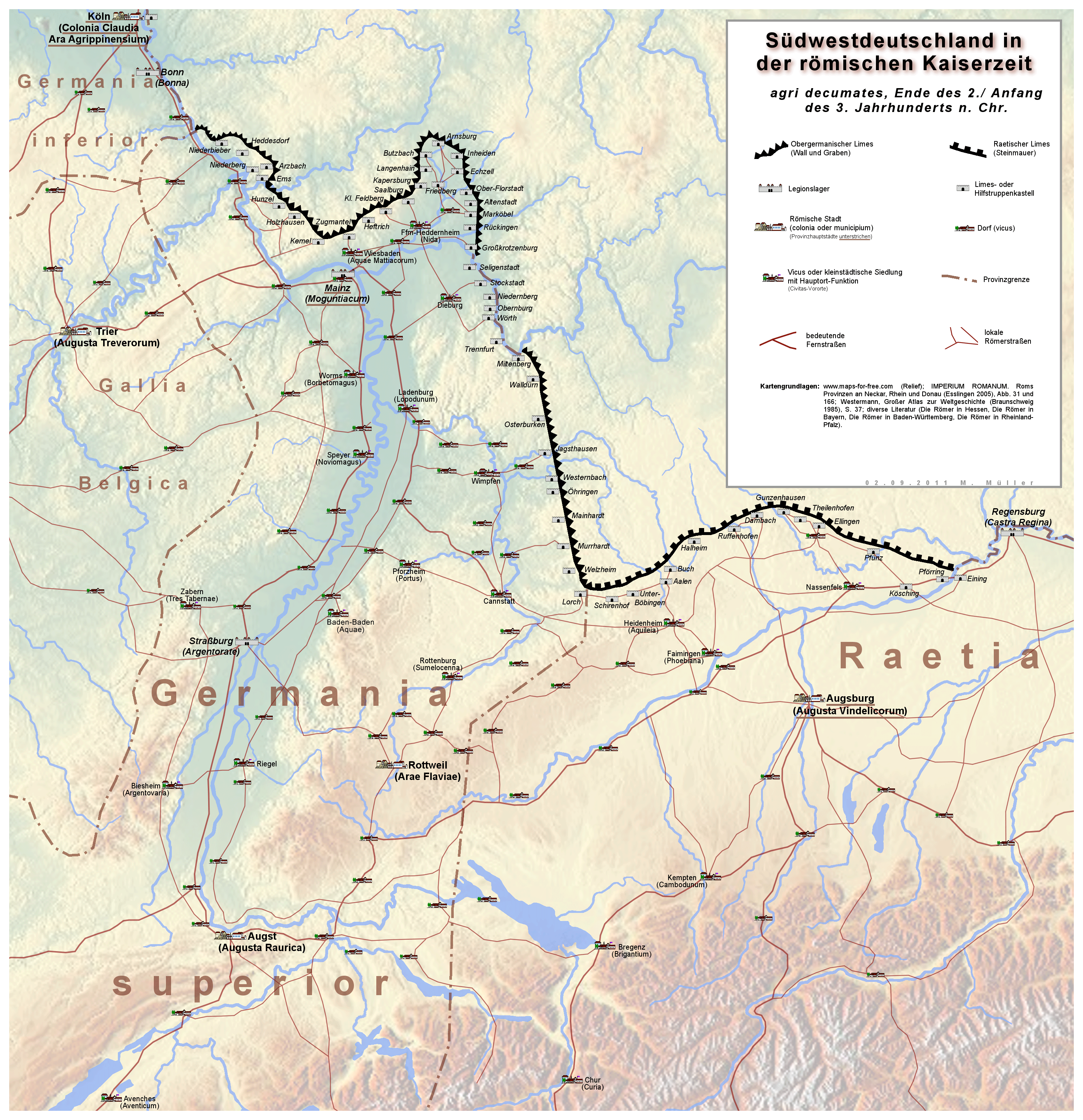
If we (somewhat arbitrarily) start at shortly before the Migration Period, we see Germanic tribes expanding from modern day northern and western central Germany, first into the agri decumates in the 3rd century and then by the 6th century settling west of the Rhine and the Roman provinces of Raetia and western Noricum (so, modern Bavaria south of the Danube and western Austria - this would be the approximate time of the ethnogenesis of Bavarians).
By the late 8th century, the "core area" of Continental West Germanic looks something like this. Modern German largely arose from Old High German (green on this map, distinguished by the High German consonant shift which was in its last stages at this point), but as you can see, large swaths of northeastern Germany and eastern and southern Austria are at this point not included.
With the rise of the Frankish realm, the history of German(ish) speaking peoples also becomes highly intertwined with the history of this political entity and its successors.
During the 9th and 10th century, the area east of German settlements is highly contested between the Frankish realms and their Avar, Slavic and later Hungarian neighbours to the east. While different tribes are subjugated/incorporated multiple times, they also revolt, and there is little large scale settlement of the area in this time.
One of the earlier examples during this phase is the re-establishment of the marcha orientalis in 976, corresponding roughly to modern Lower Austria, which sees German settlement under its new Babenberger lords.
"Ostsiedlung" / Hochmittelalterlicher Landesausbau
After the largely militarist expansion of the eastern borders, by the late 11th century and lasting into the 14th century, a new phase begins. Historically (in the sense that 19th and early 20th century historians called it that) this has been dubbed Ostsiedlung - eastern settlement or colonialisation and was framed within an explicitly nationalist context of Germans systematically colonising Eastern Europe. This was co-opted into one of the propaganda cornerstones for Nazi aggression and occupation policies against Poland and the Soviet Union, for example.
Since the 1970s, this has been replaced by looking at a more generally European of transformation in land use; the Medieval Warm Period and the development and spread of new agricultural practices saw great population growth that also led to massive internal land recovery (clearances, drainages, etc) before extending outwards into peripheral areas (which eastern Central Europe would be from a Frankish/German/HRE perspective).
Noticeably there was not a single defined policy to resettle Slavic lands, and it wasn't wholesale replacement of the previous inhabitants. We're rather talking centuries of individual, regional efforts, and resulting assimilation pressures slowly transforming the linguistic and cultural landscape.
This isn't to imply that it was a wholly peaceful process without conflict. The law in newly founded towns was sometimes clearly discriminatory towards non-Germans.
This map shows roughly the chronological progression in Central and Eastern Europe, but is also problematic as it ignores the fact that large areas weren't universally Germanified at any point (cf this map). The Sorbs (in the area marked "Lausitz") survive as an endangered Slavic minority language in Eastern Germany today, for example.
This process slows down at the beginning of the 14th century, with the Black Death being a very noticeable, but not solely causative point.
High German, Low German, Standard German, Deutsch/dutch
A quick side note, again to properly frame the concept of a "core area" of German: modern Standard German developed out of regionally used written varieties that acquired a growing hegemonial area and started to push out more small-area varieties. A large prestige push, of course, came from Luther's writings, especially of course his Bible, and the Reformation. At the same time, this cannot be decoupled from contemporary political history.
What is today northern Germany saw a large-scale abandonment of the traditional Low German/Low Saxon dialects in favour of adopting a spoken version of the written German based on High German dialects - finally coming back to the High German consonant shift I mentioned earlier; in an alternate history, northern Germany might well form a modern linguistic unit with Dutch.
Habsburgs, Ottomans and Danube Swabians
The conflict between Habsburg Austria, Hungary and the Ottoman Empire was a formative aspect of their respective history from the early 16th to the mid-to-late 18th century.
Frequent fighting led to large areas in what was then Hungary being devastated and depopulated - from the 1680s, these areas were systematically repopulated, largely drawing prospective settlers from the western areas of the HRE. The goal was to both secure the area against future incursions, as well as to restart the economic contribution to the realm.
Cf this map of Hungary based on the 1880 census; yellow areas are majority German-speaking areas.
Catherine the Great and Germans in Russia
Finally, the spread of German-speaking populations into Russia largely happened under Catherine II, so in the second half of the 18th century.
The motivations were similar to the settlement in the Balkans, to populate newly acquired territories that had hitherto been sparsely populated or agriculturally used.
---
So, as a general note, and as you can probably see from the length of the replies, I'm happy to answer follow up questions particularly on the development and spread of German from a more linguistics-motivated perspective; but I'll freely admit to limited knowledge on latter settlements in the Balkans and Russia - I've included them nevertheless to give a somewhat complete picture of the different phases of German-speakers spreading in Europe prior to 1945.