OK, so this is going to be a complicated one, but just to start, I'm going to push back on your idea that poor whites predominantly live in rural areas, and poor minorities live in inner cities. This was true a few decades ago, but it's not true today. In raw numbers, suburban poverty is the most common form of poverty in America today. (This violates the 20-year rule, but it's necessary to clear up the misconception.)
Anyhow. Now that I've gotten that out of the way, I'm going to speak to urban poverty and how it became synonymous with minorities.
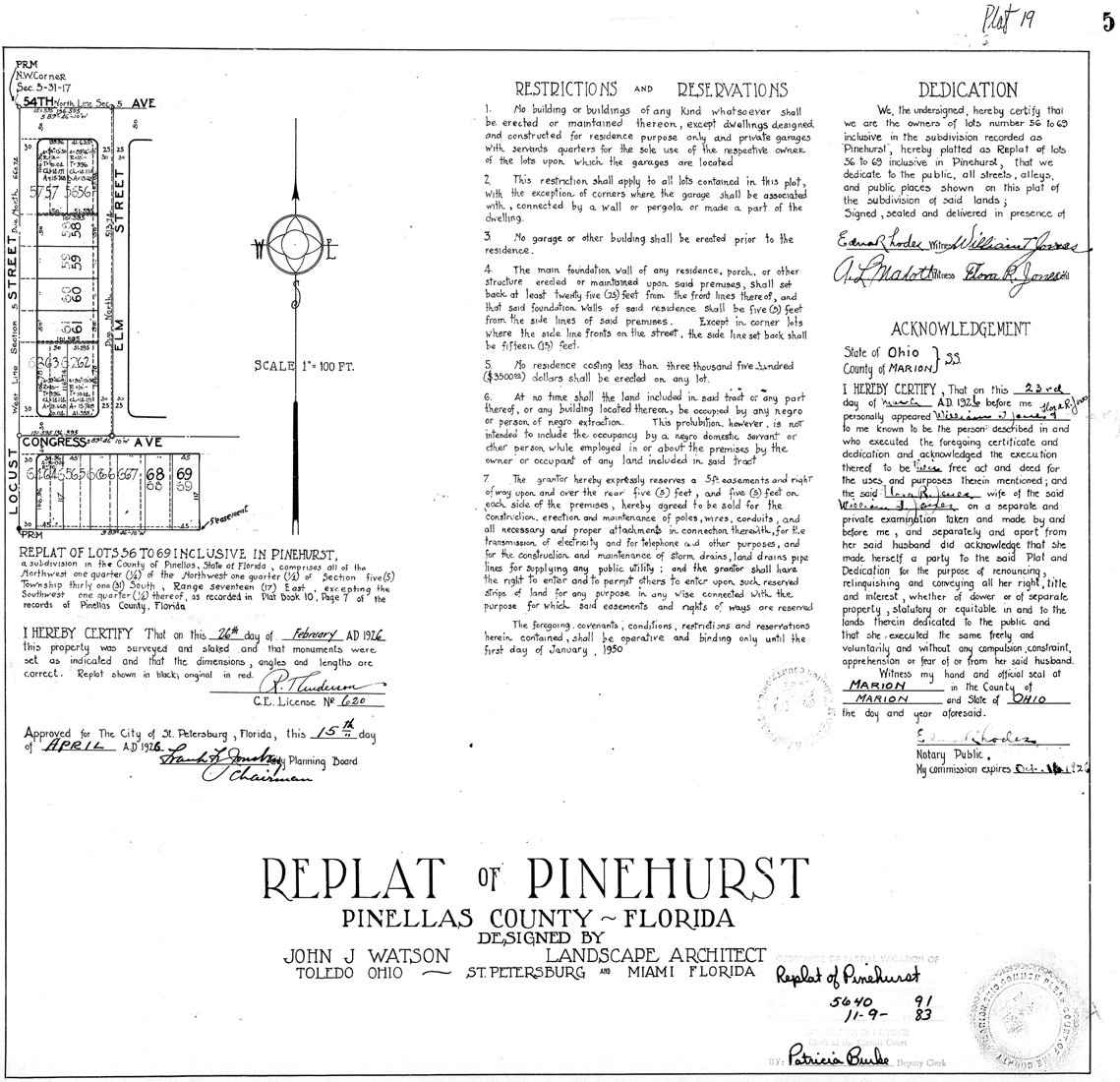
1900-1948: racist property deeds and redlining
The first part concerns a rather bad part of American law which has now, thankfully, been abolished: the racial covenant. When you buy a piece of property, you agree to certain restrictions in the real estate deed. Starting in the early 20th century, it was extremely common for real estate deeds to contain racial restrictions on who could own the property. Most commonly, this was used to keep blacks out of white neighborhoods, but could be used to keep other "undesirables" out, depending on who the targeted minority of the moment was - on the West Coast it was common to exclude Jews, Hispanics and Asians as well as blacks. These racial covenants were invalidated by the court decision Shelley v. Kraemer in 1948.
But racist policy concentrating poor minorities in specific urban neighborhoods wasn't just limited to racial covenants, either. The Federal Housing Administration actually refused to finance mortgages in minority neighborhoods, a practice called redlining. If you want to check out what one of these maps looks like, here's one of Los Angeles from 1939. That big block of red to the east of Downtown LA? That's Boyle Heights, which was filled with Mexicans, Jews and Asians. The other big block of red directly to the south of Downtown L.A.? That's South Central Los Angeles, which was the hub of L.A.'s black community. The federal government flatly refused to invest in these neighborhoods, leading to their decline. And when the FHA helped finance new suburban housing developments, they deliberately segregated them by requiring racial covenants in the '30s and '40s, and in some cases as late as the 1960s.
1948-2000: freeways and deliberate housing shortages
After the Second World War, there was a truly massive housing shortage due to the underbuilding in the Great Depression and the lack of new home construction during the war years. So, the federal government stepped in, and did two things that concentrated poor minorities in the decaying inner city.
First, the federal government invested truly enormous sums into building freeway networks. And new freeways were deliberately routed through minority neighborhoods - Black Bottom in Detroit, Boyle Heights in Los Angeles, the South Bronx in New York City - so white, suburban commuters could drive downtown. Because no one wants to live next to a freeway, and the federal government wasn't investing in those neighborhoods, those who could leave, did - and the white residents decamped en masse for the newly-built, lily-white suburbs, which where also financed by the FHA. Conveniently, these new freeways also made it much, much easier for suburban commuters to get downtown, bypassing all the older city neighborhoods in-between. Minorities and the poor, without the money to leave, ended up in the older city neighborhoods, which is how you get "the inner city" stereotypes.
Second, starting in the late 1960s, wealthy, white neighborhoods - especially in rich, liberal areas - just decided to stop building new housing altogether, rather than to allow apartments to be built. (Apartments, it was thought, were for poor people, minorities, and poor minorities.) Rich places like Beverly Hills, Santa Monica, Berkeley, and Scarsdale all just decided to stop building new housing altogether, effectively pricing out minorities and the poor. Despite being in incredibly desirable parts of the country, the population in many of these rich, white places has remained stagnant - or in some cases, has shrunk - since 1970.
| City | 1970 pop. | 2019 pop. |
|---|---|---|
| Beverly Hills, CA | 33,416 | 33,792 |
| Santa Monica, CA | 88,289 | 90,401 |
| Berkeley, CA | 114,091 | 121,363 |
| Piedmont, CA | 10,917 | 11,135 |
| Nassau County, NY | 1,428,080 | 1,356,924 |
| Scarsdale, NY | 19,229 | 17,871 |
2000-present: why the stereotype of urban poverty is no longer true
But this has changed in the last twenty years or so, as most cities have generally stabilized, and now it's the older suburbs that have started to age. The oldest post-war suburbs have begun to decline, as the infrastructure and housing stock are nearing seventy years old.
In some places, like LA and NYC, the massive housing shortage caused by the refusal to build more housing in rich neighborhoods has meant that property prices remain high and a ton of city gentrification has happened, even in "inner city" neighborhoods that rich whites never would have gone in 1980 or 1990. These are places like Bedford-Stuyvesant in NYC (home of Notorious B.I.G.), and Crenshaw, Los Angeles (home of Ice-T), where a house can easily run you $1,000,000 these days. And as this gentrification has happened, the poor end up getting priced out, and move to older, outer-ring suburbs like San Bernardino, CA or Bridgeport, CT.
The canonical book on the subject, by the way, is Rothstein's The Color of Law, which I highly recommend.
So I'm going to start by questioning the premise, specifically "poor whites predominantly live in rural areas and poor blacks and poor Latinos predominantly live in inner cities".
There are powerful political and media narratives that support this assumption, but is it really true? Let's try to dig into some numbers and parse some terms.
First it's important to note that "Inner City" is a commonly-used term, but it doesn't actually have a statistical meaning. The Census Bureau, which collects these sorts of statistics, in 2010 defined an "Urbanized Area" as a tract with a population with over 50,000, and an "Urbanized Cluster" as a tract with 2,500 to 50,000 people (this is basically an exurb). Everything else is "Rural". As such, it's actually much more common to talk about "Metro" populations and "Non-metro" populations, because while the latter clearly means Rural, the former includes cities, suburbs and exurbs.
This is important because while the African American population in recent years is overwhelmingly "metro" based, it's not in cities per se. Elizabeth Kneebone of the Brookings Institution used 2010-2014 American Community Survey data to estimate that the African American population broke down as 39% suburban, 36% urban, 15% exurban and 10% rural. There was a time when a solid majority of African Americans did live in urban areas, but that was solidly in the 20th century, and demographics have changed since then.
A second significant point is that there are significant rural and small town regions in the United States that are actually majority African-American, Native or Hispanic. The majority African American regions are mostly concentrated in the "Black Belt" farming areas of the Deep South, plus the Mississippi Delta, while the majority Hispanic regions tend to be in New Mexico, and southern Texas. The Native areas are mostly reservations.
Connected to this, we should look at how poverty rates stack up in a matrix defined by race and by metro/nonmetro. This report from 2002 is one of the few places I could find this breakdown, and it's worth noting that for all racial groups in the US, there is a significantly higher poverty rate among the nonmetro population than there is among the metro population. Of course, the nonmetro population for all of these groups is also much smaller, and in absolute terms the number of nonmetro Americans in poverty numbered 7.5 million versus 27.1 million Americans living in poverty in metro areas. Figures for minority rural poverty rates in 2010 saw little change.
So to try to work these numbers out, using 2010 data:
| Race&Ethnicity | Rural and Small Town | Suburban and Exurban | Urban |
|---|---|---|---|
| White | 50.5 m (77.8%) | 105.7 m (69.7%) | 40.6 m (44%) |
| African American | 5.33 m (8.2%) | 16.42 m (10.8%) | 15.93 m (17.3%) |
| Native American | 1.2 m (1.9%) | .667 m (.4%) | .369 m (.4%) |
| Asian | .630 m (1.0%) | 6.34 m (4.2%) | 7.49 m (8.1%) |
| Hispanic | 6.03 m (9.3%) | 19.25 m (12.7%) | 25.2 m (27.3%) |
If rural whites have a poverty rate of around 7 %, that's around 3.6 11%, that's 5.5 million whites living in poverty , compared to 1.75 million African Americans, 1.61 million Hispanics, and 415 thousand Native people (it's also worth noting that large numbers of rural people live just above the official poverty line). White non Hispanic rural Americans living in poverty are actually a plurality, but not a majority about 59% of rural Americans living in poverty. ETA - I got the rate wrong, but numbers are now corrected.
Nor are rural white non Hispanic Americans the majority of such classified Americans living in poverty either. Out of some 146.31 million white non Hispanic Americans living in suburban and urban areas, about 11% 7% live below the poverty line, which comes to some 10.2 million Americans (or almost 4.5 times twice the number of white non-Hispanic Americans living in poverty in rural areas).
So generally speaking, when we are talking about concentrated poverty (communities where large numbers, if not the majority of people, live below the poverty line) we are often talking about rural areas, and those areas have quite a range of racial and ethnic majorities. When we are talking about the majority of people living in poverty, we are talking about people living in urban but increasingly suburban areas, and this also tends to hold true for African Americans and Hispanic Americans as well as whites.
As for historically why the African American population was majority urban in the mid 20th century, and why it saw such a concentration of poverty, that largely is related to the Great Migration of African Americans from the rural South to urban areas across the country, starting circa 1910 and continuing well after World War II. Once African Americans settled in those cities, they often faced redlining and other discriminatory measures that kept them concentrated and in poverty in particular parts of those cities. Frankly these two subjects on a national scale are a bit outside my area of expertise, so I will pass for now in describing them.
Unfortunately search is not providing great results for either the Great Migration or Redlining here, bar u/searocksandtrees linking to some older discussions.
ETA: or...take a look at u/fiftythreestudio's answer above!
All of these responses are amazing and insightful.