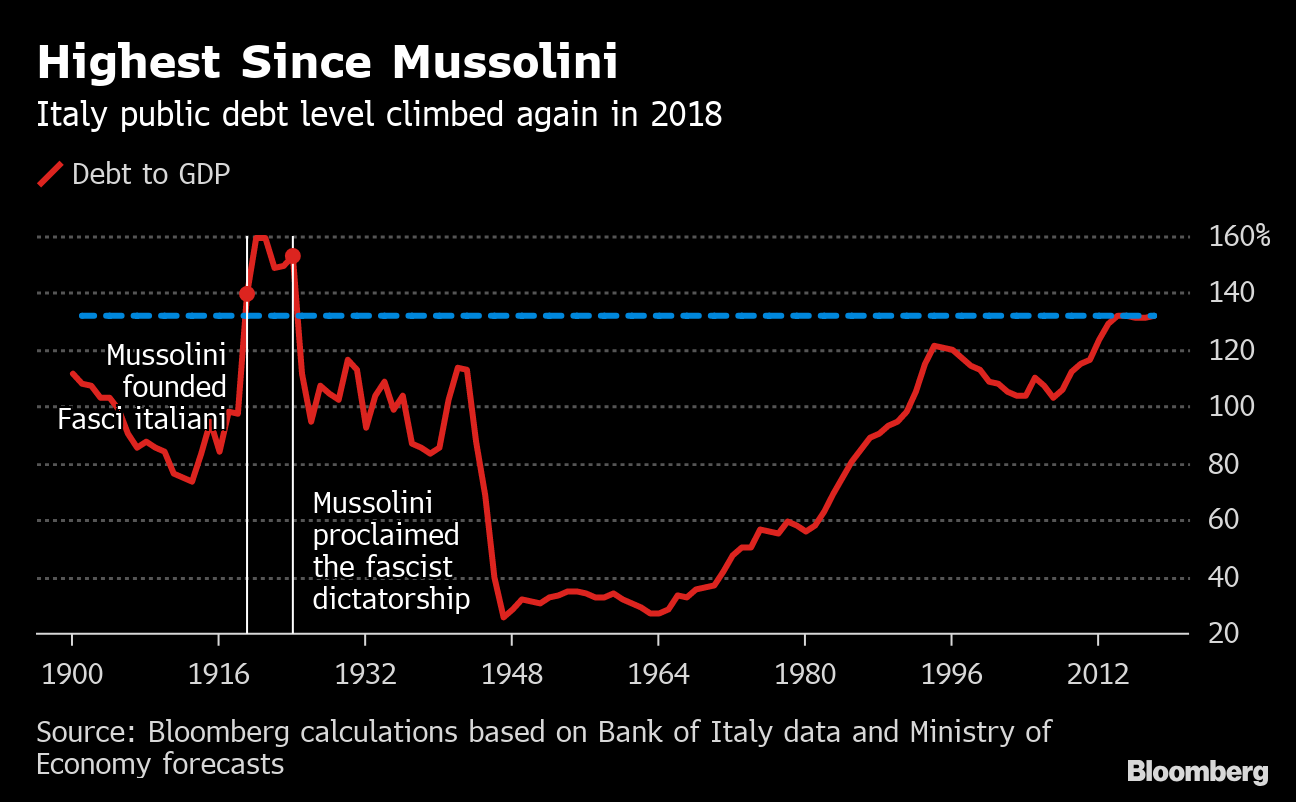
I've been reading a bit into Mussolini's history and I've seen opinions saying that Mussolini was actually quite good for the Italian economy. He drastically lowered the unemployment rate and the national debt as a part of the GDP dropped by almost 70% under his rule.
https://assets.bwbx.io/images/users/iqjWHBFdfxIU/iIfShEVadJO0/v0/-1x-1.png
Further, quoting from https://www.cato.org/publications/commentary/economic-leadership-secrets-benito-mussolini:
"Between 1921 and 1925, the Italian economy grew more than 20 percent. Unemployment fell 77 percent."
It seems as though he made intelligent economic decisions that resulted in clear economic development.
I'm not too knowledgeable about Italian politics, but if anyone can give me an unbiased review on Mussolini's:
Impact on Italian economy?
Public support/opinion of him. Was he well received during his rule? His he still admired after his death and today?
General effectiveness as a leader? I've seen people say Mussolini was actually very eloquent and bright when he wasn't putting up his ridiculous WWE-style act in his speeches.
Well, Jim Powell is no historian of Fascism, I dare say. His introductory summary is one of the worst things I have ever read.
The son of a socialist blacksmith, Mussolini believed in government ownership and government control of the economy. He became outraged when socialists opposed Italian entry in World War I, because he figured that Italy could emerge from the war with an empire like Great Britain, France and Germany. So he blended nationalism with socialism and came up with economic fascism. This involved private ownership and government control of the economy. Individuals continued to own their property and their businesses, but without the right to do what they wanted. Government told everybody what they must do and not do.
Even accounting for the need to provide a brief introduction, recycling two half-paragraphs from any of Payne's forewords would have served him and the readers much better. Capped with that, his clearly polemical arguments lose whatever weight they may have held.
In general, I am reluctant to embrace this kind of diatribes. Powell is - very obviously - not concerned with providing an accurate picture of Fascism, nor with informing his readers about Fascism, but rather, under the pretense of clearing up misconceptions, taking pot-shots at those supposedly "liberal" or "democratic" institutions which looked at Italian Fascism with a relative degree of favor or tolerance during the 1920s and early 1930s.
To "correct" his introductory statements, pick up any book on Fascism. To correct his other arguments, pick up any book on Fascism. Maybe not von Mises.
The comparison between 1921 and 1925 is in itself rather problematic. In 1921 Italy suffered from the consequences of its participation in the Great War - which had caused the public debt to rise by a few times pre-war GDP - massive social conflict (which the fascists themselves were active participant in, if not, by late 1921, the main cause) with consequent financial disarray and international mistrust. Furthermore, despite the Italian hopes on a renewal of international commerce and credit lines, the British and especially American financial worlds had proven far more invested in their own markets than in the Italian one. Italy was also coming out of a period of serious scarcity of materials, and was in the process of normalization of certain overgrown industrial cartels - the Ilva and Ansaldo steelworks, above all - with a consequent score of troubles afflicting the Italian credit system, which was still in many regards a "mixed bank" one (for reference on these points, see Forsyth's The crisis of liberal Italy). 1921 data - especially when taken out of context (see for instance Einaudi's tentative defense of the Italian situation in his contemporary writings for the Economist) - therefore depict probably the worst financial situation in Italy's history until 1944-45. Compared to that point, the Italian economical situation showed a significant improvement, due to both certain adjustments accomplished by De Stefani, and to the general improvement of the international commerce and credit situation (the perception of an increased stability may have played a role in making American investment more forthcoming). The inherent problem with De Stefani's liberist policies - as discussed again by Forsyth, but also in traditional tratments, from Einaudi to Toniolo - is that their practical execution relied on a series of contingent situations.
First, the reduction in unemployment was recorded by the Fascist authorities in a rather sympathetic way. In other words, those socialist who had been removed from their workplace and forced to find a new residence or to emigrate did not count as unemployed. Furthermore, the year of 1921 had reached a relative peak in per-hour salary, both in the industrial and agrarian sector. Workers had also obtained the introduction of the "eight-hours" workday - a measure which large portions of the Italian establishment regarded as premature, given the laggard state of development of the Italian economy. As a consequence, there was room to increase employment by partially accepting those improvements (for instance, returning work-days to nine hours instead of ten to twelve) while on the other hand, offering the extremely convenient opportunity of doing unpaid extra hours when necessary. This offered the agrarian and industrial owners a degree of flexibility in the treatment of their work-force; something which even certain fascist organizers regarded as very close to "labor exploitation".
In addition to that, Mussolini's government - strong of the suppression of any leftover "Bolshevik threat" - was able to command a degree of pliability from the industrial world, in so far as certain structural measures were demanded (such as a process of concentration of the Banking system), while the previous liberal governments, caught between the two fires of socialist strikes and fascist violence had been unable to accomplish.
In traditional liberist terms, those were positive economical developments; but their achievement on part of Mussolini's government had been due to contingent reasons, and not to structural ones. Something which men of unquestionable liberist faith, such as Einaudi himself, didn't fail to notice. Meanwhile, the oppressive and violent methods employed against political opponents continued; and absent any semblance of a socialist threat, they could no longer be understood as a form of "immune reaction" of the Nation against the "Bolshevik disease".
There was therefore no underlying economical policy devised by Fascism which one could regard as better than the previous policies adopted by the liberal governments. Fascism, like every other government in the history of Italy, remained constrained to the double bottleneck of materials and credit - two things that the Italian financial system had consistently lacked or struggled to muster.
It was only natural that, when international circumstances changed, the economics of Fascism should change as well.
(continues)