I was reading on Wikipedia about the pagan early medieval temple at Uppsala
https://en.m.wikipedia.org/wiki/Temple_at_Uppsala
What I gathered from reading this is that the post holes that were originally thought to the the foundation of the temple are in fact from other, unrelated buildings. The lines of post holes found in 2013 seem like they might have been part of the temple. I've been unable to access the original published data from the 2013 survey so I've got a couple questions I'm hoping someone here could help me with.
What leads archeologists to the conclusion that these posts were part of the temple rather than a wall or fence row? An enclosure 1,000 m by roughly 1,000 m seems like it would be more likely to be a wall around a small city than a single building.
If the post holes are part of a building, and presumably enclosed with a roof, how would a roof that size have been built? I don't mean to say it's impossible or even especially unlikely, but it's a significant outlier in building size for that part of the continent.
First you jmight want to read this previous answer of mine, detailing much of what we know (and don't) and the historiography of the temple at Uppsala.
I've been unable to access the original published data from the 2013 survey
All the formal reports as PDFs are [available here] (https://arkeologerna.com/publikationer/utgravningarna-i-gamla-uppsala/); (in Swedish). Particularly the catalog of post-holes may be of interest (there are maps on page 8 and 33-37 which ought to transcend any language barriers) There's also a link to the book at "Upsalum – människor och landskapande" by Beronius Jörpeland et al. There's also Kristina Ekero Eriksson's Gamla Uppsala - Människor och makter i högarnas skugga, which also summarizes and contextualizes the results of the excavations for a popular audience.
What leads archeologists to the conclusion that these posts were part of the temple
These post holes found in the last decade are not considered to be part of the temple and never have been. No remnants of the actual temple have been found. In the excavations done around the church 100 years ago, some post holes were found - and these are ones that some thought might be from a temple but which are now attributed to an earlier wooden church that existed at site. Nevertheless (as I explained in that earlier post), the temple is still considered to have existed.
The new post holes, found in the excavations for the new railroad in the 2010s, were in two straight rows, the larger running more-or-less parallel to the present day Vattholma road (north-south) and thus were very likely along the Viking Age road there. A second, much shorter row was found south of them, running east-west-ish, and would appear to have along a road that doesn't exist anymore. They're about 6 meters apart on average; somewhat closer in the southern row. In either case, much too far apart for a building or other structure even if that idea hadn't been contradicted by the basic geometry here.
In short, they were pretty obviously not part of a building. A wall appears unlikely; the lines don't enclose anything, the posts are too far apart to work effectively in a wall, and defensive walls in Viking Age Uppland looked nothing like that; they were constructed as wooden palisades on foundations of piled stones, so they don't leave post holes but rather stone walls. (e.g. look at Birka on google maps and the ridges from the wall foundations are still clearly visible from the air, here's an even more obvious example.) In any case, there was no 'small city' in Old Uppsala to enclose in the first place. Nor is Old Uppsala claimed to have had fortifications, and it's not a very defensible spot; the Medieval (of which we know more) but also Viking Age defenses appear to have been focused instead on choke points on the waterways that went there instead (fortifications at (Almare-)Stäket, Biskops-Arnö and Biskopstuna in Österåker) Ultimately Stockholm would become the 'lock' that stopped lake Mälaren from the incursion of raiders.
These posts were not part of the temple or a wall but they were part of the religious complex of the site. There was after all more than just a temple there; you had the huge royal burial mounds and hundreds (thousands even) of smaller ones. It was an important cult and political center for centuries. But not an urban center. By the late Viking Age it wasn't even easily accessible anymore due to post-glacial rebound effects giving rise to the tricky rapids on the Fyris river, requiring portage around them. (which ultimately lead to the establishment of the village of east Aros 'River-mouth' as a separate port for Old Uppsala, which ultimately became the 'New' Uppsala in 1273)
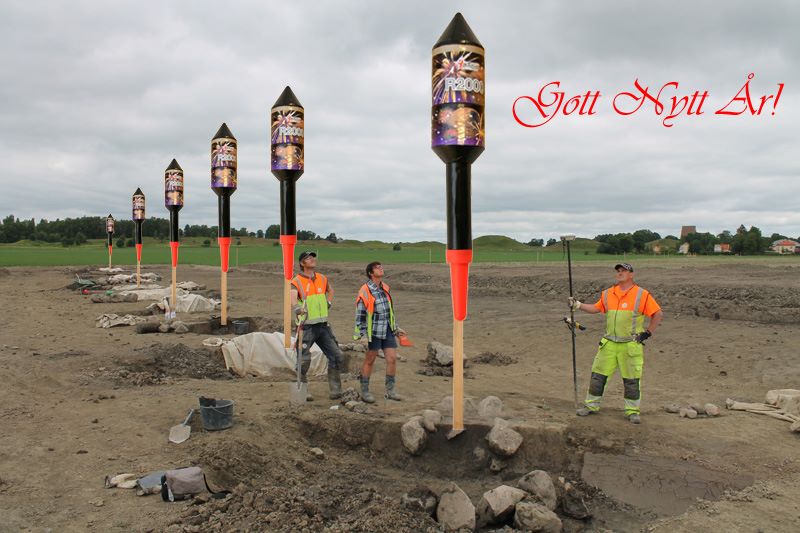
Obviously we don't know if these were just wooden posts or if they were ornamented; and what purpose they may have had besides being impressive. (fireworks displays have been suggested.. but not seriously) They could have been wooden statues/idols, even. Wooden god idols are a well-known thing from pre-Christian Scandinavian religion, both in Viking Age sources and later Saga literature. Wooden posts - of some kind - were also erected in outdoor cult sites/sanctuaries (ví), although not in straight lines then. There was also a fence around them (for which the term viband) has been coined, but the post-holes from that were far more tightlly spaced. It's unclear whether these various posts had anything to do with each other though.
But this is not the only set of such post holes on a kind of processional route; a similar but far smaller row of post holes at excavations at Anundshög, another major cult site and þing-place and a road of political significance even after the Viking Age. The possibility of these being a viband has been raised as well (report) as they're more tightly spaced, but the 'processional route' option seems more likely as they do not enclose the site but rather run in a straight line parallel to the road, as in Old Uppsala.
(If anyone happens to be in Sweden, it's national Archaeology Day on August 30th and one of he places they'll be having events is at a dig in the aforementioned Biskoptuna, where at least one of the main people involved in the 2012-2013 digs in Old Uppsala is working. So you can ask questions in person.)