I just read Robert Forczyk's Case White about the invasion of Poland, he devotes a couple of paragraphs to the Polish annexation of the Czech territories of Zaolzie in 1938. Writing that since the Czech's hadn't stood up to the Germans, it made sense for the Poles to act while they had the opportunity.
I'm curious about Polish/Czech relationship before and after Munic, and if there was ever any exploration of a defence pact against German or the USSR?
I’m going to break my answer into three four sections. Hopefully I will have sketched a suitable answer to your question by the end. My background is largely on Czechoslovakia so I will tell the story somewhat from the Czechoslovak point of view. This is not because I have a (conscious) bias against the Polish position on this, it is just what I know better.
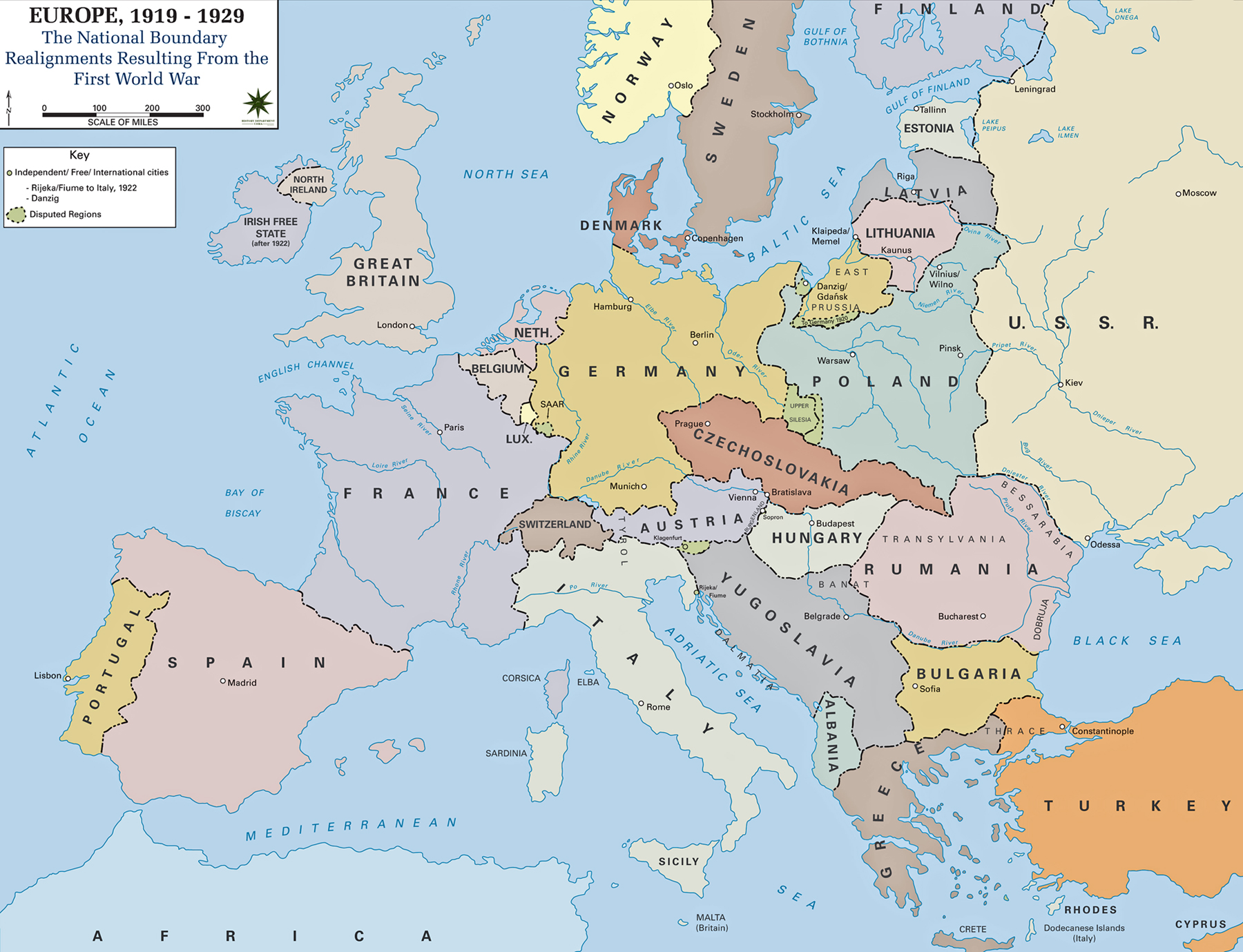
To understand Czechoslovak-Polish relations in the Interwar period, we need to provide some context and talk about just how chaotic the Interwar period itself was. The First Czechoslovak Republic (ČSR) and the Second Polish Republic (Poland) were among the collection of new states that emerged after WWI out of the collapsing German, Russian, and Austrian empires. I say “collection of new states” because it is difficult to give a concrete number. The typical map of the Interwar period looks something like this and shows roughly 9 new states with clean borders. What a clean Polish border in 1919!
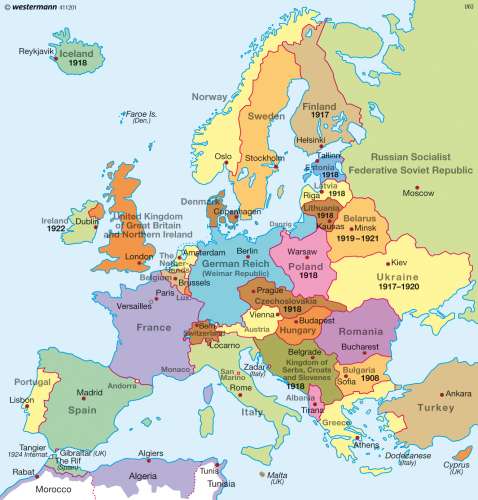
But wait! The map could also look more like this one, which includes some short-lived breakaway states and territorial gains (looking at you, Greek Izmir). But even that doesn’t capture just how absolutely bonkers the late 1910s/early 1920s was in Central and Eastern Europe. If you’re interested, you might want to look at this atlas starting with this late 1918 map and click forward through a few. How could any one map show the absolute chaos that took place? Who could include Banat, the Republic of German-Austria, the Kingdom of Croats, Slovenes, and Serbs and Serbia, Béla Kun’s Hungary, and all the different Ukraines on one map?
If you’re still looking at those maps, note that these changes all take place before the Treaties of Versailles, Saint Germain, and Trianon were signed. This was a messy breakup. Rather than creating these new states, the internationally acknowledged interwar borders more often reflected and codified the situation on the ground. However, these states didn’t arise from nothing. In the case of Czechoslovakia, the seeds of this state were sown in wartime negotiations, primarily with the Austrians, local Czech actors, future president of Czechoslovakia Tomáš Masaryk, and US president Woodrow Wilson.
The declaration of independence by the Czechoslovak National Committee in October 1918 is too complicated to really deal with here, but it is enough to say that it happened spontaneously in the area immediately around Prague. It was understood (to different degrees by everyone involved) that there would be a new joint Czech and Slovak state after the war. Based on this understanding, Committee Czechoslovakia quickly began to expand to encompass the historic Bohemian Crownlands (Bohemia, Moravia, Silesia) as well as Slovakia. For its part, Slovakia had declared independence from Hungary in October on its own accord and signaled willingness to join with the Czechs and build a common state. But there was a problem. Hungary still controlled Slovakia. So the ČSR National Committee began to organize an invasion of Slovakia in November, 1918. This is also when the ČSR-Polish conflict over Zaolzie begins.
Note: Těšín and Cieszyn are the respective Czech and Polish names for the same place. I will use both to avoid confusion.
The Second Polish Republic entered the picture as a unified state under Józef Piłsudski, who took control over the local puppet government set up by the Germans in November, 1918. It was understood that a new Polish state would exist, but the exact borders were debated. To grossly oversimplify, the two main competing visions for the new Poland were either a state between the Elbe and Vistula watersheds where primarily ethnically Polish people lived, or one based on the borders of the Polish-Lithuanian Commonwealth that included significant non-Polish populations. Under Piłsudski, Poland actively pursued both. This would famously lead to not only wars in the east over Ukraine and Belarus, but also a less well known conflict with Czechoslovakia.
Remember that understanding in Prague that Czechoslovakia’s borders would include the whole Bohemian Crownlands? Well that historic border included the Duchy of Těšín/Cieszyn, which was majority Polish and for that reason claimed by Poland. Perhaps most importantly, Těšín/Cieszyn also had the distinction of being a highly industrialized area with an important coal deposit and steel works that both sides wanted to control. Committee Czechoslovakia was especially interested in the region because the only railway to eastern Slovakia ran through it, which was strategically vital for the invasion of Hungarian-controlled Slovakia that the Czechoslovak National Committee was planning for early 1919. There was also concern in Czechoslovakia that acknowledging Poland’s claim to majority-Polish regions would threaten the multi-ethnic Czechoslovak state’s control over other disputed borderlands, such as the majority-German Sudetenland.
In October 1918, competing Polish and Czech national councils had established themselves in Těšín/Cieszyn. The two councils came to an agreement on November 5th that divided the region between themselves, with the Polish council in control of most of the region. It was not uncommon for local agreements like this to be made without involvement from the central authorities, with the understanding that the disputed areas would be resolved later by plebiscite. As troops from new governments across Europe began to occupy their new borderlands, skirmishes occasionally broke out over the many disputed regions. One of these skirmishes took place in Těšín/Cieszyn in late January, 1919 when Czechoslovak troops invaded the Polish side over a breach of the November 5th agreement by Polish authorities. There is a map of the conflict here for those who might be curious. The Entente intervened after a week and in early February a new border was drawn along the Ozla River as part of the Spa Conference. This border agreement, with some adjustments made in 1924, is what created Zaolzie (the lands over the Ozla).
At the risk of sounding cliche, the 1920/4 border agreement was a classic compromise that satisfied nobody. The tension this agreement created was one reason that Poland and Czechoslovakia were unable to form an alliance before or after Munich. Despite that, there were politicians in Czechoslovakia and Poland who wanted to align or even federate the new states. For example, the Polish leader Józef Piłsudski’s Międzymorze project sought to unify all the new states ‘between the seas’ against the Soviet Union. There were some politicians in Interwar Czechoslovakia actively promoting ideas similar to what Piłsudski had in mind, most notably Milan Hodža. Hodža was unsuccessful for a few reasons, but it can be argued that the most important reason is that he was Slovak. While Czechoslovakia was ostensibly a multi-ethnic nation, it was completely dominated from Prague by the Czechs, who were on the whole less interested in a Central European Confederation.
There were also longer, historical reasons that prevented Czech and Polish nationalists from aligning against common enemies. Czech and Polish national identities were both popularized in the 19th century while the regions were controlled by the Austrian and Russian empires. Because of this, resistance toward those empires became fundamental parts of their national identities; Czech against Austria, Polish against Russia. Since Russia and Austria were rivals at that point and the enemy of my enemy is my friend, Czech nationalists looked to Russia for their best chance at independence. These pro-Russian and panslavic leanings of Czech nationalists made it difficult to join in alliance with Poland. On the other hand, Polish nationalists were much too comfortable with Vienna and hostile to Moscow for the Czechs’ liking.
This dynamic continued into the Interwar, particularly in the Czechoslovak government’s willingness to work with anyone so long as it was in the new ČSR’s interests, including the Soviet Union. Foreign Minister Edvard Beneš and President Tomáš Masaryk both expressed interest in alliances with anyone, but not those that risked dragging ČSR into a foreign war. The primary geopolitical concern for Poland was their precarious position next to the Soviet Union. For Czechoslovakia, an alliance with Poland posed too great a risk of a war they had no interest in. In Poland, there was division on who posed the greatest threat in the early 1920s, the USSR or Germany. The more conservative factions thought it was the Soviet Union and looked to Hungary for an alliance, while the liberal democrats thought Germany posed that threat and were willing to try and work past their resentment toward Czechoslovakia in common defense.
One last thing I should mention is that France was also interested in forming a unified Central European bloc to protect the independence of the new states. This materialized as the French-backed Little Entente of Czechoslovakia, Yugoslavia and Romania. There were some agreements made in an attempt to bring Poland on board, culminating at the Genoa Conference in 1922. Despite this agreement, the internal divisions within Poland meant the agreement was undermined from the start and did not last.