I hope some of my previous answers might answer OP's question, though I'm willing to write some follow-ups here (so please don't hesitate to ask further in detail):
The most evident example that changed the society of the Vikings on their homeland was Christianity, associated with Latin alphabets. Contrary to a common assumption, as I wrote in this previous comment, several 'Viking' kings in the 11th century who led a multitude of his fleet to conquer England, such as Cnut the Great (see this illustration) and King Harald Hardrada of Norway, together with the majority of their warriors, were in fact Christians. The three medieval Scandinavian kingdoms (possibly except for Sweden - the final unification of its provinces would take much time until the 12th and 13th centuries), with the coinage system as well as a larger scale of naval levy, were essentially creation of later Viking Age around the millennium, modeled after European (especially Anglo-Saxon) rulers.
The famous Old Norse religion (The religion of the Vikings) could be changed in course of the Viking Age due to the cultural contacts with Christianity. While modern scholars had traditionally debated the possible Christian influence on the extant text of Old Norse myth, such as Ragnarök, since the 19th century, an increasing number of recent studies now tend to consider 'Old Norse religion' not as a fossilized set of myths, but rather as a fluid set of beliefs without 'a canon', and emphasize the chronological change/ development of such beliefs in response to the possible exposure to a new Christian idea of the supernatural being(s). In other words, some (well-known) beliefs of Old Norse deities could be re-vitalized or newly developed as a result of such a cultural interaction with Christianity (Steinsland). To give an example, Abram points out the the famous God Þórr (Thor) became more friendly and helpful in the sources from the last decades of the first millennium, much like Jesus (Abram 2010: 149-57).
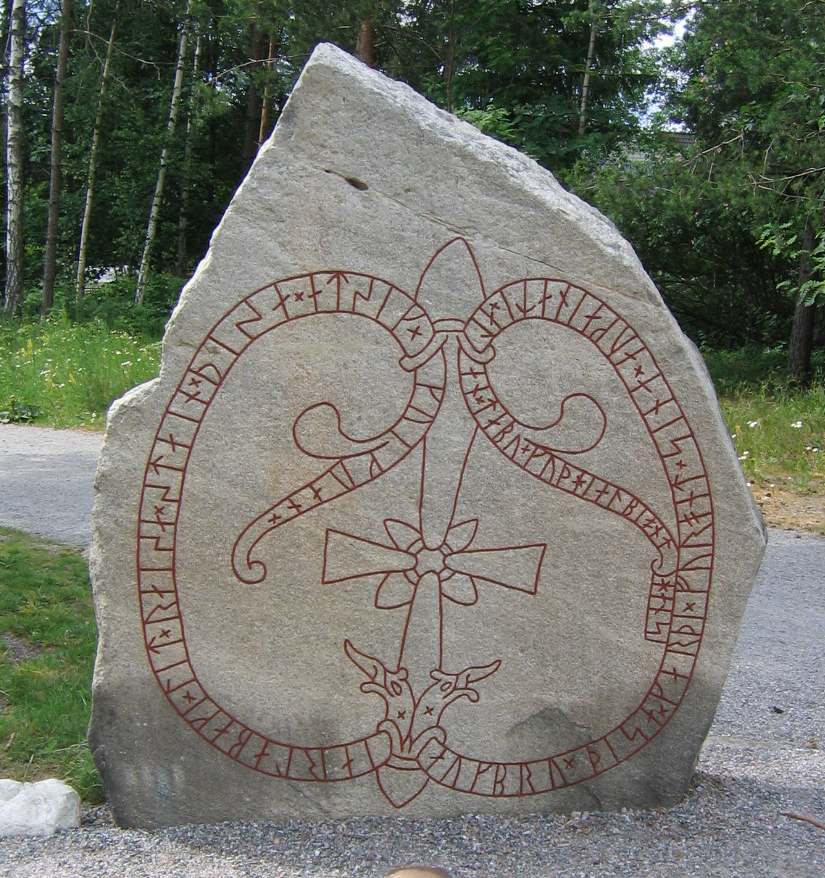
I'd further argue that rune stones can be also regarded as products of increasing cultural interaction, especially with Christianity. it is true that the Scandinavians had invented runic alphabets long before the Viking Age, based on Latin alphabets and had a long tradition of erecting the runic stone, but the vast majority of the extant runic stones came from the late 10th and the 11th centuries, the conversion period in many parts of Scandinavia. Many of these runic stones from that period have explicitly Christian elements, as we can easily see in the iconography as well as the text of this rune stone (U164: middle of the 11th century) found in Central Sweden. The rough English translation of the runic inscription is as following: 'Jarlabanki let this stone erected while he is still alive.....and also a bridge built....for his soul. He alone own all of Täby [i.e. he was probably a local magnate who rule Täby district.] May the God help his soul'. It is suggested that an increasing number of local magnates, especially converted ones, commissioned to erect this kind of the runic stone memorial to ascertain their continuing presence within the local community across Scandinavia in the period of religious as well as political transition around the first millennium (B. Sawyer).
Additional References: