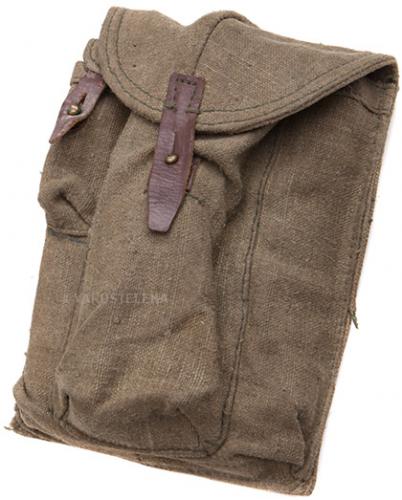
As is perhaps the case with many internet discussions of the Soviet military, this claim is a true fact wrapped up in a gauzy myth. I am not going to go into too much detail here, as a full breakdown of the evolution of Soviet load carriage and squad/platoon-level doctrine from 1945-1991 is going to be really complicated and rather dry. For our purposes we can say that for the majority of the Cold War (Afghanistan notwithstanding) the doctrinal ammunition load for a Soviet motor rifleman was indeed 3 spare magazines in addition to the one loaded in the rifle, to be carried on one's belt-and-suspender type webgear in a pouch looking something like this. This seems like a rather low amount, when one considers that a modern American rifleman may go into battle with 6, 8, or perhaps even 14 magazines. But in the context of the times it is not exceptional. If you look at the fighting loads carried by Western forces during most of the Cold War it's not far off. For instance: a 1950s Belgian manual has each rifleman carrying 3 magazines for his FAL, with 200 rounds of total ammunition carriage (some of this would be carried in stripper clips in a bandolier or the rucksack). The Swiss, at around the same time, carried a doctrinal load of 120 rounds per Stgw.57 automatic rifle (though the Swiss are weird, they didn't issue a separate machine gun and just used the squad's automatic rifle firepower instead, plus lots of rifle grenades). What I have found for American troops fielding the M14 is similar - it seems to be anywhere from 80 to 180, with the higher end numbers coming mostly from Vietnam.
Now, it must be noted that 80-200 rounds of 7.62x51mm NATO ammunition vice 120 rounds of lighter and shorter-ranged 7.62x39 Soviet ammunition still seems like a rather svelte fighting load for the Soviet rifleman (боекомплект or б/k for short is the Russian term of art for a ‘combat load' of ammunition, by the way). And this is quite true. However, unlike their NATO counterparts, by the end of the 1960s the Soviet Army had gone over almost entirely to a mechanized force structure. Every Soviet rifleman outside of specialized units like the VDV (paratroopers), MorPeh (naval infantry), and the various 'Spetsnaz' units was a motorized rifleman. In the 1950s, this meant being clown-car'd into an uncomfortable wheeled contraption like a BTR-152; from the mid-60s, this meant a slightly less uncomfortable and slightly more well-armored tracked vehicle like a BMP. In either case, though, two key assumptions held, which serve to explain the seemingly-low ammunition allotments for the motor rifle troops:
As an aside, I have seem some documentation to suggest that as the Soviets transitioned from the AKM to the AK74 with its lighter 5.45mm cartridge, the doctrinal ammunition loads increased. A 1975 paratrooper table of organization and equipment mandates 300 total 7.62 rounds carried for the AKM vice 450 total 5.45 rounds for the AK74. And of course load carriage in Afghanistan was its own beast. But, in summary: Yes, the Soviets really did only expect their riflemen to carry 3 spare magazines, but it was not based on an expectation of short combat lifespans; rather, a doctrinal logic of how the motor rifle squad was expected to fight.
I can provide specific sources upon request. Thanks must of course be given to /u/thom430, whose repository of primary source equipment and organization charts for both the Soviets and their Cold War adversaries is exceeded only by his generosity in sharing.