In a way, yes. In a funny turn, northern states - which had factions debating forming a new nation loyal to Great Britain in the early 1800s to escape the southern and western states and the Dem-Republicans in them - started to pass "Personal Liberty Laws" that did things like stipulated what legal avenue must be taken to return runaways. The states had passed laws essentially violating federal law (by restricting federal authority) because they didn't like the law. In fact some liberty laws actually predate the Constitution. And when I say northern states, I mean just about all of 'em. Between the 1780s and the late 1850s, the following states passed at least one liberty law (most had several): Maine, Massachusetts, Connecticut, Vermont, Rhode Island, New Hampshire, New York, New Jersey, Pennsylvania, Ohio, Illinois, Indiana, Michigan, and Wisconsin.
A well known example and extremely important case is that of Prigg v Pennsylvania. Edward Prigg and some associates had tracked down several escaped folks - a woman named Margaret Morgan and her children (she was likely free anyway) - and returned them to Maryland to her previous estate (where they were immediately sold and sent further south), but the men had not gained the permission of the Commonwealth of Pennsylvania, or an agent thereof, to remove her from Pennsylvania. The 1826 law titled An act to give effect to the provisions of the constitution of the United States relative to fugitives from labor, for the protection of free people of color, and prevent kidnapping. directly stated they must, else it was kidnapping. Prigg was subsequently convicted. Before long the case was in front of our Supreme Court. In a decision in early 1842 the court sided with Prigg (with one Justice dissenting) - a state could not interfere with federal recovery efforts or set barriers to agents removing escaped persons.
States quickly went to work rewriting their liberty laws. The court had said they couldn't interfere but said nothing about not assisting, so the new laws prohibited any state agent or resource being used to capture, track, imprison, or return anyone for the purpose of "slave catching" - even those who were known to be runaways. As you can guess, southern politicians flipped out. Soon an agreement was reached that would handle western expansion, better define the power of the fugitive slave act, and eliminate the D.C. slave market; we call it the Compromise of 1850. In a true compromise, nobody was happy.
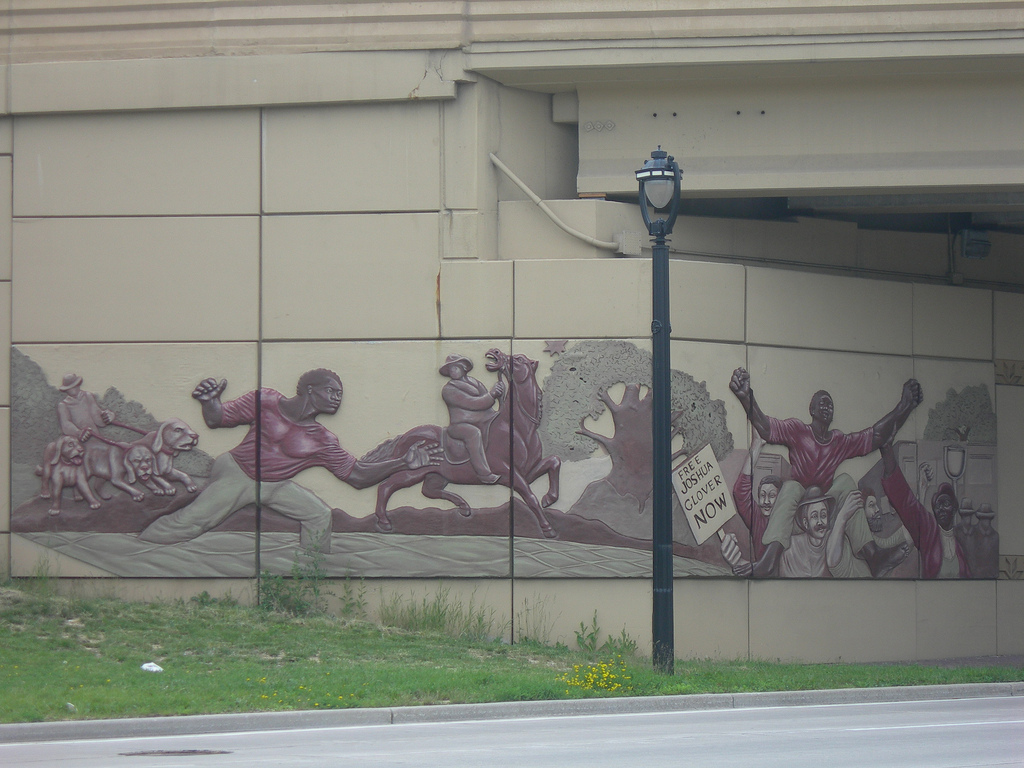
Soon after, a great specific example took place. In 1852 a man named Joshua Glover escaped from St Louis and made his way to Racine, Wisconsin where he began working at a sawmill. On March 10, 1854, 7 men - two federal agents, Bennami Garland (the "owner"), and four others - busted into a cabin where Glover was playing cards and (violently) arrested him. Fearful Racine would not be a safe place to hold him, he was taken to Milwaukee instead. As they were awaiting the federal court permitting his removal, a local man named Sherman Booth, owner/editor of the Wisconsin Free Democrat, heard and petitioned the court to free Glover. His petitions were denied, but a large group had traveled from Racine in the mean time and increased its numbers with Milwaukee abolitionists upon arrival. More locals came to the court house after learning of the unfolding drama. Soon US Marshall Stephen Ableman, the one detaining Glover, was faced down by several thousand people at Milwaukee's jail. The mob went into the jail and - in a scene that would repeat itself hundreds of times over the next 100 years - a large group of (mostly) angry white people forcibly removed a black man from a jail cell. Unlike nearly all other times that happened, though, it was to protect Glover. He was quickly sent to Waukesha, and soon found himself aboard a boat bound for Canada. He would make it and remain a free man for the rest of his life.
For Booth, however, the trouble had just begun. He was arrested by Ableman for aiding and abetting an escaped slave, something even normal citizens could be punished for under the 1850 update to the federal law. Wisconsin's courts immediately issued a writ freeing him, so he was released. Again, they arrested him and Ableman appealed to the Wisconsin Supreme Court. They ruled the Fugitive Slave Act itself was unconstitutional and - of all claims to make by a northern state at the dawn of the civil war - claimed it violated states' sovereign rights (this really is a true story, I promise!). This case made it all the way to SCOTUS as well, being decided in 1859. Again the court would say any agent acting under federal authority had the right under the Act to recover escaped people, but it really didnt matter at this point. Wisconsin basically ignored the ruling. War had all but started and no court decision would stop it at that point. For Booth, though, it wasnt over. He was again arrested and locked in a federal building in Milwaukee to keep Wisconsin courts out of it. Several attempts later he was succesfully busted out and spent a week free before being arrested again - this time while giving a speech (not the smartest fugitive thing to do). Eventually he was freed and slipped away into history (he was also heavily involved in creating the Republican Party, particularly in Wisconsin).
Joshua Glover's influence can still be seen today in [two murals] (https://emke.uwm.edu/wp-content/uploads/2018/06/5919752521_0e228c86d7_b.jpg) dedicated to his story painted in Wisconsin, one image showing him being pursued by dogs and catchers, the other showing him hoisted on the shoulders of the abolitionists, both white and black, that refused to accept the legal reality that he was not free.
E for link and typo