Both parts of your question have been answered before. I'll link to past answers, and expand a little on the first part of the question.
The second part is easy: people first started using wagons and carts about 3500BC, in some parts of the world. In other places, even though the wheel was known, it wasn't widely used for transport.
For more on the invention of the wheel, see
As for the first part, pack animals (and human porters) are still in use. Pack animals (and human porters) have three important advantages over carts and wagons: they are more maneuverable in crowded urban environments, they can cope with much rougher terrain and aren't dependent on roads, and are more efficient for carrying small light loads. The cart and wagon have the important advantage of being able to carry heavier loads. Thus, the best form of transport depends on what needs to be moved, and where. Indeed, in some places (notably, much of Central Asia and the Middle East, pack animals largely replaced carts and wagons when the camel was available).
For some past answers on this, on the hidden costs of wheeled vehicles - road building and maintenance - and the relative merits of pack animals vs wheeled vehicles, see:
https://www.reddit.com/r/AskHistorians/comments/ihxl2o/why_was_the_wheel_invented_so_late_in_human/
u/Chamboz and myself in https://www.reddit.com/r/AskHistorians/comments/e2locu/why_was_wheeled_transport_replaced_by_animals_in/
To expand on those answers, pack animals and porters are sufficiently competitive not just with carts and wagons, but also with motorised transport, in some circumstances. The road-independence of pack animals has led to their use in large numbers in warfare as recently as World War 2:
Mules carrying artillery shells in WW1; each shell (assuming for an 18-pounder gun) weighs about 10kg, so each mule is carrying 80kg of shells: https://i.pinimg.com/564x/8e/ec/d1/8eecd12e09063b686a70097ec117b35d.jpg
Mule ambulance in WW2, in Italy in 1944: https://i.pinimg.com/564x/5d/05/51/5d055192e503901a6760ed3bd4ca6ee0.jpg (see https://www.iwm.org.uk/collections/item/object/205222092 for further details)
Pack mules in Burma in WW2: https://i.pinimg.com/564x/05/3b/5a/053b5a63c936ff40df8e1e1ad11ab3d6.jpg
US Marine Corps mules at the Marine Corps Mountain Training Center (MWTC), 2012: https://i.pinimg.com/564x/9c/b2/66/9cb2663fc2f64023d7afdee2a0e83c1b.jpg
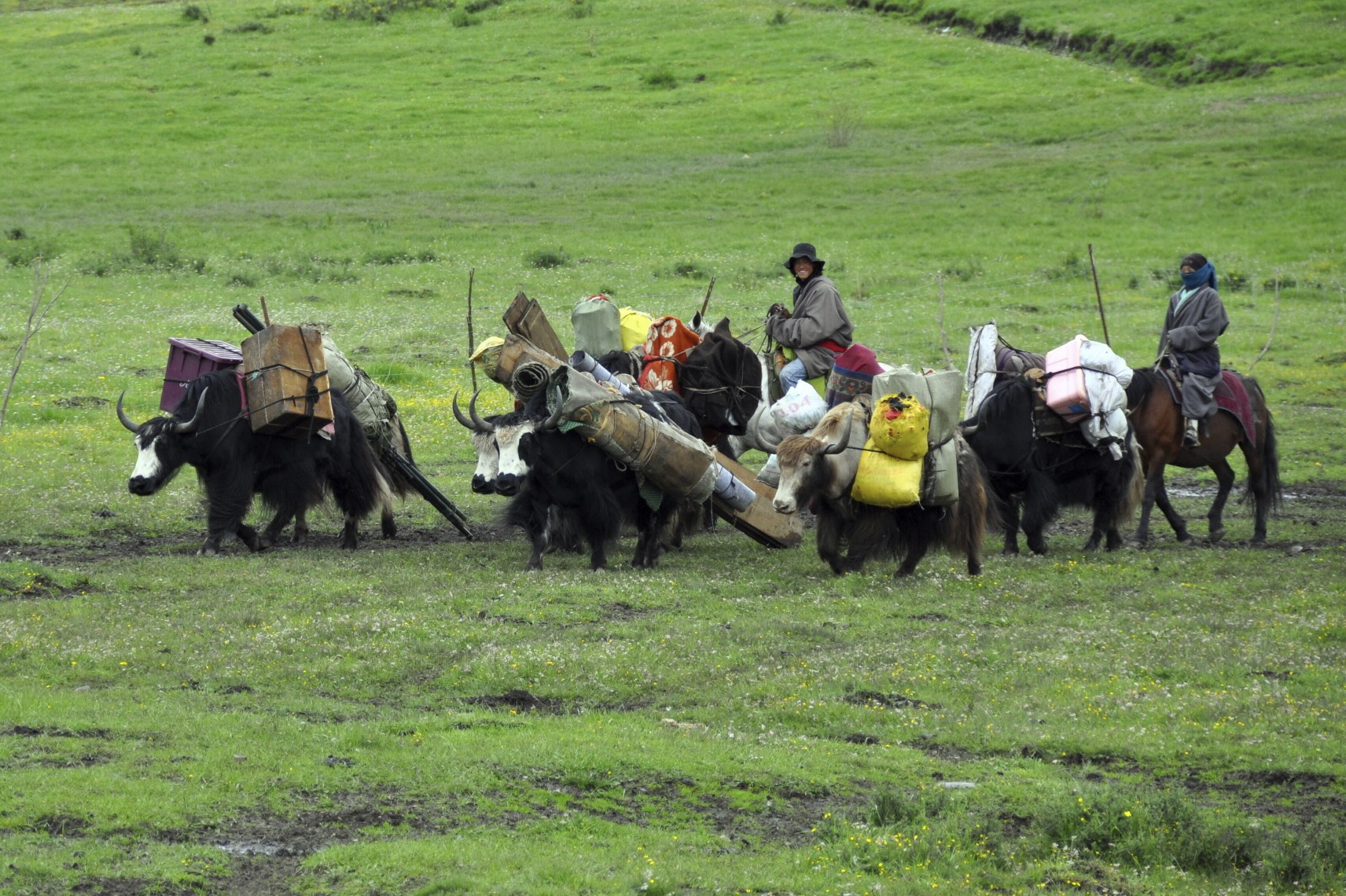
Pack animals are still used in civilian contexts where roads are poor and/or motorised transport is too expensive, sometimes alongside wheeled vehicles (with the heavy loads carried in wagons or carts, and light loads on pack animals):
Tibetan nomads in northern Sichuan, with pack yaks: http://www.thelandofsnows.com/wp-content/uploads/2012/02/CSC_0142.jpg
Pack camels in Mongolia: https://mapio.net/images-p/61025057.jpg
Pack camels in Chad: https://commons.wikimedia.org/wiki/File:Caravane_des_nomades6.jpg
Pack animals in difficult terrain, Mongolia: https://youtu.be/JvMoeYqw7N0?t=48
Human porters still work in places, perhaps most famously in Istanbul:
where many streets are very unfriendly to wheeled vehicles (note the stairs, a serious obstacle to wheeled vehicles and Daleks). Yes, that's a statue commemorating porters. The porters can earn more than the average household income, typically earning from about the legally-prescribed minimum salary to about 50% more than that, averaging about 25% more.