I thought this was weird. The way history goes it’s almost as if Europeans and Africans met for the first time during the age of exploration and colonization, but there were interactions between Rome and North Africa during the Roman period. Greece knew of places beyond Egypt and had 2 other categories for them, one for North Africa and another for everywhere else.
Black Romans were definitely around. What happened to the population after Rome fell? Did they simply dissolve into Europe’s gene pool, did they flee to another continent?
Black comes in many shades, like white. Was it just Europeans interacting with a different “Type” of black than they did 1,000 years later? Same way the British and Germans are distinguishable?
Could the Renaissance period have also skewed Europe’s perception of the ancient world? I’d guess it’s understandable having made all subjects including Jesus in Renaissance art white if they weren’t aware of the racial makeup of civilization 2,000 years ago, or didn’t see a point in it. Most of Egypt in Renaissance art before Greek and Roman conquests is depicted white, instead of Arab or black or whatever else it could’ve been.
I can talk about the later Middle Ages!
In 1414-1418, the western Church held the Council of Constance to end that time when they had three popes. In 1441, the Council of Florence tried to reunite the western (pre-Catholic) and eastern (pre-Orthodox) Church(es). There were Ethiopian monks present at both councils.
There was also that time in 1407 when a Spanish (Aragonese) man went to Ethiopia and ended up its ambassador to India and China.
The western Christian crusaders and colonists in the crusader states encountered a reasonably-sized Ethiopian presence there, and probably in Alexandria as well.
I don't want to oversell the scale of these connections (except for the part where Rome gave the Ethiopian Orthodox Church a church in Rome, and then a better one. Or when Aragon and Ethiopia tried to negotiate a marriage alliance, but their messengers kept disappearing/dying en route.) The prevalence of monks among the Ethiopians in 14th-15th century western Europe suggests the community depended on immigrants instead of being self-sustaining.
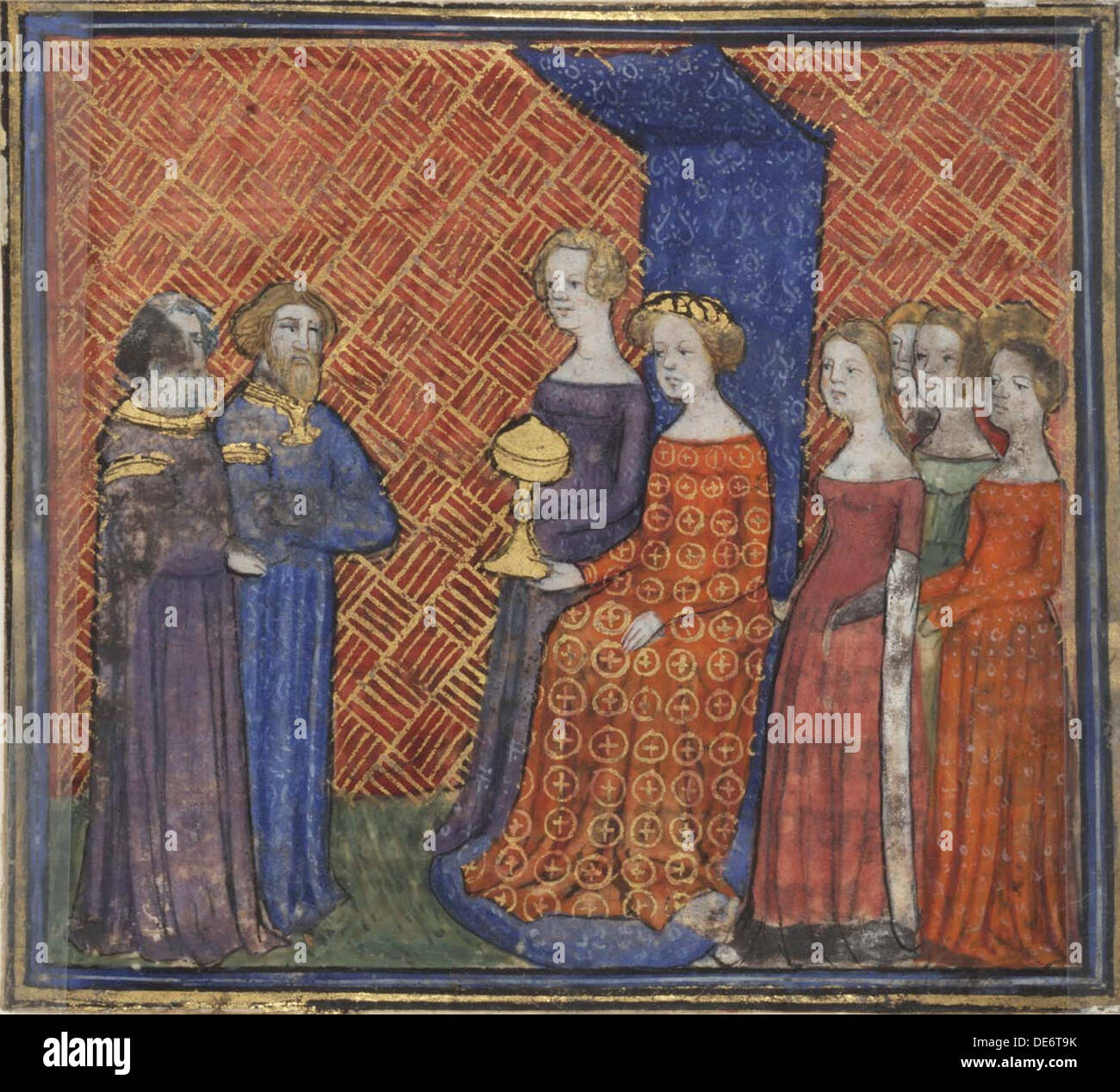
And even so, the connection between skin color and geographic/ethnic/family origin was…loose. Stealing directly from an earlier answer of mine: here's a 15th century Queen of Sheba. Here's a 15th century Queen of Sheba. Here's a 15th century Queen of Sheba. Here's one from right around the turn of the 16th. Heck, here's one from the 18th century..
Why should that surprise us? A person of any color in medieval Spain or medieval France was...a Castilian or a French person, right?
[New again] Still there's plenty of evidence for both (a) people with skin tones possibly all over the spectrum in medieval Europe--i.e. Europeans (b) that direct evidence is NOT comprehensive, at ALL.
One of the most intriguing and perplexing sets of art in the whole Middle Ages comes from thirteenth-century Magdeburg in Germany. Sometime between 1220 and 1250, an unknown person patronized, and an unknown artist(s) created, a statue of the church's main saint--who looks like our stereotype of a sub-Saharan African, in terms of facial features and hair. St. Maurice shows up in stained glass as black at that time. But...not elsewhere. That only starts later.
So this is really important because first of all, Maurice wasn't a new fictional hero of the romances (where skin color was—suffice to say that the son of a Muslim and a Christian could have spotted skin). He was a Christian, a hero, and a saint. But also--where did the sculpture and its model come from? The German St. Maurices are an island in western Christian depictions of skin color that are as just as ideological as the attention this question is getting. ;)
In most art and literature, we are NOT dealing with nuances of color. [Stealing again] In romance literature, 'Saracen' characters sometimes have their skin change from black to "white as milk" when they convert from Islam to Christianity (Cursor mundi, 14th century). In the most famous German take on Arthuriana, Parzival, Feirefiz has a Muslim parent and a Christian parent, and...is spotted. The Estoria de Espana blasts the conquering Saracens:
Their faces were black as pitch, the most handsome among them was black as a kettle, their eyes shone like candles
and the Song of Roland says about Saracen character Abisme that he is "black as pitch," with the archbishop wishing, "This Saracen seems quite heretical; it would be much better if I were to kill him."
You'll notice a pattern here: dark skin, in medieval writing, is associated much more closely with Islam than with Africa, much less Ethiopia. By the 14th century, Latin Europeans looked to Ethiopia to save them from Muslims.
...So now after my chunk of not-self-plagiarism, let's talk about some of the evolution of all that. Also a very hot topic in medieval right now. :)
First, of course, there's the issue that late medieval artists really did not care about an "accurate" mental image of the Roman Empire or really any earlier era. In the Exodus story (Moses, parting the Red Sea, &c), “Pharo” is depicted living in a very late medieval European-style castle. They weren’t going for historical accuracy.
More to the point is that skin color—and the absolute polarity of it—is as ideological then as today. And as you have guessed, it has become moral. “White” signifies good; “black” signifies bad; it doesn’t matter what skin color people actually are.
So yes, there was an African and African-European population in later medieval Europe. It just didn’t always metaphorically or ideologically look like what we might think. ;)
~~
This is a hot topic in medieval scholarship right now, so nothing I say will be the final word. (I have some things in earlier answers that at some point I should go back and delete...Oops.)
instead of Arab
I know your question is about Africa, but based on this I figure you might be interested in the Arab part of this as well. /u/sunagainstgold mentioned the association of dark skin with Islam in the medieval period, but we have evidence of the pre-Islamic Arab presence in Italy as well.
Before the emergence of the Arabic script, Arabs in the area of what is now Jordan wrote what in many cases is still almost 2000 years later intelligible as Arabic in a script called Safaitic.
The script itself is entirely unrelated to Arabic script, but for those who can read Safaitic aloud or transcribe it into Arabic, it is often almost shockingly clear (or close enough).
In any event, this comes back to your (entirely correct) intuition that there were Arabs in Rome prior to the age of discovery. We know this because archaeologists have found Safaitic inscriptions (graffiti, essentially) in Pompeii, likely put there by Arab soldiers in the Roman Army.
As to what "happened" to them, I don't think it's really possible to say except to talk about the nature of population exchanges between Europe and Arabia over the course of the next ~1000 or so years. "Population exchange" basically being a euphemism for various forms of invasion, rape, and slavery in the Mediterranean World.
On invasion, the periphery of Europe didn't just encounter Arabs, it was conquered by them, notably in Spain and Sicily, but with raids into southern France and the Italian mainland.
Slavery, though not a speciality of mine is also a critical part of the dynamic. One of the reasons why I suspect this impression exists is that while (by my understanding) the classical Roman slave trade brought slaves into the Roman Empire/Italy, by the early medieval period Europe was effectively so comparatively poor that human beings were overwhelmingly being sold south as Europeans were sold into slavery from Christendom into Islamdom. African slaves were unlikely to cross the Mediterranean when the price for slaves was so much higher in, say, Egypt, than in Italy.
Sourcewise, this last aspect is very well-detailed in Michael McCormick's Origins of the European Economy: Communications and Commerce AD300-900.
On Safaitic, there was an excellent article on this in the New Yorker a couple years ago profiling one of the few specialists in the world on this here.
A lot of people answered you on most of the question, I am here just to note that north african people were quite similar to mediterranean’s ones (the italians today, whom genetics is really similar to the ancient romans’ one). That’s because the Sahara was a formidable barrier, both geographically and genetically. Their population changed after the arabian invasion in VII century. Roman expeditions ahead were occasional, so black people were really something unusual in the “Urbs”.
You can find some scientific papers on this matter, but it isn’t really an unresolved topic, so don’t expect too much :)