I've been looking around for an answer to this question but I just can't find it. I can't even find information stating that they actually went both ways: with current and up current.
This question came into my head, while I was at the banks of the Danube in Austria near Durnstein, watching the current and watching mechanical engine powered vessels struggling with going up the current; I was thinking how did they pull this off 500 years ago?
I assume traffic went both ways, since all the cities along the river prospered on the trade.
Since you are asking about rivers in modern-day Germany, I can answer regarding that. In short: ships were pulled up river by horses or human power. This is a very ancient method of moving goods that dates back to antiquity, as a single donkey could pull a simple leather round-boat with 2000kg cargo up the Euphrates to Babylon.
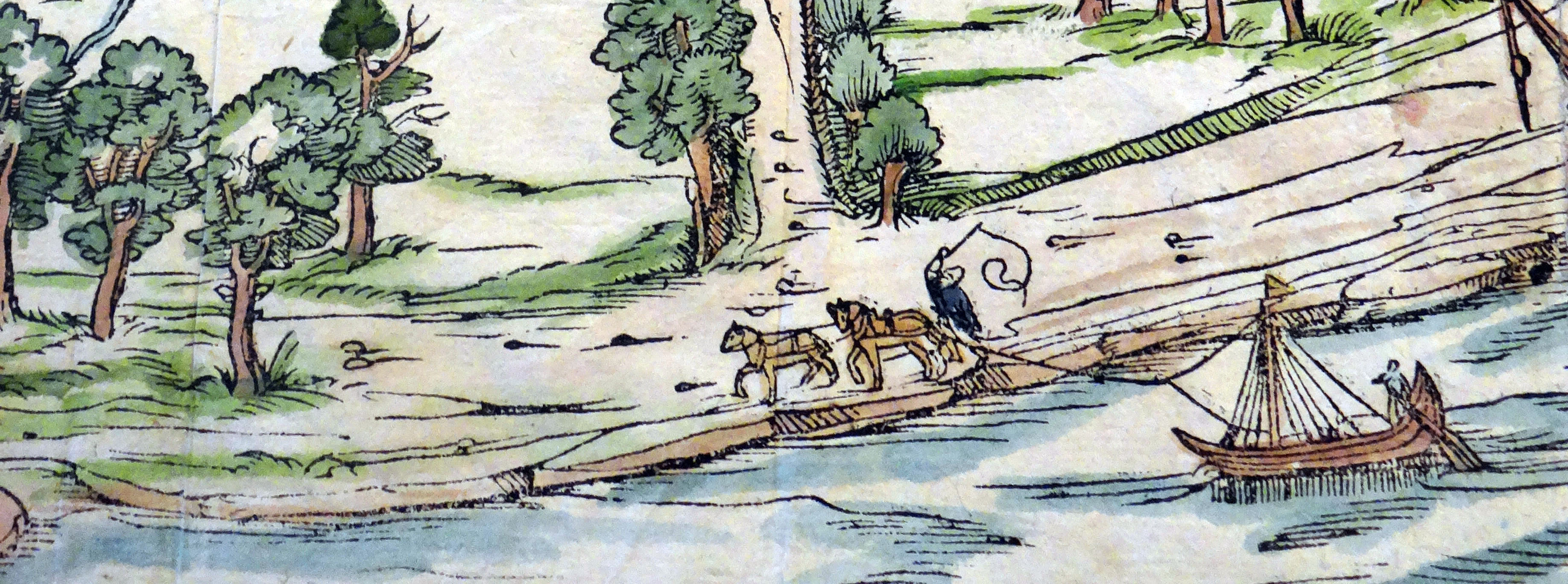
In fact there is a lot of vocabulary regarding this in German: to pull the ship is called treideln, but also halferei or bomätschen (in Saxon). You can find good images of this on Wikipedia, for example here or here. Whatever the source of power, they simply drug the barges up the river on a path called the Towpath (in English) or the Leinpfad (among other words in German), which could be anything from a cleared area on the banks to a more developed path. Generally this area was blocked off from use by other traffic, for example on the Rhine, a path was built on the left (facing upriver) side which was for use only to pull barges. One horse or a few people could pull a smaller barge. 4 horses were needed for an Oberländer, a common barge type of the 16th C. which you can see here, and up to 40 (Rhine) or 60 (Danube) horses could be brought into service to pull chains of ~6 barges. Horses could be owned by the skipper or hired for specific stretches, and we see a lot of arguments regarding this: landowners demanding payment for crossing their stretches of the bank, farmers claiming that the overworked horses pulling the barges would make their animals sick, or human barge-pullers worrying that their jobs were taken by horses (in the 18th C. a horse was measured to have 6 or 7 times the power of a human, somewhat less than the modern 10:1 ratio, which can be explained by the smaller size of horses back then).
Along major stretches this process was out-competed by steam/electric-driven barge-pulling systems or by steamships in the mid 19th C. (for example, electrified or steam driven locomotives used in parallel to the canal to pull barges upstream), but there are many examples of animals or people pulling small ships or barges along narrower canals well into the 20th C., and in fact if you are interested there are companies that still do this today for touristic purposes in Germany and the UK (and perhaps elsewhere!), and there is even a Horseboat Society in the UK.
A thick hemp rope would be tied to the mast and attached to a special harness, and the horses generally had to pull in a diagonal direction while the helmsman countersteered to keep the barge in line. This could be very dangerous when weather caused the path to be soft, muddy, or slippery.
If you speak German you can find a rather extensive commentary to a number of images of this process here by Dr. Heinrich Stettner, or for a focus more on the animals here (pdf!) by Dr Helmut Meyer.
Of course this technique was used in many other countries as well, for example the modern day tourist barge in the Netherlands is descended from a more practical form of transit on Trekschuit (sail and horse-drawn tugboats) but someone else could talk about that with more detail.