Hello historians,
I'm doing a research about Ancient Greece military/war and it just make me confusing a lot because Ancient Greece has multi faction instead of a united one. And almost all factions has the same/similar armor like the others. But the most confusing thing is the hair on top of the helmet, is it some king of rank symbol? Like image1, image2, image3. I thought the person on the left side of Image1 is a general or high rank soldier due to his helmet hair look so difference to the other, but then I remember King Leonidas in Sparta wearing the same helmet like his men, so I have no clue. How Ancient Greece can identify the ranking in military?
Best regards.
(Sorry for my bad English, it's not my main language)
No, the horsehair helmet crest did not show a warrior's rank.
In ancient Greece, every warrior had to buy his own equipment. Based on what gear he could afford, he would fight as light infantry (with javelins or a sling), as a hoplite (with spear and shield) or as a horseman. This meant that everyone's equipment was individually made and sold, and each piece was different. What kind of helmet and cuirass a hoplite had depended on his wealth and taste. To some extent this was also true of shields: fully bronze-coated shields would cost more than simple wooden ones with a painted blazon.
In other words, the more elaborate crests were partly a sign of wealth. It was how you knew that a warrior was richer than the rest, because he could afford bigger and flashier helmet decoration. This was not something that only officers were allowed to do, though it is possible that high-ranking officers would deliberately buy fancy armour so that they would be more easily recognised. But this kind of decoration was also meant to impress, to make warriors look intimidating, and big crests were associated with fierce and warlike types (in Aristophanes' comedy Acharnians, the general Lamachus is constantly identified by his triple-crested helmet).
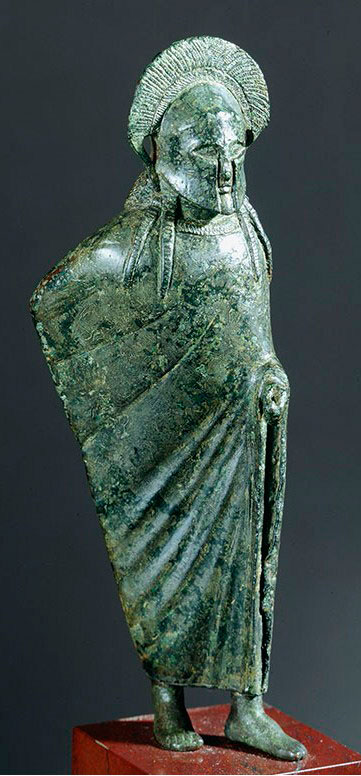
The figure on the left in image 1 is based on this Spartan statuette. Because this is clearly high-class warrior (note his tight cloak and carefully dressed hair, both signs of leisure-class status), many people have assumed that the transverse crest must mark him as an officer. After all, among Roman legionaries, it was usually the centurions that wore transverse crests. But I don't think we have any evidence of such a rule at Sparta. Since Spartans tried to present an outward image of sameness - again, useful to intimidate the enemy - they may not have wanted their officers to wear any different equipment from the rest of the troops. In any case, Sparta was unique among Greek states in actually having very many officers in a detailed chain of command, so if they all wore crests like that, it would simply have meant an entire front rank of men with transverse crests. Not very helpful if you're hoping to be recognised!
In any case, such marks of recognition were probably not necessary. Since most Greek armies were militia armies of ordinary citizens, and most positions of command were elected, the men would know perfectly well what their ranking officers looked like. They were the men they had themselves elected. Each unit would consist of men from its commanding officer's town or district - his own neighbours, relatives and friends. Even if he didn't know all of them personally, there was probably little reason for him to mark himself out with special gear.
The figure in image 3 is not a Classical Greek warrior. His "Thracian" helmet, the design of which is based on the Phrygian cap worn by Thracians, probably marks him out as a Macedonian or other Hellenistic-era infantryman.