Hello all,
As someone who enjoys history and art, I have wondered about the accuracy of the portraits, especially when compared to the modern interpretations of the same figures, particularly in video games. The question may be better illustrated with examples:
This is the first picture that comes up on Google for Masamune Date
https://s3-ap-northeast-1.amazonaws.com/bhive-jp/media/yabai/article/3020/Date_Masamune.jpg
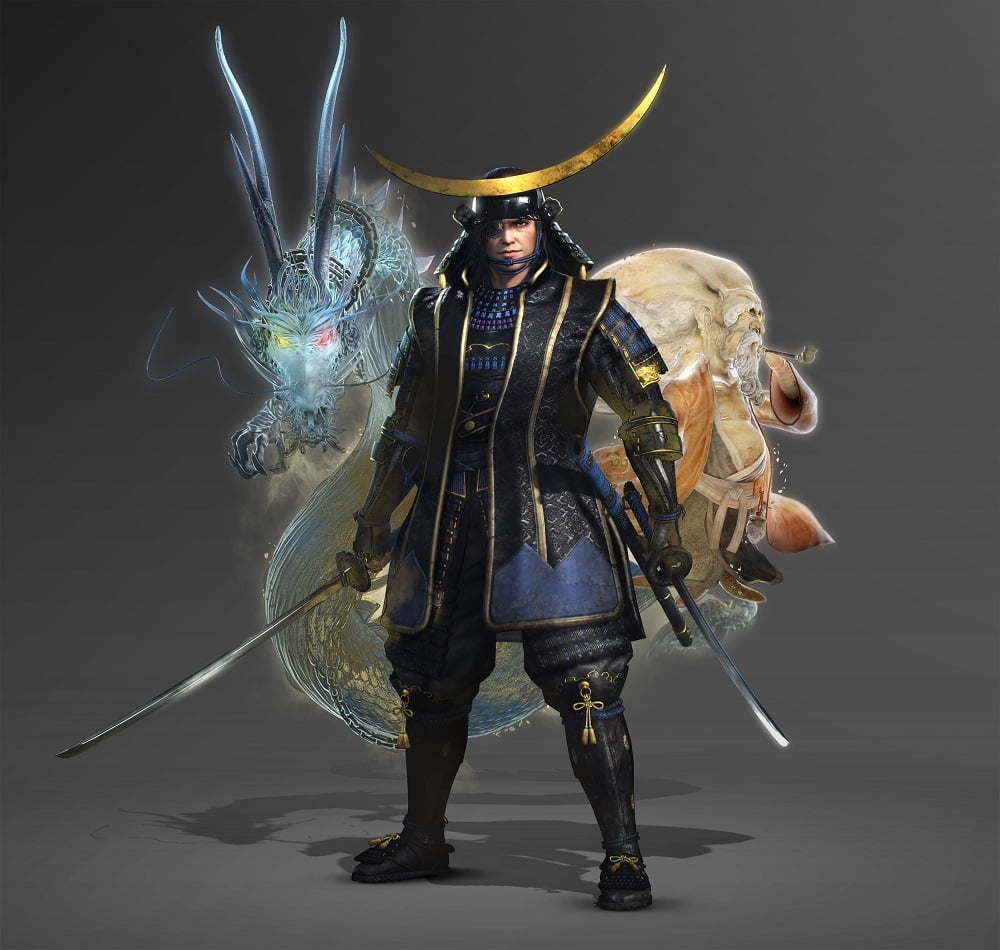
This is one from Nioh
https://nioh.wiki.fextralife.com/file/nioh/Date_Masamune_Artwork.jpg?v=1510354277178
Would Date have approved of the look presented in the game? And was the first picture held in the same regard as something like a White House official portrait (I hope that comparison makes sense)?
Thank you for reading.
Put it simply, the modern portrait of Masamune DATE in almost all the popular history (among others, video games) is not directly based on the contemporary evidence, such as OP's first one, though contemporary one (OP's first) might have also been stylized.
The primary origin of his modern interpretation is the historical drama series made by NHK (Nippon Hoso Kyokai: Japanese Broadcasting Association) in 1987, [added]: called Dokuganryu Masamune ('Masamune, One-Eyed Dragon') (you can see his image in the trailer in NHK's archive): https://www2.nhk.or.jp/archives/tv60bin/detail/index.cgi?das_id=D0009010339_00000
This has been the most popular (in regard with highest audience rating) of all these NHK's historical drama series, and the work that made young Ken WATANABE (a Japanese actor featured in Last Samurai) very popular.
It is worth noting that the on-air year of the drama was roughly overlapping with the first golden period of video-gaming (Nintendo) period in Japan. Among others, famous SLG series, Nobunaga no Yabo, by Koei, features the portrait of Masamune roughly based on this Ken Watanabe's historical drama, so the drama (and possibly the famous game series followed it as well) has determined his modern interpretation.
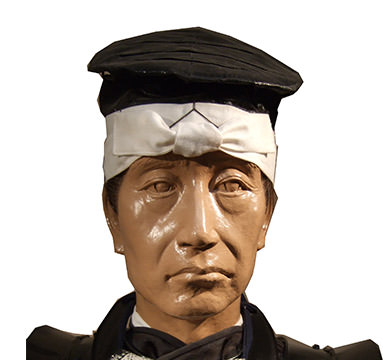
On the other hand, Masamune is also the rare case among Sengoku warlords in Japan that his skeleton kept intact in the grave. The official site of his grave, Zuiho-den museum in Sendai, Miyagi Pref., states that the investigation during archaeological excavation in 1979 reveals some of his real features based on the extant skeleton. You can see His height was 159.4 cm high, an average for the Japanese male in the 16th/17th century. In some cases, the alleged height of the warlord can be also deducted based on the armor in his lifetime (though the its historical accuracy is at most very questionable in most cases), but compared with some of them, this is about the average. You can see the most accurate reconstruction of his head, based on this investigation, in the left on the bottom in their site.
You might also notice that this reconstructed portrait lacks one of his most conspicuous trademark in the popular modern interpretation: One-eye and eye patch to hide it. His skeleton is reported to show nothing on this very famous visual feature on him, so the modern research instead suggests he just lost eye-sight of one eye without noticing visual feature on his visage. Surprisingly enough, this result also corresponds with the contemporary illustration (OP's first one). Then, one-eye as his striking visual feature belongs rather to the myth (the legend) than to the history.
The same can be said on another very famous historical figure in the 17th century Japan with one-eye as his trademark, Jubei Mitsuyoshi YAGYU, a swordman from the Yagyu family, the official sword tutors in Early Edo period.
I'm sure /u/ParallelPain can tell much more (both in quality and in quantity) on this Masamune's portrait, but this summary is almost all of what I can say for now.
References (sorry for only in Japanese):
(Edited): typo fixes, and also adds the title of the historical drama series in which Masamune was featured as a protagonist.