Please Be Aware: We expect everyone to read the rules and guidelines of this thread. Mods will remove questions which we deem to be too involved for the theme in place here. We will remove answers which don't include a source. These removals will be without notice. Please follow the rules.
Some questions people have just don't require depth. This thread is a recurring feature intended to provide a space for those simple, straight forward questions that are otherwise unsuited for the format of the subreddit.
Here are the ground rules:
Top Level Posts should be questions in their own right.
Questions should be clear and specific in the information that they are asking for.
Questions which ask about broader concepts may be removed at the discretion of the Mod Team and redirected to post as a standalone question.
We realize that in some cases, users may pose questions that they don't realize are more complicated than they think. In these cases, we will suggest reposting as a stand-alone question.
Answers MUST be properly sourced to respectable literature. Unlike regular questions in the sub where sources are only required upon request, the lack of a source will result in removal of the answer.
Academic secondary sources are prefered. Tertiary sources are acceptable if they are of academic rigor (such as a book from the 'Oxford Companion' series, or a reference work from an academic press).
The only rule being relaxed here is with regard to depth, insofar as the anticipated questions are ones which do not require it. All other rules of the subreddit are in force.
How did the stereotypical witch clothing (black dress, black pointed hat, broom) came to be?
How common was slavery in late medieval Europe? Especially in the italian republics.
Tell me about post-Roman Cognomens!
We could make a more or less continuous line of European "The Greats" for millenia; but that was hardly the only Cognomen outside of the Roman Empire. Henry the Navigator, William the Conqueror, Ivan the Terrible. Were these commonly used at this time? Was Henrique of Portugal referred to as "the Navigator" by his contemporaries, or were a lot of these assigned by historians? Also, why did they fall out of use?
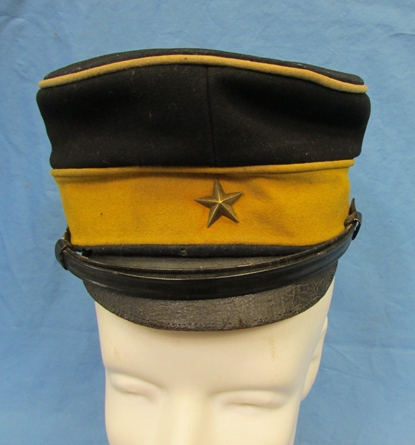
I am a historical reenactor looking to put together an early imperial Japanese army uniform and I was wondering what this hat is called
Any information or resources on Scots who fought in the Thirty Years War, remaining in Germany?
How do the recipients of a customs or tax farming contract actually make money from it? It seems they were pretty lucrative, did they just take a cut of the money they collected? Thinking in an early modern European context, especially Britain
The last paragraph of the poem on Paul Revere's Bloody Massacre engraving is as follows:
"But know, FATE summons to that awful Goal, Where JUSTICE strips the Murd'rer of his Soul: Should venal C-ts the scandal of the Land, Snatch the relentless Villain from her Hand, Keen Execrations on this Plate inscrib'd, Shall reach a JUDGE who never can be brib'd."
What does "c-ts" refer to? Cpt Preston is also referred to as "P-n" earlier in the poem. I assume this was probably because he felt it would be heathen to write the quote unquote murderous perpetrator's name in print? In the original flyer there is literally a dash between the letters. What word does "c-ts" refer to and why did Revere write some words like that?
What was Britain's and other nations immediate reaction to Napoleon crowning himself Emperor of the French?
Was it "Look at this upstart trying to play king!"
Or
"Oh good. Another monarch instead of this republican stuff. Now we know how to negotiate with him."
Did Sigmund Freud snort cocaine or did he take it by needle or some other method?
Why do we assume it's Roman copied Greeks rather than the other way around, in basically everything? Especially earlier developments?
I hope its okay to post here. The link for the remindme bot just sends me straight to the front of the sub instead of opening a new message. Is there a fix for that?
Did nationalism, as we understand it today, exist in any pre-French Revolution states across the world?
Did daily life change noticeably for the Polish nobility after the partitions?
How democratic was Carthage after Hannibal's reforms following the Second Punic War?
Was there ever a law in the U.S. that forced women to take their husbands last name?
I’ve tried looking this up but I can’t find anything definite. Some articles indicated that it was never illegal but had legal implications down the line. Other articles indicated that this was on the books until the Tennessee Supreme Court set the precedent in 1975.
Whenever I see a map of The Hanseatic League, Denmark is never a part of it. Why?
How did different accents in the US get to the point it is now? Like how people from Minnesota sound different from people in New York.
What was the American opinion of Napoleon at the time?
We fought the Quasi War with revolutionary France but later got a great deal in the Louisiana purchase from Napoleon and were at least cobelligerents during the War of 1812 and Napoleon's final years.
Taking a law course and a teacher talked about a "formula" of some sort that the Ancient Romans created, that we still have today. But I can't seem to find any information about it. Maybe I'm poorly translating the term, but apparently during the Kingdom era of Roman history, priests, who dealt in "legal" matters asked people to recite a "formula" for certain disputes that the priests could not solve. Nobody knew this formula because for a while it didn't exist. So the priests "couldn't do anything about it". Apparently they did this so that they wouldn't be murdered for cases they weren't qualified to solve. Then in the Republic period, it got fleshed out, and remains in the Western legal system to this day.
Sounds very anecdotal, even Astérix-esque in nature, that's why I've come here to ask if a) it existed and b) if there are any reputable sources on Roman law that discuss it, be they books or websites.
What is the meaning of "I have, & ca.,", usually found on the signature of 18th-19th century letters?
If Hitler "despised the kaiser" and blamed him for the WW1 failure, why didn't he punish him when they occupied the Netherlands?
Had anyone involved in the Russian Revolution interacted with Marx in person?
Why didn't 506th Infantry Regiment during WW2 had any heavy weapons company? 3 Battalions had 3 companies each (total from A to I).
Was it because they were paratroopers?
If Homer’s epic is named the Iliad after the city of Ilios (or Illium? Wilusa?), why then do we call it Troy?
Would Cleopatra be more closely related to Gal Godot if she were Greek or Egyptian?
Nowadays we often hear the comparison between the fall of Rome and the fall of other entities, like the EU or the US. My question is whether that was common in the past as well? Did people compare the decline and splintering of the HRE or the British Empire with Rome?
How do we know that the Romans used sponge-on-a-stick to wipe their bottoms? Did someone bother to write it down or something?
Looking for demographics on slavery and it's relation to three-fifths compromise. What percentage of slaves were considered "black" at the time the 3/5ths compromise was agreed upon?
I imagine the only other significant population of slaves that were not black would have been natives, and even still I would think this was very low. I ask this because I keep seeing people say the 3/5ths compromise was not "based on race" because it isn't explicitly and legally laid out as such, but it seems like a pretty dubious claim to make, in context.
I’ve got a professor who seems to embellish. The class is “History of NC”. She says that soldiers on Sherman’s March “lit trees on fire because they would explode like fireworks” and that “Sherman went easy on NC because they didn’t really want to secede”. Are either of these true?
re: 17th-18th century colonial history terminology: are a factory and a settlement the same thing?
What, if any, is the historical consensus on the political and military skills of Santa Anna of Mexico?
What did people use to clean their hair before the invention of shampoo?
I imagine this varies by region, but a lot of haircare blogs advertise "natural" cleaning products such as chickpea flour, apple cider vinegar etc. Were these actually used before shampoo? Do we know if haircare was important to the general populace?
Apologies if this has been posted countless times before, but what’s the story behind the design of masks worn by plague doctors during the Black Death? Was there some scientific or religious reasoning that made it the standard for the time?
Humans causing environmental damage isn’t new. Lions used to live in Europe, Iceland used to be covered in forest, the Sahara desert was much smaller, and the Romans made a birth control herb go extinct, to name a few instances. What’s the earliest known example we have of people drastically changing the environment or making a plant/animal go extinct?
Cuba 1930's . The gentleman on the right looks famously familiar. But I could be way wrong. You kind folks would know more than I would.
On the left is my great grandfather aurelio Garcia Guerra, from camaguey cuba. I believe he was speaker of the house to cuba in 1933 and/or president of Congress in 1935 (you know how family stories can be). I assume this photo is from the 1930's in cuba. But it was framed in such a way that it seemed of importance.
Any ideas who the man on the right is? https://imgur.com/gallery/HcpORCj
Here is a bonus one of him speaking next to Batista. I think this one is Cuba 1933 https://imgur.com/gallery/Ka91Dan
I visited an Insane Asylum in West Virginia and didn’t have the chance to ask the guide: were patients allowed to get married while admitted?
(Origination of my question comes from the fact that apparently if a woman was admitted by her husband and he died, she could not be released! It sometimes took 2-3 years for them to go through paperwork and such for her to have a relative sign for her release!)
Was street lighting provided in Redlined neighborhoods? Was it typically dark or did cities provide street lights?
(They told me to repost my question in here even though it's long.)
I have tried every combination of Google search terms for this question:"Crossbow Weight" = crossbow draw-weights"Crossbow Weight -draw" = modern crossbow weights"Crossbow Mass" = "...crossbows were 'mass'-produced..."etc...
So I'd like to know, how much could various historical crossbows weigh? Preferably including the weight of any windlasses or goatsfoot levers (or a third cocking mechanism I can't remember the name of) necessary to use them.
I know there were many different kinds, so I only expect to get something of an imprecise range. I don't need ballista weights at the moment, but I would like to know the average weights of anything a single person could load and fire, from crossbows meant to be fired in one hand, to chu-ko-nus, to gastraphetes, all the way up to heavy arbalests (even if those were meant to be swapped out and loaded by a second person.)
I’ve been trying to remember who coined the phrase “the guild” as a way of referring to formally trained professional historians. I think I was once told that the book that did it was written sometime around mid-century, but I can’t come much closer than that. Maybe Bloch, Carr, or Collingwood?
Did yougrt (and strained yogurt) exist in Neolithic West Asia and Europe or are the later Turkish inventions?
Very dumb question : Is there any ethical way to purchase antiquities or does every single one available anywhere to purchase pretty much comes from illegal (or at least unhetical) looting ?
I recall once hearing about a Roman open letter of denunciation of person “X” simply titled “Against X”. And possibly that this was a common format. Is this right? Who was “X”?
Hi everyone, I have been reading up the events of World War 2 for sometime and I am now keenly interested in the Allied occupation of Germany. I would like to know how the policies were for the four different occupation zones and how the attitudes of each Allied power to their occupation zone was. It would be great if you could suggest any literature or articles regarding this.
Why would early modern brewers ferment cider with jalap, a purgative?
I came across Thomas Chapman's The Cyder-Maker's Instructor, a collection of hot 18th century cider-making tips, on Project Gutenberg. The text mentions jalap several times.
Here's an extract of the fermentation recipe (emphasis mine):
To one hogshead of cyder, take three pints of solid yest, the mildest you can get; if rough, wash it in warm water, and let it stand 'till it is cold. Pour the water from it, and put it in a pail or can; put to it as much jalap as will lay on a six-pence, beat them well together with a whisk, then apply some of the cyder to it by degrees 'till your can is full.
Jalap is apparently a cathartic and purgative sourced from the aptly named Ipomoea purga, a New World plant known to indigenous groups in what is now Mexico.
I can't find any reference to another substance known as jalap. Was it used as some sort of yeast nutrient? Did it have some other effect on the brew, or did brewers really include it for its medicinal effects?
Quick "historical mythbusters" question: I read a claim on social media that kings wanted "virgin" brides so that if they were unable to sire an heir, they could blame the woman and "dispose" of her (through whatever means).
Every claim in there, implied or otherwise, sounds like nonsense from someone who picked it up from an in-universe explanation in a fantasy novel.
Did all, or even most, kings require virgin brides? Does anyone know of accounts from any kingdom that ruled by heredity supporting this claim?
Logically, by the time bride number four came and went, people would start thinking (although probably not saying) "maybe let's consider that it takes two to tango and maybe the brides aren't the problem."
I remember being told about a war general that had a troop of very loyal men. From what I recall of the story, there was a war where this general, while standing outside the gates of his opponent with its king watching over, instructed his men to jump off a cliff. One by one, the soldiers faithfully jumped off to their death in obedience to this general. Seeing such display of unwavering loyalty, the king felt that he stood no chance against such troops and surrendered.
Did this really happen? Who was this general?
What would you call a member of the Carolingian dynasty? As in, what would be their "of ~dynasty~"? (For example, Von Habsburg, De Bourbon, etc)
I'm very interested in the time period beginning with the later stages of WWII up to around 1970, particularly with how the aftermath of WWII (that is to say, the policies, alliances, military actions, and arms race) created the current geopolitical landscape. Can anyone recommend some good documentaries that are more than just "USSR scary America hero" in terms of content?
Anything that looks at how the US got all these military bases and arrangements with other countries worldwide, and what strategic issues they were intended to address would also be really interesting.
I am searching for a well written, facts based history book on the French Revolution. I really want to dive into this subject and learn in details about this time period. It’s for my personnal interest. I have an academic background and I’m used to read historical analysis. I just want your best recommendation. Can be in french (my main language) or in english.
Thanks in advance!
In the late republic (100ish BCE) were Roman veterans allowed to get married? I heard they weren't allowed during service? help please.
Do folks have tips/advice on how to start an historical analysis of a technique? I'm new to historical research and not even sure how to identify primary sources/an archive to look through.
Basically I want to understand the emergence and evolution of 'machine learning' from the 1960s until now. Any resources/guides appreciated.
During the middle ages as per CK3, 800 AD - 1000 AD, would baronies actually fight back against overwhelming armies and solicit a siege?
Does anyone know when this video-performance of Eartha Kitt's "I Want To Be Evil" is from, and in what context it was made?
Haha that's super interesting because that's basically what dry shampoo is nowadays! Fragrant oil-absorbing powder.
Thank you for the insight. I expect that powder wasn't as good as a full wash, but given lower hygiene standards of the time it makes sense.
Why did Christianity stray from blood sacrifices? I understand Jesus is believed to be the lamb of god, so no one has to sacrifice their own lambs anymore, but was this to distance themselves from Judaism or pagan beliefs? I'm having a hard time figuring out how to Google this exact topic.