The relationship between colonizer and colonized is obviously an extremely complicated one. How have Latin American countries dealt with the legacy of Spanish/Portuguese colonialism? Do they see themselves as part of the same world, ie the Anglophone world/Commonwealth? Has the relationships between these two parts of the world changed notably compared to the period after independence?
I can speak about Argentina's case, as usual.
When it comes to looking at the colonial heritage, the most obvious wound we still carry is the language. The Spanish conquistadores made it a point to try and eradicate most traces of native cultures, starting with their language and their religion, a trend that was carried on by the early Argentinian State. We have several different variants of Spanish here in Argentina, the most well known one in the rest of the world being the rioplatense variant, spoken primarily in the Atlantic coast, from Buenos Aires to Ushuaia.
But the early ideologists of Argentina's State weren't going to change the language, so efforts were made to try and change the way the population spoke the language. Over time, the different variants became increasingly different from the traditional Castilian Spanish, the most notable differences being our very different use of the word "vos", historically used in Spain to refer to someone in a position of respectability (alongside "usted"), with "tu" being the colloquial form. The word "tu" basically doesn't exist in Argentina, having been replaced entirely by "vos" as the universal term, and "usted" being the only formal form of the word "you".
You probably aren't very interested in linguistics though, so let's move forward. When looking at the construction of Argentina's cultural identity, from the very first stages following the May Revolution of 1810, the dissolution of the Viceroyalty of Río de la Plata and the formation of the United Provinces of Río de la Plata, several efforts were made to distinguish the creole or criolla population from the royalists fighting in the Spanish army. The earliest of these instances was the creation of the first Argentinian cockade and flag by Manuel Belgrano, a lawyer and general considered as one of our founding fathers. During the early stages of the revolutionary wars, Belgrano proposed that the army needed a cockade to distinguish themselves from the red-wearing royalists. The First Triumvirate, then the executive branch of the United Provinces, approved the creation of a cockade that would have to be white and light blue. However, when this insignia was created, there was no flag to be used by the army. That's why, on February 27th 1812, Belgrano wrote to the Triumvirate "[...] Finding it necessary to fly a Flag, and not having one, I've ordered a white and light blue one be made, according to the colours of the national cockade: I await Your approval". We don't really know what that flag looked like, but most historians agree that it was probably comprised of a white stripe on top of a light blue one. However, as the year progressed, the Triumvirate became increasingly worried that a complete separation from the Spanish symbols would betray their initial goal to pretend to continue being allied to Spain, simply as former colonies, but still loyal to Fernando VII, still a prisoner of Napoleon. Therefore, they forbade Belgrano from flying his flag.
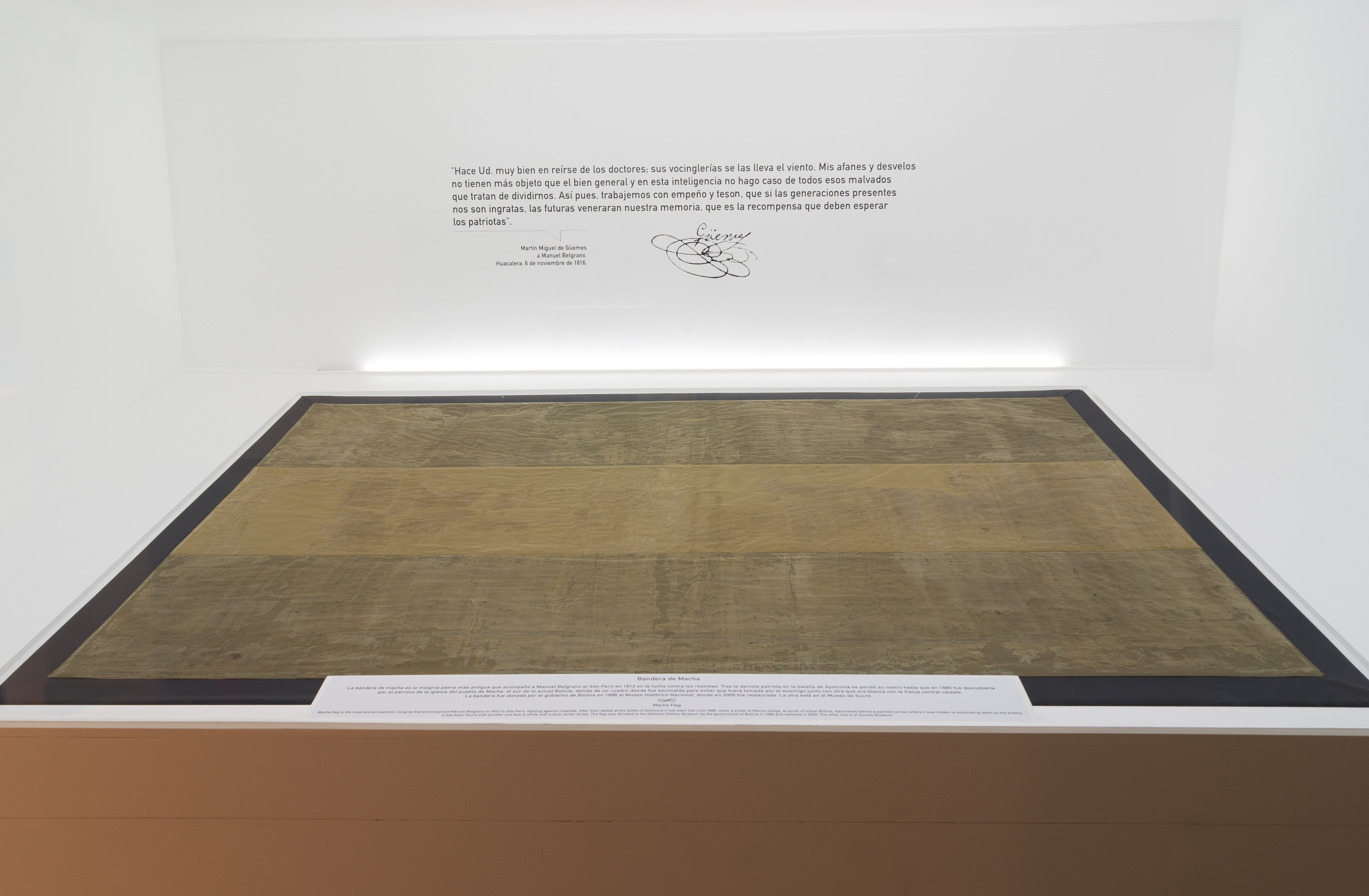
Fortunately for Belgrano, the First Triumvirate fell and was replaced by a Second Triumvirate, more inclined towards full on revolution. This Triumvirate called for a Constitutional Assembly, known today as the Assembly of 1813, which failed to produce a National Constitution, but recognised the need to create national symbols that fully represented an independent identity. Belgrano was then authorised to create a new flag, this time made of three stripes: light blue on top, white in the middle and light blue again at the bottom. That original flag, reproduced many times over, was also lost, until 1885, when it was recovered in the city of Macha in Bolivia, apparently it was lost during one of Belgrano's last campaigns while leading the Northern Army trying to stop royalist advances in the frontier with Bolivia. You can see it here still preserved in Sucre, after a restoration process that took two years and was completed in 2009.
Another important decision made by the Assembly of 1813 was the official adoption of a national anthem, written in 1812 by Vicente López y Planes and composed by Blas Parera. This anthem was, well, very aggressively anti-Spanish. Let me translate it for you.
Hear mortals, the sacred cry
Freedom, freedom, freedom!
Hear the noise of broken chains,
see noble equality enthroned.
To the heights of the Earth rises
a new and glorious nation,
its head crowned with laurels,
and at her feet lying a Lion.
Alright so far, except there's a dead lion at Argentina's feet, a very regal lion.
May the laurels be eternal,
the ones we managed to win
Let us live crowned with glory
or swear to die gloriously!
Nothing particularly noteworthy in the chorus there, at least not very different from most national anthems.
From the new Champions their faces
Mars himself seems to encourage
Greatness nestles in their breast:
at their march they make everything tremble.
The graves of the Incas are shaken,
and in their bones the ardour revives
which renews their children
of the Motherland the ancient splendour.
Now we see a very blatant mention to Mars, god of war and all that jazz, symbolising of course the violent but just nature of this new nation's rise. We also see a very interesting mention to the Incas and the Tahuantinsuyo, which signifies a break from Spanish culture and the construction of a more native identity, native not in the sense of indigenous but of creole, of having been born in this land.
Mountains and walls are felt
to resound with horrible din:
the whole country is disturbed by cries
of revenge, of war and rage.
In the fiery tyrants the envy
spat their pestiferous bile;
their bloody standard they rise
provoking the most cruel combat
Woah, now if that doesn't scream "Spanish Go Home", nothing does.
Don't you see them over México and Quito
throwing themselves with tenacious viciousness?
And how they cry, bathed in blood,
Potosí, Cochabamba and La Paz?
Don't you see them over sad Caracas
spreading mourning and weeping and death?
Don't you see them devouring as wild animals
all people who they force surrender upon?
This shows an agreement with two interesting, very incipient ideologies. I've spoken about them before here: Ibero-Americanism and Pan-Americanism, the beliefs that the newly formed Latin Américan and South Américan nations needed to find and construct a common, shared identity to fight against Spanish oppression; we need to keep in mind that, unlike most former colonies who were re-conquered by Spain, Argentina never fell to the royalist advances and managed to successfully repel them long enough for Spain to have no choice but to recognise it as an independent country, and furthermore, by 1813, remained one of the very few independent nations, with most of the continent still under European control.
This is a really complex one so I'll just add a few points to /u/aquatermain's fine post. With independence one process was first animosity to the Spanish King and then linked to wider anti-Spanish sentiment. People of European descent born in Spanish America (criollos) had not been allowed to serve in most high posts for centuries, further influencing this animosity towards people from Spain (then called espagnoles/gachupines).
At sorta the same time there's a parallel process I wanna stress though. When in power, the creole elites in various of the newly independent nations would harken back to glories of pre-Hispanic peoples - esp. the Inkas and Mexica - to strengthen their separate national myths. The descendants of the native groups were and continue to be discriminated against despite this. I go into this part some more over here:
, & here more for Mexico:
Another one might also be of interest, though more on the influences of other states like France and the US on Spanish American independence:
Hope this helps!