Runes were occasionally combined into a single 'bind rune' (the English rendering of Swedish Binderuna etc, which are a modern terms though), which is basically just a runic ligature. (a word which comes from the Latin verb for 'bind, tie', ligare) A combination of a pair of letters (usually a pair, sometimes three, very rarely more than that)
Now Harald Bluetooth's own day was the Viking Age (~800-1050) which in Scandinavian contexts precedes the Scandinavian Middle Ages (~1050-1550). I mention this not to nitpick but because in Scandinavian runological contexts 'medieval runes' and the 'medieval rune row' thus refer to post-Viking Age ones. (although it's one continual tradition)
Now there's an incredible amount of nonsense about runes and bind-runes on the internet, because some neo-pagan/wiccan/new-agey types have their own peculiar ideas about how runes are magical and have various esoteric meanings and so combining them gives some combined magical powers or whatnot.
All of it is basically unsupported by serious scholarship. To be fair, it was once commonly held among serious scholars that runes really were inherently magical and mystical and symbolic. But in the past 40-50 years or so this has been reexamined and the evidence for it has been found to be pretty lacking. Few believe that now; rather it seems more likely this attitude stems from perceptions about runes that arose around the late Middle Ages/Renaissance. (at which time there was a vogue for secret/magical alphabets; Trithemius' [Polygraphia](https://en.wikipedia.org/wiki/Polygraphia_(book)) being a prime example and enormous influence on that trend).
To be clear: magical runic inscriptions absolutely exist; lots of them. It just doesn't seem there was a perception runes were in-themselves magical; or for instance more 'magical' than the Latin script during the centuries both were in use.
The scholar Mindy MacLeod is the one who's studied bind-runes the most; and particularly whether or not they were used magically. When it comes to the Viking Age and earlier period the answer is simply: No. (Mindy MacLeod: Bind-Runes. An Investigation of Ligatures in Runic Epigraphy. Runrön 20, Uppsala University, 2002.)
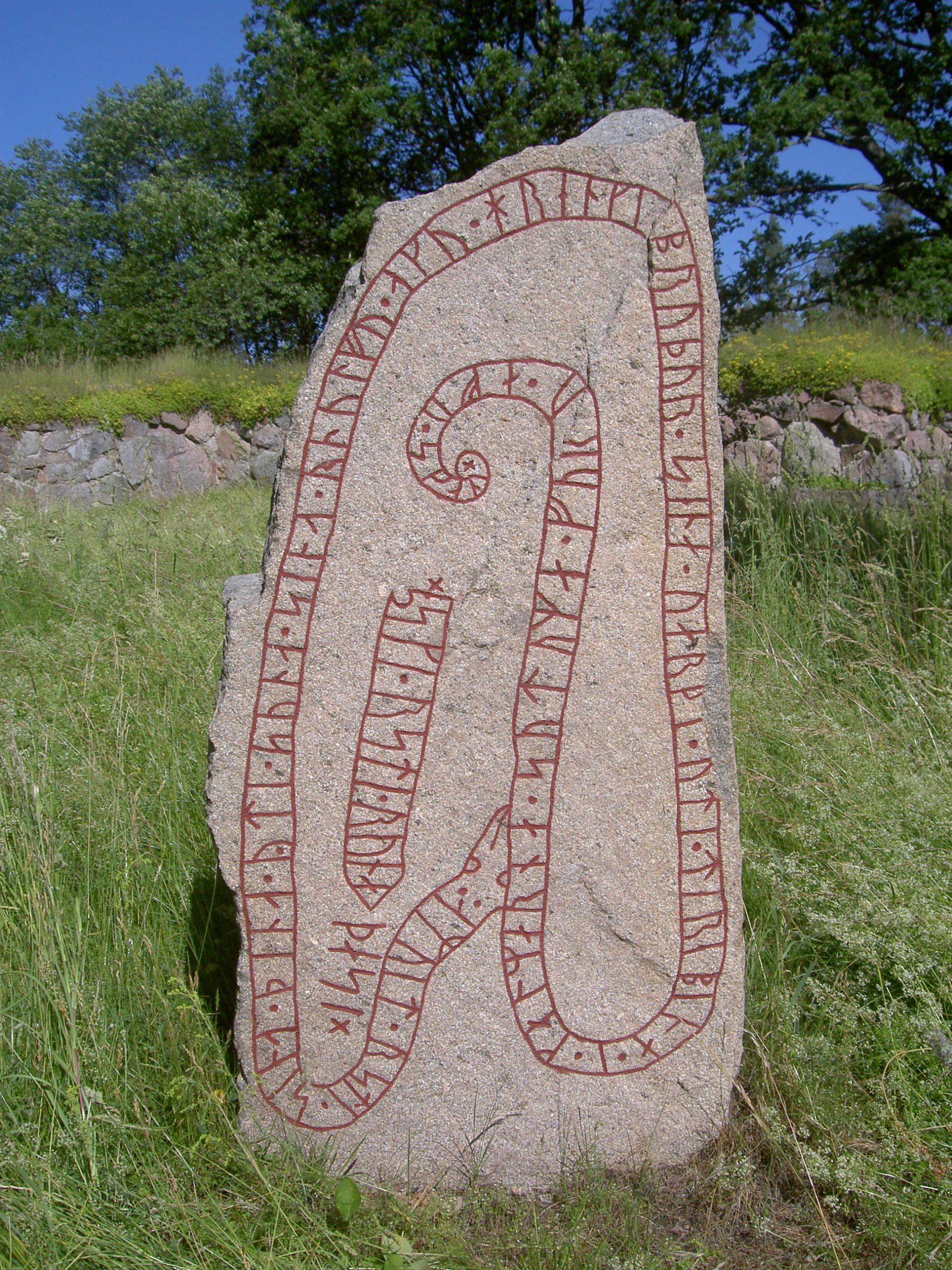
They were used only as corrections where a rune had been omitted, or to save space where it was running out. You might imagine people would carefully plan a large granite monument before they started carving away; but that's just how 'common sense' can lead you wrong - there's a shockingly large number of stones that were obviously not sketched out in advance, as the letters start with wide spacing but the words get closer and closer together as it goes on, and more abbreviations are introduced. Or even that the final words didn't fit and had to be put outside the dragon/snake coil. Like Sö 333 here where the carver Æsgeirr seems to have finished the snake, the decided to add a signature so he added a new tail section, but even then couldn't quite fit the last word þasi.
(Note: the stones were originally painted, so the disconnected snake tail was probably 'fixed' in the paint job. The modern paint is there to show all carved sections, so the mistakes are more obvious)
In the Middle Ages such uses continued, to take a random page of the Codex Runicus (c. 1300), one of few examples of runes-on-parchment. There are some bind-runes on the fifth line. o=k and a=f. The former seems to be due to an omitted k rune and the latter due to it being the end of the line and running out of space.
And it's during the middle ages where in some cases it might've had a bit of spiritual significance, such as on a set of church bells by a master Håkan ('Magister Haquinus') from the 1300s, where they carry the inscription "Ave Maria, Jesus", where "ave" has been written with runes as a=u=e.
But to answer your main question; Scandinavians did not fashion their initials into bind-runes in the Viking or Middle Ages. This largely falls on its premises, since they really didn't use initials either. Mostly, people only had a single name. They may have a by-name too but it's really more common in those cases they'd only use the byname unless necessary to distinguish them.
Also, there was no punctuation symbol like a period to show something was an abbreviation. Where we believe there to be abbreviations on rune stones for instance, it's because letters have been omitted in a way that hints it's that, and not due to a mistake or variation in pronunciation. (Like carving steinn (stone) as stn is an abbreviation, while carving tsein is a mistake and sten is normal spelling variation)
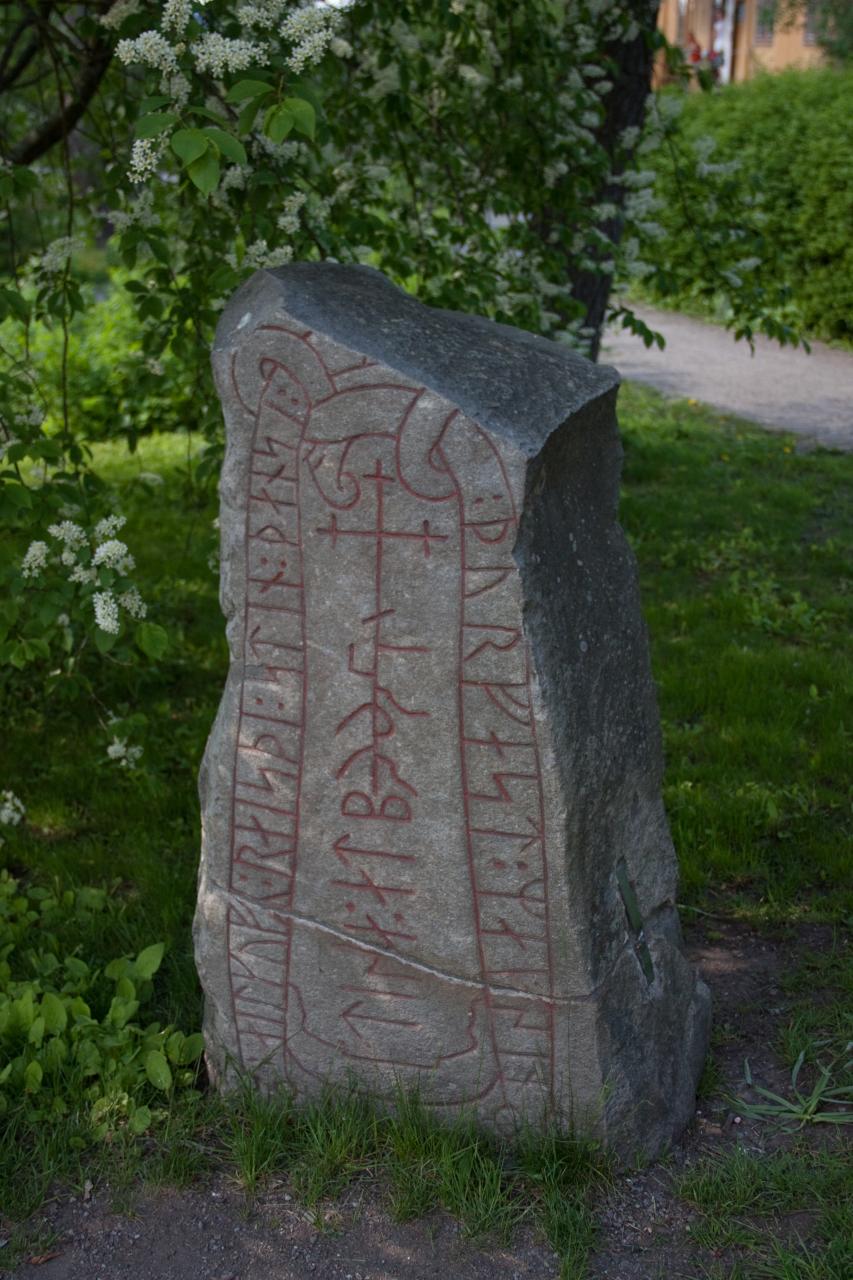
In some cases in the Viking Age, they'd also have 'shared stave' runes, where a single line would join a bunch of runes; like here, on Sö 352. It's not terribly common (a half-dozen or so examples out of ~3,000 stones) and seems to have been partially decorative, but probably also part a challenge to the reader. They have little in common in terms of what was written, but what they do have in common is that they're usually last in the inscription. There's a general tendency to increase the difficulty as the stones progressed. Both in content and how it's written. The Rök stone being a pretty archetypical example (and the longest inscription). It starts with easily read bit about who it's in memory of but continues with poetic allusions and other obscure things; switches over to having some lines written in the by-then-obsolete Elder Futhark runes, and the final lines are outright ciphered in various ways. The point was to challenge the reader.
It was a macho society - but that didn't just mean boasts of physical prowess; showing off mental skills was a big thing too. Riddles were a huge thing in the culture. And quite a few inscriptions explicitly challenge the reader to read them if they can.
There are quite a number of inscribed artefacts from the Viking Age and Middle Ages with ownership marks on them, typically reading "NN owns me". During the Middle Ages they'd also pick up the use of 'house marks', a mark used as a signature, which to the layperson might appear similar to runes as they're simple geometric figures out of straight lines, usually. They're not believed to be connected with runes though, as they first show up in present-day Germany, after Germans had ceased to use runes. House marks are also visually distinct; they often have horizontal lines, which older runes never had, and also five and six-pointed stars were common and other things that don't really obey the visual 'rules' of runes. So although it'd be tempting to imagine runic initials evolving into house marks, it's not very likely. They're not more similar than what can be explicable by the fact that there's just a pretty limited set of simple, visually distinct, line figures you can make.
All that said, the Bluetooth logo's h=b (ᚼᛒ) bind-rune is pretty authentic to how bindrunes were actually constructed in the Viking Age; a pair of runes shaing a main-stave where in the right half of the h (ᚼ) rune is removed. Not that any such bind rune is known from an actual inscription, but that's just because those two letters would very rarely be next to each other in Old Norse.