Imperial Russia is often depicted as a quasi medieval feudal state ruled by an incompetent ruler, but after a bit of research I found out that under Tsar Nicholas II Russia had begun to industrialize very quickly and was seen as a serious threat by both Great Britain and Imperial Germany. How do modern historians view his reign and how did the perception of tsarist Russia in academia change through the last century?
It was easier to judge Nicholas II when the Soviet Union still existed. The existence of the USSR and by extension, the Russian Revolutions of 1917, seemed to cast Nicholas II as a doomed figure that was incapable of stemming a revolutionary tide. The Soviet state of course naturally promoted this teleology of all roads led to Lenin, but even anticommunist historians in the West presented Nicholas II in negative terms. Richard Pipes for example presents Nicholas II as an unlucky man born to an abusive father, henpecked by his wife, and unprepared to deal with the bad hand fate dealt his empire. This pessimism was never iron-clad and a number of historians questioned the inevitability hypothesis. But the collapse of the USSR really made the Bolsheviks look less like an inevitability and more as one faction whose success was contingent on a variety of factors. This reemergence of contingency has forced a reevaluation of Nicholas II and his reign among historians. But general picture is that while it was not inevitable that the monarchy would collapse, Nicholas II's prospects were quite dim.
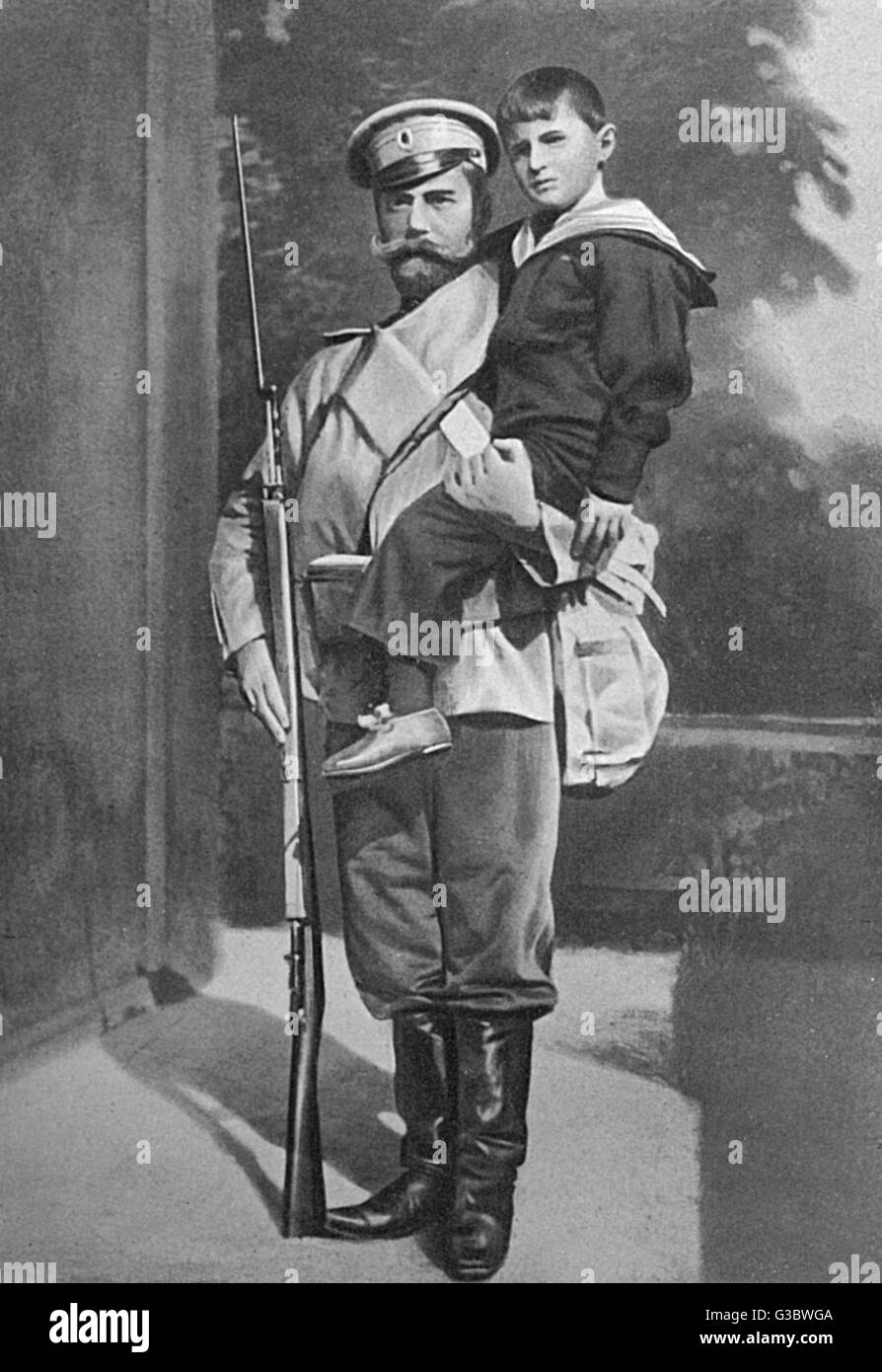
Nicholas II is a complex historical personage that that intermingled a personal affability and a striking political incompetence. Most cinematic depictions of Nicholas II emphasize his role as a devoted father and husband and this was not that far off from the mark, although they also omit his well-known antisemitism. He was by most accounts a decent family man and his personal household very much resembled that of Queen Victoria. The royal family in tsarist iconography emphasized the almost bourgeois quality of Nicholas II's family. For example, Nicholas II was the first tsar to actually share a sleeping bed with his wife. Nicholas II even humored his wife's patronage of the monk Rasputin, a man the tsar never really trusted or liked. One popular image of Nicholas II was this one in which he wore the newly redesigned uniform of a Russian enlisted man and marched a day in it so that he understood the ordeals of the common soldier.
However, the family man Nicholas II was singularly ill-suited to his position as an absolute monarch. He fused two dangerous elements into his rule: he held a deep conviction in the sacred inviolability of the position of tsar and consistently overestimated his own political acumen. These tendencies came to the fore as Russia felt increasing pressures from modernization and industrialization. Russian cities grew tremendously at the turn of the century and the ancient Romanov monarchy and its absolutist state appeared increasingly archaic for many Russians. The tsars ordinarily relied on a cadre of able servitors to run the state and Nicholas II inherited his father's able servant Sergei Witte. As Finance Minister, Witte encouraged industrial growth and a sound economy. Witte pushed a slow reformism of the empire and looked askance at the more reactionary elements within the empire. But Nicholas II never really trusted Witte oor his later chief minister Pyotr Stolypin and was ill at ease with being a tsar in an age of mass politics. The basic goal of the tsars in the nineteenth century was to modernize the economy while preventing any meaningful political reform. The result was political discontent compounded itself since the tsarist state was fostering the very demographic changes that undermined the traditionalism that was the bedrock of Romanov absolutism.
One of the central contradictions of imperial Russia in the nineteenth century was that although the monarchy was wedded to the ideology of unquestioned autocracy, the state itself was actually quite weak. The sheer size of the Russian Empire coupled with a narrow base of the educated classes meant that the empire often lacked enough bureaucrats to staff it. Emperor Nicholas I cemented a reactionary ideology within the ethos of autocracy that further narrowed the potential servitors down. Originally a response to the French Revolutionary era, reactionary thought mutated and evolved within the tsarist state structure over time, but it generally lumped all attempts at reform, running from constitutionalism to anarchism, as subversive. The emergence of Great Russian chauvinism winnowed down the potential pool as certain nationalities within the empire such as Poles were immediately suspect and could not entertain a career within the autocracy.
Counter-intuitively, the weak state made the tsarist state more prone to resort to outright repression. The relatively small size of the the tsarist police compared to the size of the empire meant that the army was the last resort to restore order. The courts were one of the brighter spots of the liberal Great Reforms, but the state increasingly used the justice system to enforce order as it defined it. This created political feedback loop in which the price of stability was an alienation of would-be allies of a reformed tsardom and a repressive police state whose repression was quite easy to violate or evade. Tsarist prisons could be quite harsh and there were numerous examples of illiberal use of violence by the state. But this coexisted with a looser regimen exemplified by Lenin's Siberian exile where he was free to set up something of a normal family life in which he hunted, had access to his library, and could write.
The monarchy itself was shaken to its core during the Revolution of 1905, which occurred during the disastrous Russo-Japanese War, which was another blunder of Nicholas II. The Romanovs weathered the 1905 Revolution, but needed to accept a limited constitution and a legislature called the Duma. However, the 1905 Revolution resulted in a peculiar political situation that some historians have described as "constitutional absolutism." Stolypin tried to act like Bismarck, that is as a White Revolutionary who would reform society while using nationalism to strengthen the monarchy against democracy. Nicholas II though was a check to Stolypin's ambitious plan. Unlike Bismarck's pliant Wilhelm I, Nicholas II was unwilling to cede political power to his prime minister. The result was that after the 1905 Revolution, the Russian state limped along, apparently intact and with some strengths, but with a number of unresolved political and social tensions.
The First World War was in many respects the absolute worst thing for the Romanovs. The economic stresses of the wartime economy, coupled with the losses of some of the empire's prosperous Western regions, exacerbated preexisting tensions between the state and Russia's working classes. The war also unleashed greater ethnic stresses within the multiethnic empire, which were simmering prior to 1914, but war brought them to a boil. Nicholas II, in a blunder characteristic of much of his rule, tried to take a more hands on approach to the handling of the war. Although he often deferred to military professionals, his rather public assumption of supreme command further damaged his battered prestige. When revolution came in early 1917, Nicholas II abdicated after it was clear that the monarchy could not cling to power as it did in 1905. The Russian Provisional Government tried to re-stabilize Russia, but were unable to control the increasingly radicalized Russian street. This led to a second Russian revolution in 1917, which brought the Bolsheviks to power. Nicholas II and his family became something of a political football during the resulting Russian civil war. The remnants of the Provisional Government sought to exile him to further distance themselves from the previous regime while traditionalist and anti-Bolshevik White forces wanted to use the Romanovs as a rallying point to retake the country.The Bolsheviks ended up in control physical control over the tsar and his family in the Urals town of Yekaterinburg. Some in Moscow wanted to put Nicholas II on trial as a symbolic propaganda victory, but such an undertaking would have been difficult. Eventually, the proximity of a local White army led the local Bolsheviks to forge documents claiming that Nicholas II was plotting with France to restore the monarchy as a pretext to execute the whole family.
Evading the First World War might have saved Nicholas II's reign but such a counterfactual would not erase the growing tensions and contradictions within the empire's government. Nicholas II himself was likely not up to the job of bridging these divides. One of his disturbing characteristics was that while he was affable to his ministers to their faces, he often ignored their advice if it contradicted his gut instincts. And his gut instinct were often quite wrong-headed. It was telling that Nicholas II was never able to craft a functional long-term political relationship with either Witte or Stolypin, the reformist liberal and the archreactionary. Nicholas II might have been a good family man and very physically fit, but preserving the empire was an incredibly tall order and one that would have been a challenge to a ruler with better political instincts than Nicholas II.
Sources
Hosking, Geoffrey A. Russia: People and Empire, 1552-1917. Cambridge, Mass: Harvard University Press, 1997.
Lieven, Dominic. The End of Tsarist Russia: The March to World War I and Revolution. New York: Penguin, 2016.
Weeks, Theodore R. Across the Revolutionary Divide: Russia and the USSR, 1861-1945. Chichester, West Sussex: Wiley-Blackwell, 2011.
Wortman, Richard S. Scenarios of Power: Myth and Ceremony in Russian Monarchy. Vol. 2, Vol. 2. Princeton, N.J.: Princeton Univ. Press, 2000.