As what the title said, why?. Matchlock firearms even with self-loading rifles are slow to reload and would give the soldiers a chance to run and charge at them?. With bows they take less effort to reload and would be great as while the gunners are still reloading, the bow men would fire a hail of arrows at them with either lit up or with whistling arrows to rout them.
I do know Bows takes alot of time to master as compared to a gun but why haven't they thought of the idea?
These posts from /u/hborrgg cover a lot of good points about the bow in the age of the gun, which i will complement/reiterate/reinforce x x
Many armies employed guns and bows simultaneously throughout the 16th century, but generally not in a coordinated fashion. Bows were generally employed among the infantry out of necessity, there not being enough firearms to equip them all with modern weapons. Why did they not use them in tandem with guns? It's hard to answer a negatively-framed question, but hopefully this should address some of the assumptions behind it.
It doesn't really matter what ratio of archers to gunners you have, or how they're used, using firearms as the sole missile weapon was more effective. If you can have 200 gunners, or 100 gunners and 100 archers, the former was generally better. The enemy could often be dissuaded from charging so long as the gunners kept some of their fire in reserve; employing 150 muskets in the firefight while always keeping 50 loaded to repel an attack while the others reloaded offered more firepower than 100 archers.
Why was this? For one, arrows had relatively little effect on advancing formations when the troops were well armored. At Vernueil in 1424, well-armored Milanese cavalry brushed aside the English longbowmen, even though they had the protection of stakes. Similarly, Scottish infantry, well armored and carrying pikes, shrugged off English archery at the battle of Flodden in 1513, fighting the battle 'at handstrokes' with the English billmen. While both battles were English victories, they were won in spite of the bow's ineffectiveness against armor. In the 16th century, when the gun developed into its mature form, armor was increasingly common on the Western European battlefield, even in poor areas like Scotland. This is in part the result of greater economies of scale involved in the blast furnace; large amounts of ore could be processed into iron at once, thus making the armoring of larger formations practical. As such, weapons that could be effective against armor naturally began to play a greater role.
In addition to their armor penetrating ability, guns had greater lethal effect on enemy formations. While arrows, pike thrusts, and sword cuts generally needed to penetrate the chest cavity or hit a vital organ to disable an enemy (a tough proposition when many are well-armored), a gunshot practically anywhere on the body could prove fatal, especially if it struck and shattered bone. Guns had greater range and accuracy too; a bullet could be fired directly at an enemy past ranges where and arrow needed to be lobbed high in the sky, and was far less affected by wind and such. Equipped with iron sights and a shoulder stock, guns could be fired 'by rule' rather than 'by guess'; compared to bows, they practically aim themselves.
Furthermore, gunners had additional protection in the form of pikemen. In the 16th and early 17th centuries, they took to the field in large squares; the mid-late 17th century, they generally fought in shallower linear formations interspersed through the line of battle. While not necessarily an accurate depiction of the Battle of Lutzen, this print shows both systems, bottom and top respectively. When threatened by cavalry, gunners could nestle themselves amidst the rank and file intervals in the pike formation. In addition to protecting gunners against charging enemies more effectively than archers could, pikes had much greater offensive potential; well armored, their charge could put to flight anything that was not also pikemen.
In general, then, armies preferred more musketeers and more pikemen among the infantry for good reasons, leaving little role for the bow other than an extemporized milita weapon.
There was a very long tradition of using the bow alongside matchlocks, and even more modern firearms. The Chinese, as the inventors of guns and also late users of the matchlock, used the bow together with matchlocks and pre-matchlock guns for over 700 years. In some cases, both muskets and bows were carried by the same soldier:
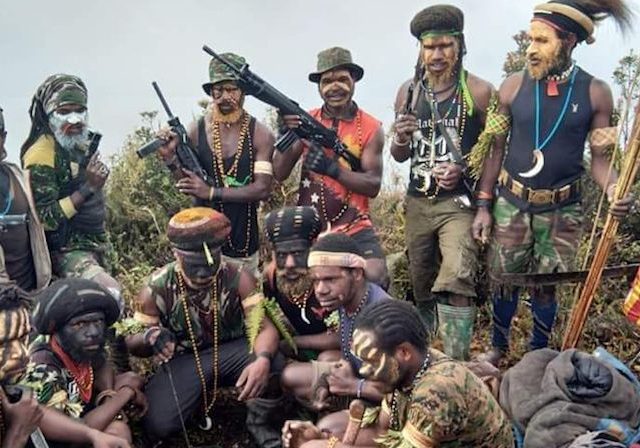
When this was done, it was usually by cavalry, who could better cope with the extra weight and bulk of having both weapons. The bow was carried in addition to the musket due to the difficulty of reloading a long muzzle-loading gun on a moving horse. The gun was carried in addition to the bow for its superior range, damage, and penetration (as discussed below). The centuries-long Chinese use of both bow and musket was also partly due to this ease of use on horseback of the bow compared to the musket - in the 16th century, the bow declined as an infantry weapon, replaced by the musket, while cavalry retained the bow. In some cases where guns have been in short supply, bows have been used alongside guns into the late 20th century, and even into the 21st century. For example, OPM (Free West Papua) rebels:
While this is a propaganda photo, OPM has used bows alongside guns, and tribal warfare in New Guinea has seen guns and bows used together. Even today, arrows can still wound and kill in battle, so have been used by people and armies who preferred the gun, but did not have enough guns.
Guns have clear advantages, such as:
Longer range.
Much higher lethality.
Much better penetration of armour and cover.
Higher lethality is straightforward, as is better penetration of armour. While armour mostly disappeared from the battlefield over the 17th century, the better penetration of cover still matters in modern warfare. For example, hiding behind a tree is generally sufficient to stop any arrow, but, depending on the gun, bullets can go through trees 10-20"/25-50cm thick. The point about longer range merits more discussion. Even very early guns will fire bullets further than arrows can be shot from a bow - this is simply due to the higher speed of the bullets. However, while a musket ball could travel over 1km, the effective range was far less. Smoothbore muskets, as used from the 16th century and into the mid-19th century, rapidly lost accuracy due to the unpredictably spinning and tumbling ball. The practically useful range was about 50-100m for person-sized targets. Pistols and earlier guns (e.g., hand-cannons, consisting of short barrels on a stick) were shorter ranged, with effective ranges of perhaps up to about 50m. The same considerations apply to archery - we need to consider both the maximum and the effective ranges. Depending on the type of bow, the maximum range might be about 200-250m (e.g., European longbow, Manchu bow, Japanese yumi) or somewhat greater (e.g., Turkish bows, Korean bows). Bows could be usefully used at such range, shooting arrows at high angles to fall onto enemy formations. However, the odds of hitting a single person-sized target at that range was poor, and even worse if the target was moving (since the arrow would take about 4 seconds or longer to travel that distance, time in which the target could move a long way). The effective range of a bow for accurate shooting at individual targets was often considered to be about 30-50m. Thus, long firearms (arquebus and musket) typically had superior effective range against individual targets.
The bow does have an advantage in rate of fire over muzzle-loading firearms, able to be shot approximately every 5 seconds. This is quicker than a musket, but a musket could be fired respectably quickly. A flintlock musket can be loaded and fired in about 20 seconds, and while a matchlock musket typically needs somewhat longer, perhaps about 40 seconds, it is still possible to load and shoot a matchlock in under 20 seconds, e.g.,:
as linked by u/hborrgg in https://www.reddit.com/r/AskHistorians/comments/53uetz/what_was_the_fire_rate_of_the_matchlock_musket/
Even with its greater effective range, a musketeer might only get a single shot against a charging enemy. On the other hand, an archer, with a higher rate of fire but a shorter effective range, would also only expect to get a single shot against a charging enemy before they closed. Neither the musket nor the bow could reliably stop a charge from closing, without the use of disciplined volley fire to provide sustained fire. The musket, with its greater lethality and stopping power, especially against armoured enemies, would be more reliable for stopping a charge. Thus, it was important for musketeers and archers to be protected by fortifications or friendly troops, or bayonets, or their own mobility (in the case of cavalry). The important point concerning a mixed force of musketeers and archers is that adding archers isn't enough to protect the musketeers from a charging enemy.
Therefore, the important thing is the effectiveness of muskets vs the effectiveness of bows. Generally, 500 musketeers are better than 500 archers. However, if you are choosing between bringing 500 musketeers or bringing 500 musketeers and 1000 archers, the latter larger force is better. If you have enough guns, 1500 musketeers would be even better, but if you only have 500 guns, those 1000 archers could be useful.
More more on the relative merits of the gun vs the bow, there are some interesting discussions linked in the FAQ: https://www.reddit.com/r/AskHistorians/wiki/faq/militaryhistory#wiki_transition_from_bows_to_firearms