While there's more to be said on the subject, I have some previous answers relevant to this:
For job roles in particular, Tolkien was not the creator of the image of dwarfs as smiths and craftsmen; Nordic myth had dwarfs create Thor's hammer Mjolnir, for example, as well as other treasures, and the ring of the Nibelunglied, which was adapted in Richard Wagner's Ring Cycle was forged by dwarfs. However, it can very easily be said that Tolkien codified certain images of mythological creatures, so that they were picked up by many subsequent authors.
I find this an excellent and pertinent question.
What is the genesis of our racial archetypes in fantasy and to what extent, if any, does our exploration of fantastical races in fiction derive its origins from racial prejudice?
This is a nuanced question and to answer it properly I have to break the question into three parts.
Folklore:
Oh boy is folklore complicated. One man's fey trickster is another's ancestral guardian. In our history there have been a lot of stories and they've coalesced over time. Even primary sources seem to conflict each other on what a certain preternatural creature is/does. Nothing about myths is definitive.
Our myths and fantasies are reflections of the self and the present. Giant humanoids, slight humanoids, beast-men, etc. Not only do most of our fantastical creations physically embody us, but they also champion, or exist as antithesis to, things we revere and idealise. This is of note when we delve into Scandinavian folklore and look at the origins of dwarfs, a race still associated with smiting and crafting, which were heavily prized in the Norse societies of the time.
You mentioned Dwarves and Elves specifically, so I'll address them. Some of the earliest mentions of Elves & Dwarfs are found in the Poetic Edda & the Prose Edda.
The etymology of 'dwarf' seems to come from Old Norse roots. We have reference to dwarfs in both the Poetic Edda and the Prose Edda, though there is disagreement on their origins. Both consider dwarfs to be derived from the being of Ymir (a primordial entity whose body would become the planet).
As figures in Norse mythology they are rarely seen. When they are described, they have divergent roles in the tales, serving as a comedic boon or grim spectres of death dependant on the telling. The recurring theme running through these accounts is their expertise in metallurgy and craftsmanship, sometimes creating magical artifacts coveted by the gods. So from our earliest accounts of Dwarfs, we see them as expert 'smiths' and wielders of powerful artifacts.
In the Poetic Edda, elves like Dwarfs, are referenced rarely and its not clear what defines an elf. They have some link to sunlight and those bearing elf blood are described as "fairer than the sun to look at". In the one whole account we have of a tale featuring an elf, we see the elf Völundr rape a human.
There is also the euphemism of, "Go and drive away the elves" meaning to go to the toilet, from an Icelandic saga, which goes some way to highlight the prevalent cultural regard for elves. So elves, if they exist separate to dwarfs, are beautiful, a race divided between dark & light and seen at least in part as being a nuisance.
While these myths are recorded in the 13th century, the saturation of our society with these fantastical archetypes is owed in no small part to the massive advancements in technology of the past century coinciding with the timely publication of Tolkien's universe. Allowing for the dissemination of countless reiterations of what became the 'generic' fantasy template.
Fantasy Stories in Media:
Races in fantasy are often defined by specific beliefs or practises. There are good or evil races, or races pre-disposed to certain positive or malignant traits. In popular fantasy media we see this with the evil races of J.R Tolkien's orcs, Robert Jordan's trollucks, Dr Who's Daleks (Written by Terry Nation). In no way are these reflections of racial prejudice, merely a portrayal of the ‘Monomyth’.
The Monomyth is, as its name implies, a study in narratology which states that all stories follow the same core template. It borrows heavily from the Jungian school of Psychoanalysis and is a useful lens for us to note how these 13th century myths are still enjoyed and perpetuated throughout our societies. The escapism inherent to fantasy is still as gripping as it was centuries ago.
While we might debate if ethics are a social construct, in a fiction we are assured of the moral absolution of supporting the hero. To some degree, Joseph Campbell's the Hero with a Thousand Faces (the Monomyth) is always about good v evil. This is prevalent to almost all stories across history.
Racism as inspiration in literature:
As an example of racial prejudice shaping literature, Shakespeare's works hold implicit tones of antisemitism. Perhaps most notable would be Shylock the Jewish money-lender in the Merchant of Venice. It's important to note that when Shakespeare was writing his works, jews had been expelled from England for centuries. The law would only be repealed some 40 years after his death. This is in no way to denigrate racism, but rather to present the idea that literature is a reflection of the society which birthed it.
Perhaps a stronger example is H.P Lovecraft, who is simultaneously a defining figure in American horror and a white supremacist. Lovecraft's work displays recurring themes of the mixing of races as both a cause and result of corrupting supernatural forces. Perhaps his most iconic book in the Cthulu mythos, Shadow Over Innsmouth, is structured around the populace of a fishing hamlet worshiping foreign gods and inter-breeding with a race of fish men. Lovecraft's work popularised a genre of cosmological horror which is still thriving today. We can see parallels between his racism and the themes which shape his fiction, though it is important to stress the fiction exists by its own merits and is not racist in of itself.
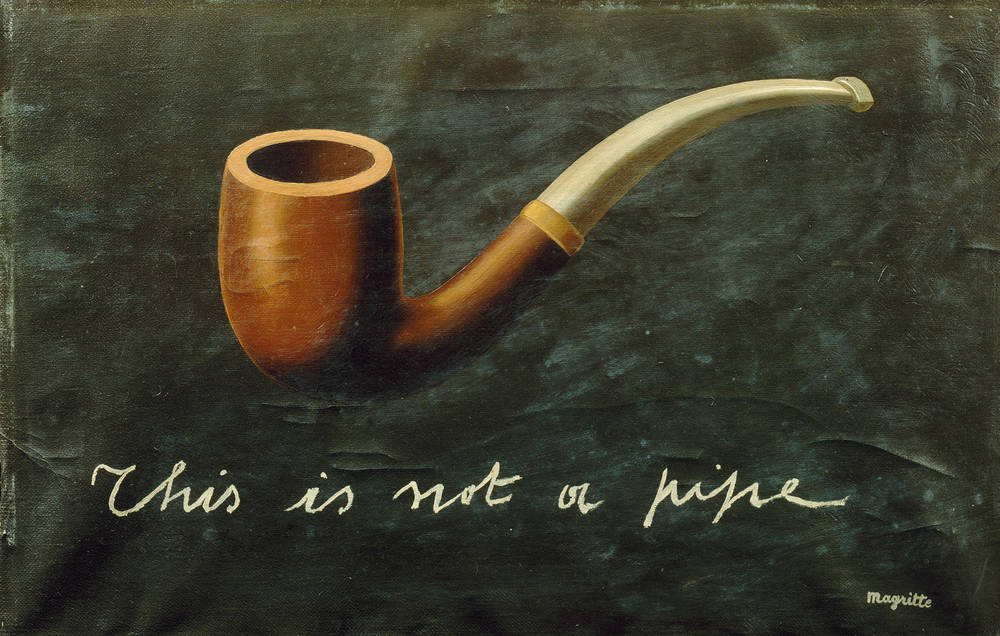
That, as a point, is best summarized by the Treachery of Images. Belgian surrealist artist René Magritte demonstrated quite aptly in his painting, This is Not a Pipe, that a rendition of a thing is not the thing itself. An important distinction, which gives artists and authors license to create art which exists beyond the scope of the mind which formed it or the society which indulges in it. This as a concept is, what I'd consider, a precursor to Jacques Derrida's Deconstructionism. The philosophical and literary stance that words and writing lack inherent meaning, that the meaning of words only exists through contrast and that very inferred meaning is both fallible and unsettled.
Conclusion:
Reading: