I heard from elsewhere that Al Gore technically won but somehow George W. Bush won through intrigue somehow. I am not American so I don't really understand the context. What happened in the 2000 USA election?
I am not a trained historian, but rather a Political Science guy, but I feel qualified to answer this. The 2000 election for those of us too young to remember was a shitshow. In fact, news stations had to recall their initial projections twice. Following the election night drama, the election continued on for almost a month before ending in a controversial supreme court decision.
Let us start with election night itself. Early in the night, major networks called Florida for Al Gore. NBC was the first network to call it at 7:50 p.m. EST, but quickly the other major networks called it as well. However, as the night grew older more and more data came out of Florida that implied the calls were too early. Two hours later, CNN retracted their call after noticing a change between what the polling data they based their call on, and the actual results that was streaming on. Following the CNN call, the other major stations withdrew their decisions as well.
Then early the next morning a little after 2 am, most of the major networks (CNN, FOX, CBS, etc.) called Florida for Bush (AP being the only exception). However, this devision would also be recalled around two hours later, as more votes came in which favored Gore. The final results on election night showed Bush up by 1,784 votes which triggered an automatic recount.
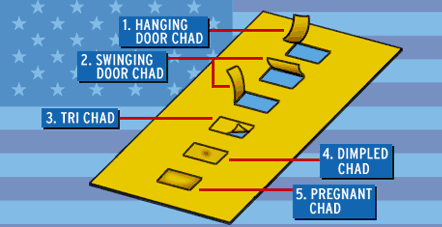
The automatic recount brought up a lot of questions. Because of the way Florida conducted its ballots in 2000, there were some ballots that had trouble being counted. Florida used a ballot similar to a push-pin, where you pushed out a dangling (or chad as they became known) to vote for a candidate Occasionally, the chads so to speak on these ballots would not be fully disconnected resulting in a hanging chad, which the voting machines could not accurately read. This lead to even further confusion in the counting.
After conducting the first recount, the new official total showed Bush with a 537 vote lead. Because of how close this margin was, both the Bush and Gore campaigns filed legal briefs and cases to try and get support. Although Gore won at the Florida Supreme Court, ultimately, the United States Supreme Court ruling in favor of Bush in Bush v. Gore. This ended the recount and was decided on partisan lines (i.e. the five conservatives on the court voted in favor of Bush and the four liberals for Gore).
Now comes the ultimate question, was the election stolen. First off, there is no concrete evidence that Gore would have won the election. A group of media organizations conducted an extensive review of the disputed ballots that were ruled on in Bush v. Gore and found it would not have decided the election in favor of Gore. However, they also didn’t claim that Bush certainly won the total vote. Besides the over 43,000 votes that were at stake during Bush v. Gore, there was an even broader group of 175,010 ballots that was rejected in other counties.
The election of 2000 in Florida was basically a statistical tie. The votes that were counted under Florida Law resulted in Bush winning by 537 votes. Either candidate could probably have claimed victory under this close of a race, but the systems favored George Bush (the Florida Secretary of State was Republican and the Supreme Court of the US was controlled by Republicans). So in my mind, it was not a stolen election just an uber close election where the system benefited Bush.
Sources (I used a lot of newspaper articles because I believe this is a time period and event where the articles are just as relevant to establishing what happened as academic journals): https://www.washingtonpost.com/wp-srv/aponline/20001108/aponline183922_000.htm https://results.elections.myflorida.com/Index.asp?ElectionDate=11/7/2000&DATAMODE=
"The 2000 Presidential Election: A Statistical and Legal Analysis" by: Richard A. Posner. https://www.jstor.org/stable/3655316?Search=yes&resultItemClick=true&searchText=bush+gore+recount&searchUri=%2Faction%2FdoBasicSearch%3FQuery%3Dbush%2Bgore%2Brecount&ab_segments=0%2Fbasic_search_solr_cloud%2Fcontrol&refreqid=fastly-default%3A10adb61f9fc83eeb386bcec0fc3a7af6&seq=7#metadata_info_tab_contents
https://www.baltimoresun.com/bal-00election31-story.html
Edit: slight correction of the ideology of the judges (I changed democrat to liberal, and republican to conservative) because as u/overzealoustoddler pointed out it was not technically accurate.
Obviously, the answer to this question is no from a legal perspective. Bush was legally the winner of the 2000 election, and he attained the presidency by victory in the electoral college as required by the Constitution. However, one could argue, and I am trying to choose my words very carefully, that Bush's election was a failure of democracy as it appears he should not have won.
So, the big deal is the Bush v Gore case and specifically the presidential vote in Florida. So, if you understand the way American presidential elections work, then you already know you need to receive the majority of electoral college votes to win. Not many foreigners understand that each state decides how these electors are distributed, but most of them, Florida included, awards all of its electoral college votes to whichever candidate has the simple majority plurality. In the 2000 election, Florida's 29 electoral college votes were enough to give either candidate the win as the other states were tied. The first official tally of the votes was called as a victory for George W. Bush. Also, the difference in votes in Florida was less than 1% that year. Florida has an election law that automatically recounts when the difference is less than 1% which was triggered in this case. Now, most of the dispute came over these recounts.
So, Florida at the time used a punch card system for voting which has since been replaced. One of the reasons is that there was a chance (I will simplify) of hardware failure that could make a vote uncountable by the machine reader, and since the final vote difference between each candidate was actually less than 0.1%, the hardware failure rate could actually change the result. Specifically, since the problem seemed to have to do with how hard you punched the card making unclear marks on the ballot, and it was postulated this could affect senior populations very much which are a large part of the Florida constituency. So, the Gore campaign specifically filed for hand recounts of the ballots in specific counties (those favorable to him) at the Florida Supreme Court because a human could more accurately count ballots because of the hardware failure issue though some saw this as a political ploy to try and magic more votes since his supporters may be inclined to give him the benefit of the doubt on unclear ballots. Still, the Florida Supreme Court ruled in favor of Gore and ordered the recount including the counts by hand as requested in accordance with Florida statutes. Now, another part of this is that the Florida Law for recounts also has a time limit to produce those results before electors are decided upon. So, Florida polling stations only had a limited time to perform this recount, but it got underway.
Now, Bush not wanting to have his initial victory overturned sued in the Federal Supreme Court in the case Bush v. Gore. His argument was generally that because each polling location was counting votes based on different criteria (which was true, each polling place was just trying to do their best on a short schedule) that this violated the Equal Protection Clause of the U.S. Constitution. Basically, treating and counting different peoples votes under different criteria was unconstitutional and the supreme court agreed. The federal supreme court ordered the recount to stop, and, most importantly, there was now no more time left under Florida Law for a recount before that elector designation as I mentioned earlier. So, the clock just ran out, and the initial call for Bush was upheld. Now, this meant that the election really fell apart because of the Florida Division of Elections not producing an effective, fair, uniform criteria for the recount which the Supreme Court ruled could have been done legally. If they had, the recount might not have been stopped, and if there wasn't a time limit, the Division of Elections could have created criteria and had a full recount, but the law was what the law was.
Now after all that was over. Several groups were able to study the ballots and do a review of the recounts based on specific criteria the state could have utilized for these ballots. The results were mixed in that different criteria produced different results for either Bush or Gore which gives some validity to the federal Supreme Court Arguments. However, one of the most comprehensive studies was the Florida Ballots Project which compared a great many ballots from the entire state that were both considered illegible for counting as well as some that were recounted which accounted for about 3% of the total vote. Their findings were pretty damning in that their review from almost every criteria would have given Gore the election had these ballots not been considered invalid due to those hardware failures I mentioned earlier.
TL;DR - Bush won legally, but Gore lost because of voting machine errors and the fact that Florida had a time limit on recounts and failed to establish statewide uniform criteria for hand recounts.
Edit: just a quick thank you for the gold
One issue most people consistently leave out when addressing this question is the voter suppression efforts of the Florida G.O.P. in 2000. " More than 12,000 eligible voters – a number twenty-two times larger than George W. Bush’s 537 vote triumph over Al Gore – were wrongly denied their right to vote in Florida," according to the Brennan Center for Justice.[2]
These voter suppression efforts were led by Katherine Harris, Florida’s secretary of state, charged with overseeing an impartial election; she was a Republican who served as co-chair of Florida’s Bush for President election committee and appointed by Florida’s governor at the time: J.E.B. Bush, George W. Bush’s younger brother.
Due to the controversy surrounding the Florida election results in the year 2000, "The U.S. Commission on Civil Rights conducted an extensive public investigation of allegations of voting irregularities during the 2000 presidential election in Florida. The investigation, utilizing the Commission’s subpoena power, included three days of hearings, more than 30 hours of testimony, 100 witnesses, and a systematic review of more than 118,000 pages of pertinent documents state that statistical data, reinforced by credible anecdotal evidence, point to widespread disenfranchisement and denial of voting rights." [1]
The U.S. Commission on Civil Rights found that:
This disenfranchisement of Florida voters fell most harshly on the shoulders of African Americans. Statewide, based on county-level statistical estimates, African American voters were nearly 10 times more likely than white voters to have their ballots rejected in the November 2000 election.
Poorer counties, particularly those with large minority populations, were more likely to use voting systems with higher spoilage rates than more affluent counties with significant white populations. For example, in Gadsden County, the only county in the state with an African American majority, approximately one in eight voters was disenfranchised. In Leon County, on the other hand, which is home to the prosperous state capital and two state universities, fewer than two votes in 1,000 were not counted. In Florida, of the 100 precincts with the highest numbers of disqualified ballots, 83 of them are majority-black precincts.
Even in counties where the same voting technology was used, blacks were far more likely to have their votes rejected than whites.
Now, while it is impossible to say what percentage of the people denied the franchise in Florida in the 2000 election would have voted for Gore rather than Bush, the groups this disenfranchisement fell on most harshly significantly favored Gore over Bush, which is at least suggestive that without the Florida G.O.P. putting their thumb on the scale, Gore would have beaten Bush. It is also important to point out that this does not implicate Bush in the cheating, but rather some of the highest ranking members of the Florida G.O.P. most notably, Katherine Harris - it also does not directly implicate JEB Bush either, however his position and responsibility in appointing Harris may be taken as somewhat suggestive as to his culpability.
[2] The Brennan Center for Justice's A Guide to Voter Caging
There's a lot to this election, but let's focus on your question - Did George W. Bush(GWB) steal the election through some nefarious means? The answer there from a legal standpoint is "no, he did not". He exercised his ability to challenge decisions in court, and the court ruled in his favor. This is no different than literally thousands of other court cases. There has never been any realistic evidence that GWB cheated or did anything illegal to gain his win.
First, to set the stage, let's talk about how the USA elects presidents. The USA does not elect presidents by popular vote. Rather, we elect presidents through use of an "electoral college". There are 538 electors, and each state gets a number of electors that is equivalent to its number of elected senators and representatives. The fewest a state can have is three. There are also three given to the District of Columbia. Each state decides how to apportion their electors. The most common method(48/50 states) is all-or-nothing, majority wins. This means that the candidate who wins a popular vote in a particular state gets all of that state's electors, regardless of how close the vote is.
So let's go back to 2000. At the end of Election Night, GWB had 246 electoral college votes and Al Gore had 250. 270 electoral college votes is the majority, and whoever gets 270(or more) wins. There were three states outstanding, but Florida had 25 electoral college votes and thus was the lynchpin. Whoever won Florida won the race.
As Election Night wore on, the state was called for Gore and GWB at different times by the media. It's worth noting that this carries no legal or electoral weight of any kind. By the time the count was finished, the margin between GWB and Gore in Florida was 1,784 votes, with GWB up. Under Florida law this triggered a mandatory machine recount. This meant feeding all of the ballots back into automated counting machines. That recount narrowed the gap to approximately 300 votes, still in GWB's favor.
Over the next several days there was a lot of argument over recounts, what kind of recount(manual or machine), and where recounts would be held. In general, Gore wanted manual recounts in specific counties, where GWB argued that a recount had to be statewide or it was invalid.
Eventually, this argument reached the US Supreme Court, the highest court in the land. I need to digress for a moment to explain a few things about the construction of the US legal system. In summary, we have a federal system and 50 individual state systems. Each state decides how they vote, how they accept ballots, what counts, et cetera. The US federal government does not tell states how to run elections, even for federal races. There's one giant exception here, though - state elections not violate the US federal Constitution. The federal courts can step into virtually any state-level matter if it violates the Constitution.
GWB sued to stop the recount, arguing that it was in violation of the US Constitution. The argument was made on two grounds: first, that it violated the Equal Protection Clause of the US Constitution, and second, that earlier decisions made to allow the recounts violated Article II of the US Constitution. The Article II argument did not stick, but the Equal Protection argument did.
Each Florida county was recounting independently, using their own criteria for manually judging ballots. This would mean that two identical ballots could be counted differently in two separate counties. By a 7-2 majority, the US Supreme Court agreed that this was a violation of the Equal Protection Clause and thus the current recount could not continue as it was unconstitutional. Of note, the 7-2 majority included both conservative and liberal justices(both sides) and it was really an 8-1 decision, as Justice Souter agreed that it was unconstitutional but disagreed on the reasoning. Only Ginsburg thought this was constitutional.
The bigger issue was what to do about this. The general agreement was that a state-set process, that was the same county-to-county, would suffice to overcome this ruling. However, there was a timing problem. State certification of electoral votes was due on December 12, and a certification done by December 12 in accordance with state law was automatically Constitutional. Florida had already stated that they would be done with the certification by December 12. The Supreme Court heard oral arguments in the case on December 11 and issued their ruling on December 12.
The more controversial decision here is the 5-4 decision, along ideological lines, that the issue be remanded to the Florida Supreme Court for "or further proceedings not inconsistent with this opinion". Given the prior Florida rulings, this effectively ended the recount, although it was not ordered as such.
Both decisions were controversial, the second more than the first. The controversy around the second stems primarily around whether the USSC should have ordered Florida to proceed with a recount and to miss the deadline. There's also an argument that the USSC could not do that as the lack of recount does not constitute a Constitutional violation that the USSC could repair.
In short, while the final answer(no more recounts) was controversial, the declaration that Florida's planned recount was much less so.
We may never actually know.
Full disclaimer, this may get removed as I'm not a historian. I am, however, an attorney. So, I can talk a little bit more about the legal battle behind it.
On the night of the election, a slew of news networks called Florida for Al Gore. However, they did so before the polls actually closed. However, after the polls actually closed, Bush took the lead by over 100,000 votes. Gore called Bush and conceded. As the night drew on, it became apparent that the race was actually closer than anticipated. The day after the election, Bush only had a lead of 300 votes. Gore called Bush and rescinded his concession. As overseas ballots were counted in the following days, Bush's lead grew. Thus began the five week legal battle to determine the winner of the election.
Regardless, the Florida secretary of state declared the election for Bush and the Democrats demanded a recount in certain counties where "undervote" was particularly prevalent. The "undervote" was a result of "hanging chads" -- ballots where the hole wasn't entirely punched through. It was unclear if these individuals intended to vote for a certain candidate and failed to actually punch all the way through, or if they began to punch and changed their mind. This led to "undervote": where the machines tabulating the ballots were unable to register ANY vote for president on around 9,000 ballots in Miami-Dade county (a heavily democratic area)
The initial stages of the recount also led to an examination of the infamous "butterfly ballots" -- an infamously confusing ballot setup. As you can see from the photo in that article, it's confusing. The first punch is for Bush, the second for Buchanan, the third for Gore. Buchanan, a conservative third party candidate, received many votes in heavily democratic areas, leading some people to believe that many people who intended to vote for Gore selected the wrong hole punch.
The Florida Supreme Court ruled that a "legal vote" was one where the intent was clear from the ballot and ordered a manual recount of the ballots in Miami-Dade County. They also empowered state officials to order, if necessary, a recount "in all counties that have not conducted a manual recount or tabulation of the undervotes ... [and] to do so forthwith, said tabulation to take place in the individual counties where the ballots are located..."
The US Supreme Court, however, reversed the Florida Supreme Court's decision. In a 7-2 decision, in Bush v. Gore they held that ordering a few specific counties to recount -- but not ALL counties -- violated the Equal Protection clause of the Constitution. In effect, they reasoned that the ballots in counties NOT subject to a recount were not given the same protections as those in a county in which there was a recount. In effect, they needed a statewide recount or no recount.
In that same case, the Supreme Court held, 5-4, that there was no alternative vote procedure that could be established in a timely manner that would satisfy the Equal Protection and Due Process concerns. This is the portion of the ruling that effectively ended the election and gave Bush the presidency.
The narrative of stealing the election primarily comes from the Bush campaign's legal efforts to stop the recounts and declare him president. Whether that is actually true, we may never know. The recounts were halted. The truth behind the mysterious Buchanan votes was never uncovered. Bush became president.
Later reports found that the "overseas" ballots which widened Bush's lead were not treated with the same standards as other votes -- with officials sometimes ignoring errors or double counting ballots. On the other hand, later reports also found that Bush maintained a lead within the disputed ballots.
Ultimately, whether or not Bush won the election the Supreme Court decision is particularly relevant today. In Bush v. Gore, the Supreme Court was willing to step into and modify a state's procedure for determining a presidential election. This precedent may soon again become relevant in the coming weeks.
To win the Presidential election you need 270 electoral votes. Each state has a certain number of electoral votes they can award a candidate (based on population of the state). In the 2000 Election, whoever won FL would win the states 29 electoral votes and achieve the required 270 votes and be the President of the United States.
Background: the governor of FL at the time was Jeb Bush (George Bush’s younger brother) and the FL Secretary of State was Katie Harris (a republican, same as Bush).
FL voting system: they used a butterfly ballot which means you essentially punch a hole in a ballot to select your choice for president. This voting style was confusing to many people and not every hole punched went completely through the ballot. Because the ballot was confusing, a third party candidate Pat Buchanan received an abnormal amount of votes. Specifically, he received 3,500 votes from a very left leaning county even tho he was an ultra conservative.
So with that background knowledge, on November 8th of 2000, Florida declared George Bush the winner of FL with 49% of the vote and beating Al Gore by less than 2,000 votes. Because the margin of victory was within 1%, the state is required to do a mandatory automated/machine recount.
After a few days, the automated recount came back and now Bush’s lead was reduced to only 327 votes. Later analysis showed that 18 of FL counties (which account for nearly 25% of all votes) did not complete the required automated recount. Additionally, residents of FL came out saying they were confused by the ballot and accidentally voted for Pat Buchanan. Even Buchanan came out publicly to say he believes these residents did not vote for him and the votes in those very left leaning counties should go to Gore (3,500 votes). This was request was denied and those votes stood for Buchanan.
Because Gore and his campaign never challenged the automated recount and couldn’t fight for Buchanan’s votes, this result stood. However, FL law allows for a campaign to request a manual recount of the votes in specific counties. The Gore campaign requested the recount of 4 counties that are traditional very pro democrat. These manual recounts are required to meet a mandatory deadline of 7 days.
The mandatory recounts are supervised by members of both parties to ensure accuracy. But instead of ensuring all votes are accurately counted, both sides would repeatedly argue over which ballots had been filled out correctly and would attempt to throw out ballots against their party. The reason these ballots were disputed is because of the Butterfly Ballot or hole punching ballot. When you punched a hole in the ballot, some did not go through all the way. This allowed parties to say that because the hole in the ballot was not completely through (known as a “hanging Chad”) it should be tossed out. This lead to arguments over how deep a hole must be punched to qualify. By the time the deadline hit, no county had finished their recount and the FL Secretary of Stare refused to extend the deadline. It was expected on Nov 18th, the FL Secretary would conclude the winner of FL was Bush.
However, on November 17th the FL Supreme Court stepped in an declared that no result could be finalized until they heard the appeals of the court cases already in process. A few days later, the FL Supreme Court ruled that the manual recount should continue and they extended the original deadline of November 14 to November 26. However, because of the hanging chad issue, most counties did not complete the recount and on the Nov 26 the state of FL declared Bush the winner by 537 votes. Gore understandably challenged this ruling.
The FL Supreme Court ruled that all ballots (around 70,000) in question must be manually recounted.
But on December 12th, the US Supreme Court ruled that the FL Supreme Court decision for a recount was unconstitutional by a 7-2 vote. Then by a 5-4 vote in the US Supreme Court, it was ruled that time had run out for a recount and Bush is the winner of FL. The US is very ideology driven and the 5 conservatives in the court ruled for Bush while the 4 liberal judges ruled for Gore.
Adding fuel to the fire Gore won the popular vote but lost 271 to 266 in the electoral college.
It depends on who you ask and how they counted the ballots.
NORC did a study in 2001 and found that Gore would have won by between 60 and 171 votes had the full by-hand recount of all disputed ballots been conducted, depending on what criteria was used to read them.
However, it's not accurate to claim that Bush "stole" the election or used "intrigue". The official count was "the official count" when Gore conceded. It is still the official count in the public record. The actual, factual count is incredibly difficult to determine, simply because of the type of ballots used by FL in 2000. The design is poor from the start - voters used a little tool to punch out a perforated section next to their chosen candidate. However, what do you do with a ballot that is only partially punched and the perforated section is not fully removed? You may have heard the term "hanging chads" - this is what the phrase refers to. What about ballots where the voter didn't press hard enough and the chad is clearly depressed, but not actually detached? There's a lot of room for ambiguity, and whether a ballot has been clearly cast for one candidate or the other is open to interpretation. There's also room for voter confusion, as the Gore/Lieberman ticket is the second option in the left hand column, but you need to punch the 3rd hole to select it. The 2nd hole is actually for the first option in the right column. Not a very clear layout.
What really determined the winner in 2000 was how the ballots were counted and when they stopped counting. Gore wanted a full by-hand recount in four extremely close counties with a lot of ambiguous/questionable ballots. Bush didn't, since he was winning based on the by-machine recount. Initially the FL courts ordered a statewide, by-hand recount of only "questionable" ballots, but the US supreme court put a hold on that because different counties count votes differently and it would fall afoul of the equal protection clause. Gore could have (and arguably should have) pressed the issue further in the courts, but he didn't.
Had he appealed using specific counting standards, it likely would have been permitted. Depending on what those standards were, he probably would have won. But by that point it was already mid Dec. and everybody was completely fed up with the whole process. The public just wanted it to be over. The Bush campaign had spent the last 5 weeks pushing the narrative that Gore was a sore loser and he was dragging the whole country down rather than just admitting he lost. Public opinion was starting to agree with the spin. At the advice of his lawyers and advisors, Gore officially conceded on 12/13/2000.
The results of the election may well have been inaccurate, but it was certainly not "stolen". It was (and still is) somewhat ambiguous who the voters in FL really intended to choose.
For further details (especially about all the complex legal wrangling on both sides), check out Deadlock: The Inside Story Of America's Closest Election by David Von Drehle.
Strictly speaking, this question is still subject to the 20 year rule, right?
Florida was not the only state whose count was in question. I don’t see any answers addressing the integrity of the Diebold voting machines in Ohio. Can anyone qualified to answer in this sub speak to that?
related question -
Is there an estimate of voters going home in western Florida after the state's winner was announced?
The theory and anecdotes on the news said that western Florida, sticking into the Central Time Zone, ran a bit more Republican and rural, and they closed an hour later. Near the end of the day, some reporters were announcing a winner for the state while they had not yet voted, then some amount of more-Republican voters gave up and went home before voting. Was it 10? 100? 10,000?
Is this real or is this talk-radio bellyaching?