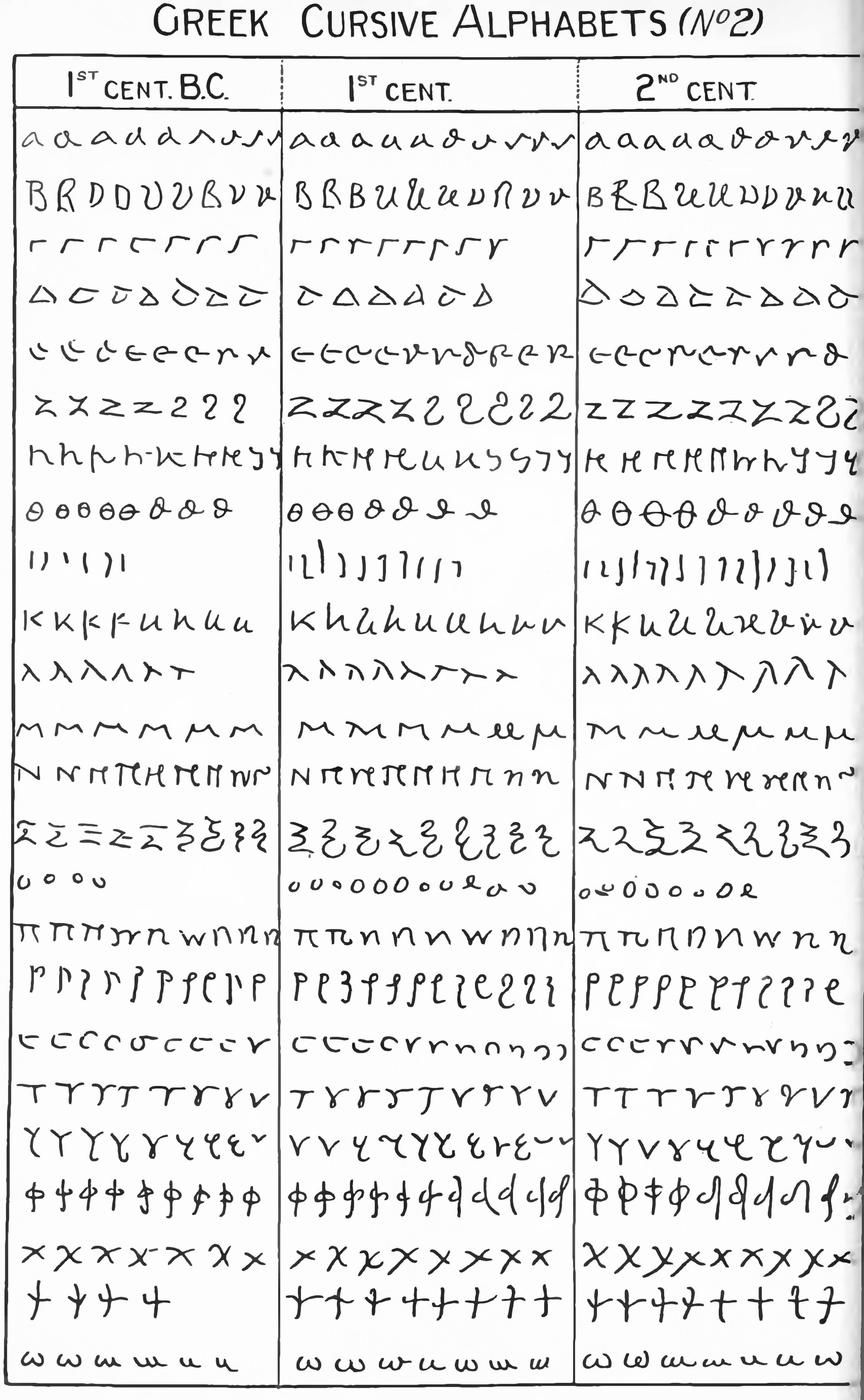
Were lowercase letters, such as α, β, γ, and δ commonly used in Greek manuscripts around the 2nd century? I'm particularly interested to see if Phlegon of Tralles used such lower case letters in his works when referring to certain dates.
"Lowercase" letters as we know them today are a post-classical style. But in your time period, the 2nd century CE ie the Roman Imperial period, there were separate styles for inscriptions (the regularized majuscule forms) and for writing on papyri. When writing on papyri, and we have thousands of examples from this time, the letters trend towards a mix of uncial and cursive forms. This chart (from Thompson) gives a good idea of the variations (right hand column). Αα in particular shows similarities to what will be "lowercase" Byzantine style later, as does Κκ, Ηη, Μμ, Υυ. These unicode Greek letters here, from my macbook Greek polytonic keyboard, also tend to be more blocky and simplified than typical Greek "lowercase" as you would find in an Oxford or Cambridge text. The variations between these letter styles could vary wildly within the same document, the same paragraph, the same sentence, and even the same word, with two eta barely resembling each other while separated from just a few letters.