I have a Ph.D. in history and my speciality is the history of Atlantic piracy during the 17th and 18th centuries, particularly their public executions. I’ve been a guest on podcasts such as You’re Dead To Me, and most recently you can find me on the new History Channel show, Beyond Oak Island.
Further proof is my website . You can find me on Twitter: @beckalex
My first book, Why We Love Pirates: The Hunt for Captain Kidd and How He Changed Piracy Forever, comes out today in the US in paperback, audible, and ebook (December in the UK). My book is based partly on my dissertation but also goes deeper to examine how the pirate, Captain Kidd, influenced perceptions of piracy that last to this day.
I’ll be here between 9:00 AM and 1:00 PM EST to answer questions about all things pirates and my book! Looking forward to it!
EDIT: Wow, this has been SO much fun! I have to sign off now but thank you so much for asking me questions today!
Great question! Pirates have always been a source of complicated fascination. During the 17th and 18th centuries they were vilified as the worst criminals. BUT many of them were known to have support from plantation islands, North American colonies, and even governors because they brought banned goods into the colonies (aka non-British goods, which were blocked in an effort to destroy Spanish and French trade).
There was a real love-hate relationship. Merchants, of course, loathed pirates and people were scared of being robbed or killed. Most pirates weren’t actually that violent but a few bad eggs such as Edward Low and Charles Vane, kept this fear alive.
The fascination, though, comes from that time period. Pirates transcended social hierarchy and could have wealth and freedom unseen or unavailable to pretty much anyone else. People were drawn to that. If captured, they were publicly executed in front of crowds of hundreds of even thousands. Their trial transcripts were published verbatim along with their speeches at the gallows before their hanging and these would sell out right away.
In 1724, Captain Charles Johnson published the book A General History of the Pyrates, which is a collection of detailed (and embellished or even fabricated) pirate biographies of the most infamous pirates of the time. It was an instant bestseller and is still in print today.
Robert Louis Stevenson used this book as a source when he wrote Treasure Island (1883), which gave us the tropes of buried treasure, “x marks the spot,” peg legs, and “arrr matey.” This was a smash hit and would go on to inspire virtually every piece of pop culture up to today.
Hi Dr Simon, thank you for doing this AMA!
Modern depictions of pirates go heavily in on their depiction as rum swilling drunkards. Do we know what pirate rum consumption was like? How did they get hold of their Rum? I'm assuming there wasn't a Port Royal Off-licence
Thanks for doing this! I have 2 questions- 1 more academic and 1 more fun.
How famous were individual pirates during the Golden Age? Would merchants and sailors know an area to be filled with pirates or a specific pirate? I guess this could kinda be asking if that's how someone like Blackbeard gets dubbed Blackbeard.
What's the strangest story from a pirate execution that you've found?
I am hoping you and your field can help unravel the entwined Cornish-Pirate story. Coastal wreckers famously became "The Pirate of Penzance"- even though wreckers used only boats as opposed to ships (and stayed to the coast). And the Cornish dialect famously contributed to the cliched dialect of pirates in film (that's right, is it not? - I may be wrong!). Cornish sailors were ubiquitous internationally, but I am unclear how much of the connections with seafaring pirates is hype (or is that folklore!) as opposed to reality. Thanks in advance for your thoughts.
I have a Ph.D. in history and my speciality is the history of Atlantic piracy during the 17th and 18th centuries, particularly their public executions.
Thats sounds quite specific. How did you end up being an expert for that?
I do have two more serious questions though:
There is a heavily romanticized vision of pirates today, and my impression is that it goes back at least to the early 20th century, but how far back can we trace the origin? Did pirates hold a romantic appeal with the public during the 17th/18th centuries themselves? If so, what did that look like? If not, when do we really start to see that develop?
I just finished Colin Woodward's Republic of Pirates and something that surprised me about that book was the depiction of fairly egalitarian, democratic, and racially equal ship "societies." While Woodward does balance the view, especially with regard to their perception of race (some crews seemed to see slaves as potential volunteers for equal standing among the crew, some just viewed them as another kind of cargo) I was wondering if this was something of an oversimplification. I know we can sometimes fall into the trap of viewing a 17th/18th century phenomenon through a 21st century lens and coming up with something that matches our own society instead of reality. So how democratic was a pirate ship? Would it vary captain by captain, or is there a general trend to speak of?
Hands down best AMA ever hosted on reddit.
So cool! Thanks for doing this
My question is: What do we know about the religious beliefs of pirates, particularly with regard to their ethical choice of making a living, ie stealing?
I am aware many Pirates considered themselves religious, and many Captains were bible carrying itinerants who saw themselves as ministers, and their crews were often deeply devout. How did they square that with stealing for a living?
Thanks for doing this!
In modern pirate media, there's often a "mystical" East Asian/Qing-empire style Chinese character, such as Chow Yun-Fat's Sao Feng in Pirates of the Carribean 3. Is this based on any kind of historical reality? I know that there was a significant migration of Chinese people to the Carribean in the middle of the 19th century, but is there any historical documentation or interesting anecdotes of Chinese people being involved in Atlantic piracy in the 16th or 17th centuries? Was there any connection at all between East Asian piracy, Singapore, etc and Atlantic piracy, or is that purely the realm of historical fiction?
Pop culture often assigns some Caribbean harbors the role of safe havens for pirates. Is this based in reality? How did these seemingly lawless communities emerge"?
Did pirates really have an affinity for pet birds? Like what purpose would a smack talking parrot serve?
Hello! I just made a podcast episode on European pirates in the Indian Ocean. One thing that came up in my readings often was pirates who found home in Madagascar. Do you have more information on their life in Madagascar? I read about Libertatia(sp?) and I am fascinated about the “lawless” actually making laws! :)
You mentioned that Madame Cheng was able to retire from piracy. Were there any Atlantic pirates who were similarly able to retire and "go legit"?
Hello,thanks for the AMA! I've often heard pirates were more open minded in general, and know there were women who disguised themselves as men as an example to join on ship- including two that apparently were kind of together romantically. Which leads me to wonder about two things really.
How many lady pirates were there really, and how accepted was it?
How did pirates treat LGBT stuff? I mean; would gay pirates have existed and how would it have gone for them?
I've seen a few writing prompts about gay pirates so I wondered how close/far from reality it would be. I'm reading your other answers too because this is super interesting!
Hi! This is great, thank you for answering our questions today! I have two:
What type of ship would pirates normally sail? The bigger the better? A fast one? A warship with lots of guns? Whatever they could get their hands on?
I'm a bit of a nerd about historic fencing. So I was wondering, did your average pirate have any formal training for the weapons they used? We're there regular drills on the ship, did the experienced folk teach the newbies what they knew?
Hello! So what is the historical consensus on Captain Kidd? Rapacious scallywag or framed privateer? I read his biography years ago, and remember the author suggesting that his condemnation for piracy is today considered unjust.
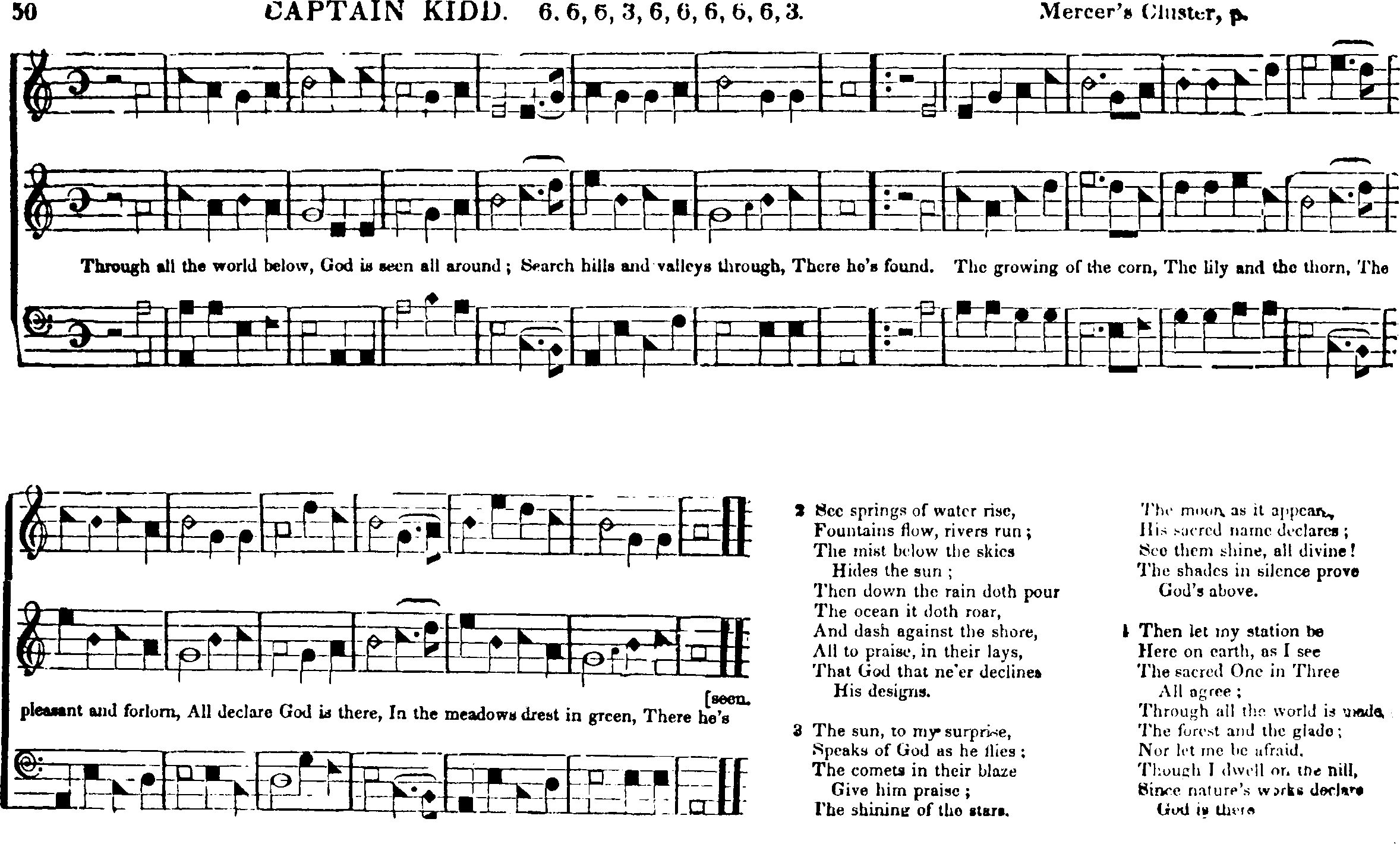
Just poked around your website a bit—have you introduced the hymn tune Captain Kidd to your choir?
Hi Dr. Simon, Thanks for doing this AMA!
In modern video games like Assassin Creed: Black Flag and tv-series such as Crossbones, there is a persistent theme of pirates wanting to form Nassau into a literal Pirate Republic.
I was wandering how pervasive this notion or idea of the pirates forming thier own republic was among the pirates themselves, if it even existed?
Were there any type of formal "government" structures in place?
Were some captains or notable figures a staunch opponent or proponent of this way of thinking?
Or is it just a modern notion that we have used to justify their actions, and dream about "what could have been" and how our notion of the pirates more fair and equal way of life might have been juxtaposed to the society at the time?
Approximately how many people took up piracy/committed acts of piracy during this age?
I know that, because these people were criminals, many names of pirates were never recorded. Only certain famous individuals/crews were remembered. But not everyone who set sail under their own flag would become Blackbeard or Calico Jack.
Along the same line, about how many women sailed as pirates in the Caribbean during this era?
Sort of off-topic, but what is your opinion of the movie, "Master & Commander: The Far Side of the World"
One of my favorite books is Under the Black Flag by David Cordingly. I'm looking forward to reading yours!
How aware of the "Golden Age" were people whilst it was happening?
Piracy has been going on for as long as maritime commerce has, since prehistory, so would there be any notion of pirates acknowledging a long tradition of nautical robbery? "We're basically doing what those Cilicians were doing 1700 years ago... Only golden".
Have you watched the series Black Sail? What is your opinion on the series?
What was Tortuga actually like?
Hi Dr Simon! I'm looking forward to getting your audiobook. I have a bunch of questions, and I'm now going to panic to try to remember as many as I can.
There's one resource I'd really love to see, if it exists, which is basically "How to be a pirate captain". I've long wanted to see, I suppose, a sort of glossary of all the things, such as commands given to crew, and what are the things that need doing aboard a typical merchant or pirate ship. What stations sailors would have, and what orders would be given to these men by the captain, etc
The most well known ones being the likes of 'Weigh Anchor' (Heave anchor to sail) or 'Batten down the hatches' (Close gaps in preparation for storm).
Do you have any recomendations for such a resource?
Furthermore, and I think if anyone knows about this, you might, but "Life aboard the ship", what can you tell about this? The mundane times. How many days can a pirate vessel go without seeing prey or land? And what happens in those days?
Lastly, for a typical merchant vessel in various routes (Do you have maps of the main routes and their associated commodities?) how dangerous would it be, and what precautions would be taken? I just imagine some sailors thinking "There's no point taking this sugar to the Spanish main, we will definitely be robbed".
Many thanks.
This is a great topic, thank you for the AMA! You mention public executions and I immediately think of the scenes in the movies where a ship is coming into port and sees the old executed pirates hung in cages as warnings. Were executions treated as big, public warnings? Would it be the kind of event the whole town would come to or something more sombre?
As a follow up if you don't mind, pirates these days feel strongly romanticized. Was in like that in the 17th/18th century as well?
A pirate starts getting a little old to keep up on a ship. What does pirate retirement look like?
Oh man this is right up my alley!
Question 1: Were there ever any daring, last minute escape attempts that happened during the execution proceedings, such as those we see in modern movies?
Question 2: Were any executions of pirates carried out by guillotine? It seems that the time that guillotines were popular was after the golden age had ended.
Thank you so much for doing this AMA! Like others in the thread I recently finished (and thoroughly enjoyed) Woodard's Republic of Pirates and it sparked a lot of interesting questions. One that comes to mind is: how much consideration was piracy given by the founding fathers of the United States? Or rather, was piracy still a prescient concern to the young nation? And generally what attitude did the new country's leaders have towards piracy and privateering? I know piracy was largely in decline by 1776 but Woodard didn't go into much detail about the lasting influence of piracy.
Apologies if this has been touched on already, I won't have time to read through your other responses until after work. Thanks again for doing this AMA!
In light of piracy being still a problem in some parts of the world to this day, is there concern among historians on the romanticized depiction of pirates in popular media, particularly children's media, which shows them as fun-loving, treasure-seeking explorers? Is there a need for bringing more awareness of the serious dangers piracy actually posed?
My question is: how would someone go about starting a pirate business? Say I was a the average British citizen, how would I become a pirate captain?
Thanks for doing this AMA
Raveneau de Lussan believed that raids on Spanish settlements were justified because the Spanish were as he considered extremely tyrannical, were these sentiments shown by other buccaneers or did they see themselves as something different.
How exactly did trials of pirates work? Were they brief affairs where the outcome was obvious or were they sometimes able to get away with their lives? Would the entire crew be tried at the same time? And if they were caught in international waters, how would it be decided who tried them? Did they just go to the nearest port?
I have consumed media which paints 2 very different pictures of Jack Rackham.
Hi! Thank you for answering questions!
So I'm actually from Rhode Island, in New England, and I have always heard that R.I. was tied to the Caribbean pirates, that it was a haven where pirates could spend their ill gotten gains, earning it the name "Rogue Island". I even heard the story of Kidd coming to Block Island, and giving a lady a ruby the size of her hand for her hospitality.
So basically, my question is, how much of this is true? And do you have any other stories or details you could add, something of interest I could tell my mates over beers or a glass of Jamaican Rum?
Hi. The golden age of pyracy is one of my favourite parts of yiman history. I have 2 questions.
Did Charles Vane actually cry like a little girl before he was hanged?
And is David Cordingly book Spanish Gold, Captain Woods Rodgers and the pyrates of the Caribbean respected?
Would you download a car if you had the option?
You seem to have made a fairly smooth transition to public history (e.g., podcast guest, publications in more commercial venues, etc.). I've often thought about trying to move from my more narrowly focused scholarly work to something that reaches out to the general public and have no idea where I'd start. I mean, pirates are obviously an easier option with that than thirteenth-century intellectual history, but I wonder if there are any general principles involved.
Just out of curiosity, what do you think of the board game Merchants and Marauders?
In most films made about or including pirates, they tend to be English-speaking. Even though Spanish, French and Dutch pirates were also active in this time and space.
Were the British the predominant ethnicity among actual pirate demographics?
Do you think Henry Every got away with his wealth?
What is your best guess about what happened to Henry Avery after he punked Aurangzeb I? Do you buy the stories about him escaping to Scotland and dying a pauper, or do you have a different theory?
Thanks for holding this, I have a few questions.
1.When looking for ships to plunder, would pirates usually know which ships they were going along with their cargo and location by acquiring knowledge from informers before leaving port, or would they mostly wander around on the most known trade routes?
2.Was raiding of coastal settlements in the New World something common, or was it too risky?
Who would you consider the most successful pirate? And is there any point when pirates' trend transited from pillaging off-shore commercial cities to attacking on-sailing ships?
This is the part of history I would like to know most about, so I'll absolutely be picking up your audiobook (or maybe even print, who knows)! My first question is a bit boring, but: What other literature do you recommend? I've been listening to a podcast on the history of the golden age of piracy, but it's quite dry, and I think a professionally made book/audiobook would be more captivating.
My second question is, what Caribbean, South American, or Central American countries/cities/places would you recommend traveling to in order to see some cool pirate history, museums, artifacts, etc? I'm hoping to do an extended travel through that part of the world after covid is under control, do you have any recommendations of places to go?
I've been a pirate lover my whole life, and have had a Renaissance of my love with the game sea of thieves! It inspired me to make my own pirate tabletop role-playing game.
I have a question about pirate treasure! I've heard that the trope of "buried treasure" was largely a fabrication of Treasure Island. If so, how did pirates store their stolen goods, gold, and valuables?
How was it stored on the ship? Where would the captain store their wealth vs. a crewmen? Would pirates have pirate bank accounts in friendly ports? Did ANY pirate ever bury their treasure, even just briefly?
I also heard that pirates mostly spent all of their money whenever they could given the lifespan of the profession! What would they spend that money on?
What were privateers of the time payed? How mutch of the cargo they stole went to their employers?
Are there any indications that treasure was ever buried or hidden?
What is a career path of a pirate like? If I were a lowly peasant and wanted to be a pirate captain with my own ship, how should I go about it?
How much (if any) new information about this age had come to light based on the work being done with the Queen Anne’s Revenge Project shipwreck find? Are there another notable shipwrecks finds from this era?
What books would you recommend (other than yours, which I have already acquired!) to learn more about the history of pirates on the golden age of piracy - not just atlantic/caribbean, but worldwide (such as Madame Cheng or Madagascar)?
Heya, i know i'm probably late about it, but i'd like to know if you had any informations about what kind of weapons pirates and privateers would use during this era, and where would they come from ?
Most of the informations found online refers vaguely to certain types of weapons, and while some get a little more specific, it's never really clear and often the best you can find is just broad categories of firearms and stuff like that
Just bought your book and looking forward to reading it. Might I also obtain a copy of your thesis?
Hi, what kind of impact do you think Napster had on the music industry, Are there any impacts still felt today?