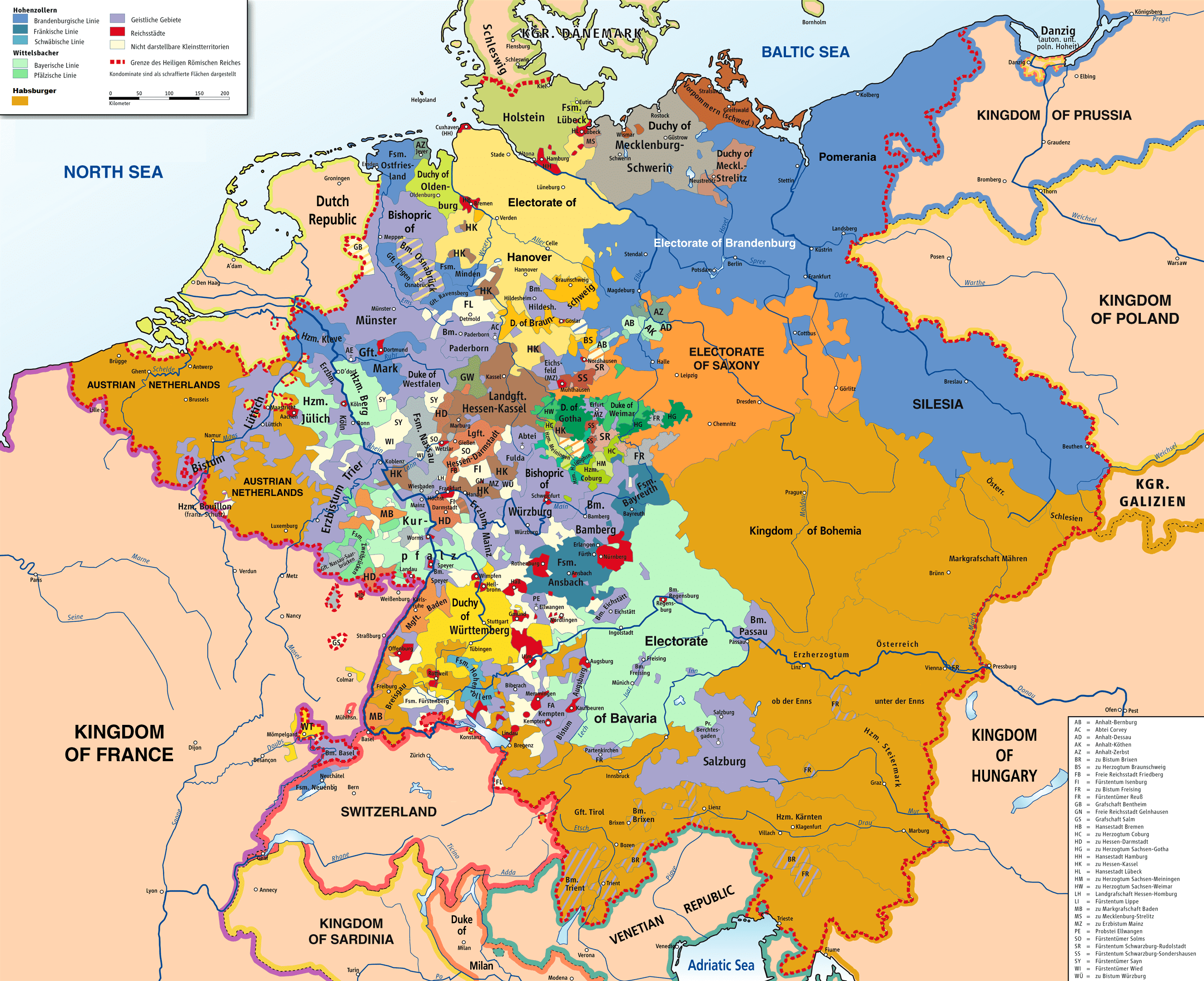
It seems that a lot of your questions stem from a fairly basis misunderstanding of the nature of the Holy Roman Empire. You're looking at the HRE as if its constituent polities are fully independent states, when that is not the case. Rather, it was a fairly decentralized feudal state that ended up with increasingly independent constituents (in relation to its neighbors) as time went on. Although the constituent polities were often at odds with the emperor, they were nominally under his authority and were reliant on the layers political and legal structures put in place over the centuries to protect the security and economic interests of the polities.
Unfortunately the HRE is a tremendously complicated thing to explain, so I'll try to answer your questions and you can throw in follow-up questions that you may have.
- The regions controlled by Prussia outside of the HRE - Ducal Prussia - were inherited by the Hohenzollern electors of Brandenburg in 1618 after the extinction of the ruling line in Prussia. At the time of the inheritance, Ducal Prussia was outside the borders of the HRE. While the Hohenzollerns ruled from Berlin and were nominally subject to the Emperor's authority, Ducal Prussia offered a degree of autonomy, and it provided an avenue for the Hohenzollerns to become elevated to a royal title (King in Prussia) - something that wouldn't have been politically feasible were Ducal Prussia within the borders of the HRE.
- The enclaves were a variety of different types of polities. Imperial Free Cities and Bishoprics made up many of these enclaves, but others were purely independent "regular" domains with imperial immediacy (not a subject of anyone but the Emperor). There also existed exclaves that were the result of similar kinds of dynastic maneuvering that resulted in the Hohenzollern inheritance of Prussia - the result of a ruler of one domain inheriting territory outside of their current domain. Though these inheritances could result in contiguous territory (see the Habsburg inheritance of Bohemia and Hungary), it could also result in non-contiguous territory (see the Western Habsburg possessions, especially in the Netherlands). These territories were sanctioned and protected by Imperial law. While they may have been vulnerable to attack (and were often occupied by enemy powers), their territorial integrity was (generally) respected in the aftermath of wars.
- Sovereignty in the modern sense didn't work the same way as we are used to today. Borders were significantly more porous, and neutrality in a war didn't necessarily mean an area's borders were closed to troop transit. In times of war, this can be seen in the campaigns of the 30 Years' War, where armies chased eachother across the country in the early stages despite the nominal neutrality of many of the states in the HRE. Even to the end of the HRE, we see incidents like Napoleon's Ulm Campaign, where Napoleon's armies swung across much of southern Germany to encircle and destroy an Austrian army.
- In the more specific terms of supply to the Netherlands, there existed a land route during the period where the Netherlands belonged to Spain known as the Spanish Road. This route, which passed from Genoa up through Spanish-controlled Lombardy and then through Switzerland and through Spanish Habsburg and friendly Imperial territories before reaching the Netherlands, was an important supply route for the Spanish as they tried to keep their hold on the region. While your map may make the Habsburg control on the Netherlands seem tenuous, the supply situation was actually more secure than that of the Spanish - they were de jure overlords of the Empire, which meant they could be more confident in the loyalty of those whose lands they would be marching through, and they lacked the vulnerable supply lines stretching across the Alps, giving them much greater flexibility in how they routed their forces.
- The situation between Hanover and England was that of a Personal Union. Personal Unions varied from place to place, but the general idea was similar to that of "inheriting" a country. The difference with personal unions like that between Hanover and England was that the decision was made to continue administering the two countries as separate states rather than integrating their administration as we saw with the Austrians or Prussians. For England, the differing succession laws between Hanover and England led to the end of the personal union in 1837 with the accession of Queen Victoria. Unfortunately, I'm not very familiar with the character of how the England-Hanover union was administered - it certainly appears to be portrayed as a largely personal (rather than administrative) union, with independence being retained by both parties, but that may not be the case.
- The proliferation of states in the Holy Roman Empire is the result of its medieval character and the failure to centralize the Empire along the same lines as was achieved in France and England. Duchies and Counties existed there as well, often with similar or greater levels of autonomy during the beginning of the early modern period, but these distinctions often aren't shown in maps the same way they are with the Holy Roman Empire. The HRE had the added complication of the ecclesiastical side of the Empire - with so much of its legitimacy drawn from the Catholic church, it had a number of ecclesiastical polities under its banner. There also existed numerous Free Cities, which were afforded special privileges and Imperial immediacy separate from "traditional" feudal polities. This system was very much a legacy of the medieval state, but it provided a useful system of patronage that could be used to protect the position of the Emperor. Land could be awarded to loyal vassals and revoked from those who were rebellious. Titles could be created or elevated, and special privileges (particularly for taxation) could be given to patrons, and the proliferation of smaller states provided more opportunity for patronage. Predatory states within the Empire would be hampered by the Empire's legal structures intended to protect the freedoms of the states, and larger states had their own self-preservation to be wary of. The first phase of the 30 Years' War showed that Electors were not immune to consequences of their actions when Frederick V of the Palatinate was declared an outlaw and the Upper Palatinate was awarded to Bavaria - all due to Frederick V's attempt to claim the Bohemian crown.
Hopefully that clears things up, though I'm sure there's plenty of room for more questions.
If you want better answers from a real expert on the subject, I'd suggest checking out "Heart of Europe: A History of the Holy Roman Empire" by Peter H. Wilson. It's dense, but it's a fantastic overview of every major aspect of the Holy Roman Empire.