This write-up in the Guardian covers most of the details. Those cited in the article are treating this as a literally unprecedented discovery that upends everything we thought we knew about etc. etc., but claiming this about discoveries of this sort is almost a trope at this point. I'm already seeing some wincing from friends who know more about ancient art than I do, so I'll ask here.
Is this discovery being oversold to the public? Is it even legitimate?
Are "readings" of the art that involve some of its more surprising contents defensible? I mean:
Their date is based partly on their depictions of now-extinct ice age animals, such as the mastodon, a prehistoric relative of the elephant that hasn’t roamed South America for at least 12,000 years. There are also images of the palaeolama, an extinct camelid, as well as giant sloths and ice age horses.
[...]
Some of the paintings are so high they can only be viewed with drones. Iriarte believes that the answer lies in depictions of wooden towers among the paintings, including figures appearing to bungee jump from them.
So, this is going to be a bit of a funky one unless we actually get someone in here who has seen these paintings (which is exceedingly unlikely). As such, we don't have much information to go on beyond the other documented rock paintings in the region.
- Is this discovery being oversold to the public? Is it even legitimate?
The first thing to keep in mind is that they are marketing a documentary. That alone makes me a bit skeptical about just how profound it is. There's a bit of flair you get when something goes on TV that is...well...remember Nessi Amun? The mummy that "talked" when they 3d printed a scan of his vocal chords? It's unlikely the vocal chords, mouth, and larynx were perfectly preserved (meaning they are no longer the same shape and would no longer produce the same sound). It's something I'm thrilled happened but the actual relevance of it in terms of history is very small but it still got a fair bit of news.
You should also take a careful look at the language used. Figures are "appearing" to bungee jump and people are "almost" worshiping the animals.
Now, this does not mean this find is illegitimate. Chiribiqute National Park does have a lot of documented rock paintings and according to UNESCO these painting range from 20,000 BCE to present day as current uncontacted groups are believed to still make these paintings. It's very likely that this is a real find and an impressive one at that - until the second episode of the documentary (and some actual published work on it - something that will take many years considering how many paintings and how new this find is) we won't really know for sure though.
- Are "readings" of the art that involve some of its more surprising contents defensible?
This is where things get a lot trickier. It's quite likely that the paintings could depict now-extinct animals considering how old other paintings in the area are. We know for a fact that humans and these megafauna overlapped in North America.
I'm more skeptical of the claims of the towers and bungee jumping (though it is possible as we don't really know how old land diving is - just that it is an ancient tradition on Pentecost Island). The main reason for that being - from the pictures in the article - it's hard to tell if those tower-like images are just geometric shapes (considering there are a many other geometric shapes depicted). It's also possible the painters climbed and used ropes to paint (hard to tell how feasible that would be from the photos). Again, we'll have to wait to see more to see how plausible that interpretation is.
- If the answers to the above are likely to temper enthusiasm, what can we still learn from whatever this site may be?
It's still a massive number of new paintings over a huge area. That in and of itself is an amazing thing and worth getting excited over. From my brief research on the other paintings, it seems depictions of hunting were fairly common so depictions of people "almost worshiping" these animals could be very interesting as a contrast. If there are clear depictions of wooden towers and land diving hell yes that is cool (either two groups independently developed the practice or there is a connection between the people of present day Vanuatu and Colombia). No matter what, it should give more insight into these ancient tribes and that is certainly worth something.
Let me preface my answer by saying that I am in no way a rock art/precolumbian art expert, but what I am is an art historian who has studied in the past under some of the true experts that have done work on other areas of Chiribiquete (which is a massive national park), so I hope I can add something to this conversation. Hopefully my comment complies with the rules of r/askhistorians.
The main thing here is that we have to separate the academic/archeological side from the journalistic/television side. As others have said, the article is definitely sensationalistic, and you're right that it seems commonplace nowadays that there's a huge discovery of this type than then fades into the background, because the real information that can be extracted from it is usually more nuanced and tentative, and takes a long, long time to study. In this sense, yes, it's a bit oversold, and most of the sensationalistic claims are probably meant to grab attention to the upcoming documentary (along with a few clicks), as u/TheWinslow has pointed out. However, this isn't exactly a bit of news that is taking the world by storm.
On the other hand, it is a big discovery that could bring new information to the table. The size, location, and content of the paintings could open room for new questions and new explorations in a place that has definitely been understudied so far. Additionally, allowing a documentary to be made that can popularise the site might help with issues of funding, further collaborations, and even protection, which tend to be pretty limited in places like this.
B. Is it even legitimate? I cannot give a definite yes, but so far I'm more inclined to believe that they are for a few reasons. u/whoopingwillow has mentioned the verifiability of the two names from British universities, and on my side I know of Fernando Urbina Rangel, who is mentioned to be involved in the project in a previous Guardian article about the site. He's a respected anthropologist from Colombia with ties to the Universidad Nacional and the Museo del Oro, and who's done plenty of field work around the country.
More importantly, though, from a cursory search I found this academic article, which is available for anyone to read, although it is fully in Spanish. I don't have time to read the entire thing, but it lays out in a fair amount of detail the manner in which the site was discovered, which has been known since at least 2017. Notably, they mention knowledge of other sites around the Guaviare region, both from archeologists and locals, and previous exploration attempts going decades back. In summary, this discovery seems to have been a long time coming, even though the name of the documentary makes it seem like a random person just decided to go find treasure in the jungle one day.
I understand from the article that they have not been dated yet, and that this poses a particular challenge because they must rely on aesthetic cues to do so and there seems to be quite a range of "styles" and motifs. Again, I'm not an archaeologist, so my knowledge of rock art dating is essentially zero and I can't make any comments apart from what the article tells me.
The article also makes it very clear that these investigations are still in the early stages, and the sites haven't even been fully documented yet. If you're wondering if it could be a hoax, or something along those lines, I guess the possibility does exist, but on the academic front it is being treated completely seriously under the assumption that it's legitimate.
We have to remember that everything you mention about "readings" are mere suggestions. We cannot make a definite statement on what such an abstract painting is depicting, but we can make educated guesses, and as the author says, it's definitely easier to establish what it isn't.
I think your third question has been better answered by the other two users, so I'm going to stop here.
Not much can be said about the find itself because, as mentioned frequently in press on it, it's not been publicized yet. Does it expand our knowledge of anything? Well, if it means anything, you could find images of similar art from the same area on Wikipedia at least five years ago.
That aside, archaeological research has been occurring in Chiribiquete National Park since at least the 1980s. Evidence for human use of mastodons in South America was published as early as 1978, based on decently sound associations between tools and faunal remains at Taima Taima, Venezula. This article has a handy summary of other archaeological sites with Proboscidea remains. It's hardly surprising to see images of extinct species when we have examples of Notiomastodon with a projectile point stuck in its face.
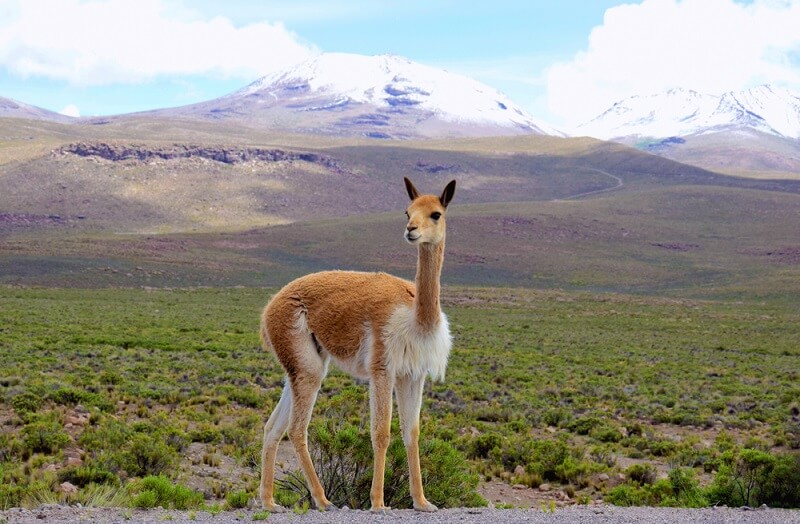
However, you should be very suspicious of the accuracy to which they claim to identify species.It can be very difficult to identify many domesticated animals even from their bones. While it's very easy to distinguish a living wild vicuña from the outrageously poofy alpaca, the only real skeletal difference is size. This makes archaic zooarchaeology difficult; studies on the origin of domestication in the Andes have usually relied on secondary data, such as preserved wool fibers or coral structures. Though not as relevant here, it is similarly difficult to distinguish sheep and goats from their bones.
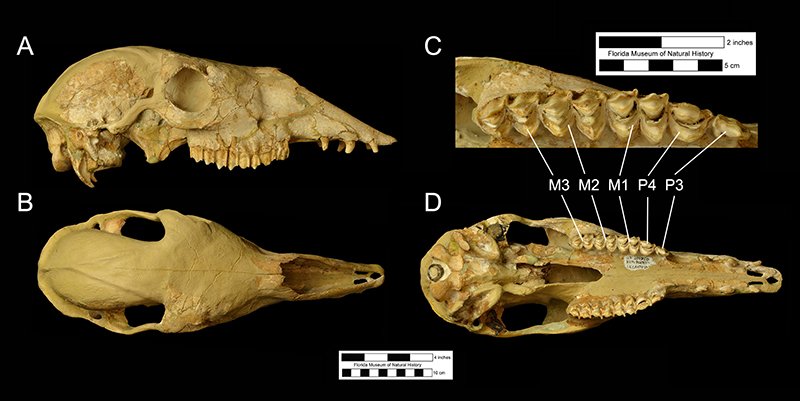
I'd be interested to know what specific things the researchers are identifying as certain animals, particularly what they're calling the "palaeolama." This is an extinct North American camelid skull. This is a modern llama. You can easily tell the difference if you know what to look for; the extinct genus has a narrower skull and smaller orbitals. Could you tell that from a profile view in heavily abstracted rock art? Heck no.
There's no reason to question these finds, and the scale of them is certainly notable. They're content, though, isn't anything new... yet. We'll have to wait for the documentary.
On that note, I do want to comment on something from the Guardian article that should make you question the approach here:
They had no choice but to walk past it, knowing that, if they were attacked, there was little chance of getting to a hospital. “You’re in the middle of nowhere,” she said. But it was “100%” worth it to see the paintings, she added.
When we entered Farc territory, it was exactly as a few of us have been screaming about for a long time. Exploration is not over. Scientific discovery is not over but the big discoveries now are going to be found in places that are disputed or hostile.”
This type of commentary is simply disgusting.
I don't know how different this is from what Al-Shamahi said. I don't know if it's been reinterpreted by the press, or if she was hyping it up herself. But I do know that Al-Shamahi that is way outside of her field here, just the "documentary presenter," and that she promotes herself as someone who seeks out conflict zones in which to do research.
To put it simply: that's colonialist as h*eck.
As someone else who works in Latin America, we don't need more people talking about how dangerous and exotic it is. They already think that. So when a scholar goes out like this and creates this neo-Victorian narrative of exploration, they are doing it to feed into their audience's preconceptions of what archaeology is like.
It's interesting to compare the quotations in the Guardian article: Al-Shamahi mostly describes the nature, the "awe," and the "wonder" of the site, while Iriarte talks about the people who made it and their culture. It's immensely frustrating to see someone with Al Shamahi's credential de-centering the creators and instead focusing on the art as a fascinating bit of natural history. This is language you should always be critical of when you see it in popular archaeology pieces.
Narratives that highlight the danger and isolation of a region and then glorify its discovery by science are the definitive colonial narrative.
Ack, multiple answers and I'm only seeing this now! As someone who studies rock art... this type of overblown news report about a site is sadly common, and the details are wildly false.
It is a wonderful and detailed site, but similar sites with just as much detail are seen regionally and have been known for decades - so it is not unprecedented. And the red finger-painting style is (afaik) stylistically dated to only ~1kyo (max up to a few kyo) in both northern and southern South America - not 12kyo at all. The scientific dating was only done at a nearby archeological dig, so... not directly dating any pigments or anything else related to the actual rock art panel. That's a pretty bad sign.
So we see small human figures next to huge animals - definitely a fascinating scene! But it likely has another explanation than depicting early Holocene megafauna. Their claim that some paintings are done very high up on the panel and could only have been reached by scaffolding? I'd agree! And scaffolding is a seemingly common explanation for lots of very tall rock art panels around the world, everyone makes scaffolding so it seems. But to go a step further and to say that we can see "wood towers" and "bungee jumping" in the panel is outrageous. In looking over the published pictures of the panel, I can't see what they're claiming are wooden towers, except if they mean the couple of tall slender rectangular geometric shapes. These are not so simple as to be direct representations of physical objects, but they are simply geometrics (and should always be called such, not buildings). Repeating geometrics are very common in rock art of the region, in the world, and you can see lots of them in the panels here as well. These are completely unknown, but are more likely something symbolic or (such as in North America) they could represent tapestries - "blanket glyphs." And lastly, bungee jumping? I have no idea what figures in these panels they're even referring to. Needless to say, the site's importance is being heavily overblown solely to hype the group's upcoming documentary.
Some responses from some rock art friends: Guillermo Muñoz, director of GIPRI Colombia...
Dear friends and colleagues. This media news has made the rock paintings of La Lindosa very famous indeed. I think they got what they wanted, to keep us all awaiting their 'findings', and of course the documentary they are preparing and announcing with a scandalous, exaggerated, imprecise, and baseless title. Yesterday, we even received a call from AP News to corroborate the information, I think they were not very happy with our answers...In 2018 UNESCO declared the Chiribiquete National and Cultural Park as a World Heritage Site. The Colombian state tries to keep this site away from tourists, and even researchers, since it is a natural reserve and it is also said that there are indigenous communities which have not yet been contacted [nearby] and [they] want to remain in this way. For these reasons, this area cannot be visited, and they decided to expand the protected area to the Serrania de La Lindosa, which is approximately 150km away...
It is in the Serrania de La Lindosa where we, GIPRI Colombia...have been working since 2017 in the systematic documentary, study of pigments, and conservation diagnosis. We have documented 13 [sites], indeed there are many murals that have not yet been registered and documented. Even [locals] have been finding more murals, not just the mural [seen in] media news! There is still much to study, this has been done little by little because it is still a conflict zone, and the Serrania may be more or less 40km long. Adding up the length of the murals which have been recorded so far, there are not 12km of murals!!!! Because there are spaces without rock paintings.
On the other hand, the representations that exist in the murals show different types of anthropomorphs, zoomorphs, abstract figures, and we [GIPRI Colombia] still do not dare to make precise interpretatios of their motifs and scenes. However, some researchers see representations of megafauna (Morcote, Aceituno, Iriarte 2019, 2020) or of war dogs bought in during the Spanish Conquest (Urbina, 2018), or of llamas from the gold trade with Peru (Gheerbrant, 1948). What would be essential is the rigorous study of the entire mural and not simply the identification of isolated figures. The truth is, there [is] no dating, neither absolute nor relative, of the rock paintings, nor is it known which ethnic groups made them; so there is still no chronology of them. Finally, records of some of the murals have been in place since 1948 (Gheerbrant) and new ones continue to appear. As the investigations have been carried out by people who speak Spanish, and the reports appear in Spanish, it is as if they did not exist [in Anglophone world media]!!!! Europe is still discovering America.
And from Diego Martinez Celis...
Megafauna of the Early Holocene or fauna introduced by the first European invaders? NOTES FOR A DEBATE:
In a recent article published in Science Direct (Morcote et al. 2020)^1 and its echoes in certain mass media (The Guardian^2 El Espectador^3 etc.), it has been alleged news of the "discovery" of rock art in the mountain range [serrania] of La Lindosa (Guaviare, Colombia), which, based on certain evidence in the surrounding subsoil, would have an antiquity of more than 12ky. This would be reaffirmed by the supposed representation of megafauna, especially megaterios, paleo-llamas, or American horses (!).
In principle, it would not be a "discovery" since these have already been noticed and investigated for more than 70 years (Gheerbrant, 1952, Botiva, 1986, Urbina, 2015, etc.); nor would they be representing megafauna but rather, according to Fernando Urbina Rangel^4, specimens of war dogs, cattle, and horses, introduced by the first European invaders, and noticed by the indigenous people of the Guaviare region since the 1530's.
The truth is, that according to the aforementioned research, the paintings themselves are not dated...Apparently, the conventional archeological projects which approach rock art for the first time continue to repeat the naïve claim that buried remains in the environment of a rock art site would automatically account for the context of the production of the paintings/engravings.
In this case, the result is even more perverse, because without finding vestiges of megafauna, the authors extrapolate the dating of other buried evidence to the imagination of the past and of a period (early Holocene) that triggered their findings. That is why they believe they see representations of megaterios and American horses, where most likely, it is of war dogs and American horses that Europeans brought...
2: 'Sistine Chapel of the ancients' rock art discovered in remote Amazon forest
3: El Amazonas tiene una de las colecciones de arte rupestre prehistórico más grandes del mundo
4: Perros de guerra, caballos y vacunos en el arte rupestre de la serranía de La Lindosa, Río Guayabero, Guaviare, Colombia, by F. U. Rangel http://www.rupestreweb.info/serranialindosa.html