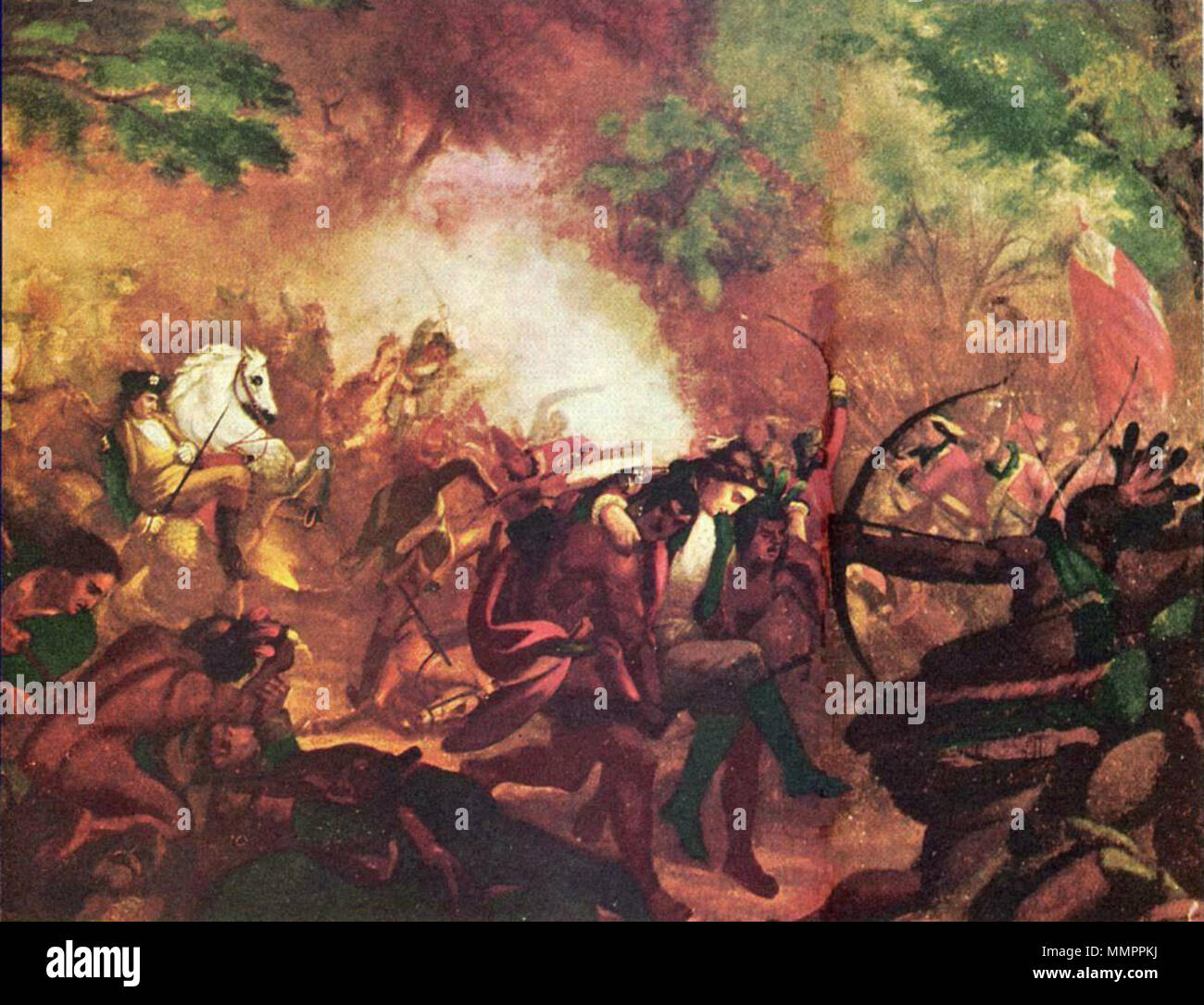
This is a really interesting and amazing question that leads to a story that I can't imagine telling without doing so completely. In truth, however, so much can be said about it that I feel that I have only told it in part here, despite the wealth of information provided. I hope you enjoy the tale of the Convention Troops as best I can tell it here.
Sept 1777: Burgoyne was moving towards Albany when he was stopped by General Gates at Saratoga. The Americans had fortified on the west of the Hudson River, just west of the riverside road leading to Albany. A Polish engineer, Tadeusz Kosciuszko, had built a well fortified battery which encouraged Burgoyne to attack further north than the battery on Bemis Heights. He chose to do so at Freeman's Farm, and his Sept 17 attack was stopped and repelled mainly by the crack shots from Daniel Morgan and his company of riflemen. They tried again a couple weeks later, on Oct 7, with the same result ([this painting] (https://c8.alamy.com/comp/MMPPKJ/english-benedict-arnold-at-the-second-battle-of-saratoga-italiano-il-generale-benedict-arnold-durante-la-seconda-battaglia-di-saratoga-del-7-ottobre-1777-19th-century-unknown-arnold-alla-seconda-saratoga-MMPPKJ.jpg) is of the second battle; the [man on the horse] (https://www.hgwt.com/arnold/images/saratogabig.jpg) is none other than Benedict Arnold whose patriotic leg earned its statue that day - the rest of him, however, was traitorous. The wounded man being carried on the right is British General Simon Fraser who died hours later, allegedly cut down by marksman Tim Murphy who is depicted in a tree in the top left of the image but unfortunately I can't locate one that includes the whole image with Murphy in it. In many opinions, that one rifle shot began the turn of the war). In addition to losing Gen Fraser, the British lost 1200 men to the two engagements and skirmishes around them, and had been repelled, becoming bogged down. They looked to move north and escape the American pursuit, and did so albeit very slowly and while being peppered by militia along the way, but soon the door was slammed shut by 1100 Americans arriving on their northern face being the Hampshire Grants under command of John Stark. The numerous American forces collectively now had over three men to every one British soldier, and had effectively surrounded them. One British sergeant reported;
Numerous parties of American militia... swarmed around the little adverse army like birds of prey.
Another comment, this coming after the fact from Hessian General von Reidesel whose forces were being protected during movements by the brave Scotsman Fraser and his troops when he was struck down and was with him when he died early the next morning (and attended his funeral in which cannonballs landed so close that dust showered the chaplain as he spoke graveside);
Every hour the position of the army drew more critical, and the prospect of salvation became less and less.
It was over, and they had lost. On 14 Oct 1777 Gen Burgoyne asked for surrender terms, and Gates was surprisingly generous in the 13 points agreed to on Oct 16 (which were largely dictated by Burgoyne, actually, and there is more to the story of Gates' generosity than just being kind hearted but we'll leave that for another day):
[Articles of Convention Between Lieutenant-General Burgoyne and Major General Gates;] (https://avalon.law.yale.edu/18th_century/burgoyne_gates.asp)
I. The troops under Lieutenant-general Burgoyne, to march out of their camp with the honours of war, and the artillery of the entrenchments, to the verge of the river where the old fort stood, where the arms and artillery are to be left; the arms to be piled by word of command from their own officers.
II. A free passage to be granted to the army under Lieutenant-general Burgoyne to Great Britain, on condition of not serving again in North America during the present contest; and the port of Boston is assigned for the entry of transports to receive the troops, whenever General Howe shall so order.
III. Should any cartel take place, by which the army under General Burgoyne, or any part of it, may be exchanged, the foregoing article to be void as far as such exchange shall be made.
IV. The army under Lieutenant-general Burgoyne, to march to Massachusetts Bay, by the easiest, most expeditious, and convenient route; and to be quartered in, near, or as covenient as possible to Boston, that the march of the troops may not be delayed, when transports arrive to receive them.
V. The troops to be supplied on their march, and during their being in quarters, with provisions, by General Gates's orders, at the same rate of rations as the troops of his own army; and if possible the officers' horses and cattle are to be supplied with forage at the usual rates.
VI. All officers to retain their carriages, batt-horses and other cattle, and no baggage to be molested or searched; Lieutenant-general Burgoyne giving his honour that there are no public stores secreted therein. Major-general Gates will of course take the necessary measures for the due performance of this article. Should any carriages be wanted during the march for the transportation of officers' baggage, they are if possible, to be supplied by the country at the usual rates.
VII. Upon the march, and during the time the army shall remain in quarters in Massachusetts Bay, the officers are not, as far as circumstances will admit, to be separated from their men. The officers are to be quartered according to rank, and are not to be hindered from assembling their men for roll call, and other necessary purposes of regularity
VIII. All corps whatever, of General Burgoyne's army, whether composed of sailors, batteaumen, artificers, drivers, independent companies, and followers of the army, of whatever country, shall be included in the fullest sense and utmost extent of the above articles, and comprehended in every respect as British subjects.
IX. All Canadians, and persons belonging to the Canadian establishment, consisting of sailors, batteaumen, artificers, drivers, independent companies, and many other followers of the army, who come under no particular description, are to be permitted to return there; they are to be conducted immediately by the shortest route to the first British port on Lake George, are to be supplied with provisions in the same manner as other troops, and are to be bound by the same condition of not serving during the present contest in North America.
...
XIII. These articles are to be mutually signed and exchanged to-morrow morning at 9 o'clock, and the troops under Lieutenant-general Burgoyne are to march out of their entrenchments at three o'clock in the afternoon.
[signed] Horatio Gates, Major-general
[signed] J. Burgoyne, Lieutenant-general
Saratoga, Oct. 16th, 1777
This was the plan - to send the Canadian and loyalist auxiliaries (including many Native warriors allied with them) back to Canada and the rest away to Europe with assurances none would not return to America and engage in the fight, or alternatively to be exchanged for American POWs held by the lobsterbacks, uh, I mean the British Army. We would feed them, and their stock, as if they were in our service (typically a pow recieved 2/3 rations, not full rations, making this quite odd). None of their baggage would be searched and the commanders could keep their sidearms while enjoying pardons in Boston. The surrender occured and the Canadians left, leaving very roughly 3,000 British soldiers and some 2,500 German soldiers engaged for them. There was one problem with Gates' plan - he thought he had the authority to declare terms, and Congress did not. In fact Gates never even informed Gen Washington of the surrender, who found out through the proverbial grapevine;
Sir, By this Opportunity, I do myself the pleasure to congratulate you on the signal success of the Army under your command, in compelling Genl Burgoyne and his whole force, to surrender themselves, prisoners of War. An Event that does the highest honor to the American Arms, and which, I hope will be attended with the most extensive and happy consequences. At the same time, I cannot but regret, that a matter of such magnitude and so interesting to our General Operations, should have reached me by report only, or through the channel of Letters not bearing that authenticity, which the importance of it required, and which it would have received by a line under your signature, stating the simple fact. - Washington from his camp outside Philly to Gates, 30 Oct 1777
Cont'd...