I am wondering if we have any idea or any artifacts that show how Ancient Chinese people used to dress in the Han, Song, Tang and etc Dynasties.
My curiosity stems from the fact that under Mao Zedong's cultural revolution a lot of Ancient Chinese artifacts were destroyed. There are a few things that come up online.
But lately, I have seen discourse from other Eastern Asian Communities that none of the clothing presented online is truly what the Chinese wore back then as it was all destroyed under Mao Zedong. Anything that says so, is propaganda by the Chinese Government.
That is why I am doing research on this right now. I want to get an accurate view of what Ancient Chinese used to wear and to see whether or not what is shown online is truly ancient Chinese clothing.
Thank you for taking the time to read this, and I've also posted this question in r/history, as I am uncertain whether or not this question fits here.
There is a lot of archaeological evidence available about what people wore during pre-Qing periods. As far as "what is shown online", it really depends where you're looking. You haven't specified at all what sorts of sources you're talking about, so I can't engage with them in my answer. I'm going to focus on the Song and Liao dynasties for my answer, as there is plenty of archaeological and art historical information available about clothing in those periods.
The Song Dynasty (960-1279) produced a lot of art which depicts the clothing of various ranks of people. Rank was the key determining factor in what clothing you wore in Song China. Sumptuary laws were in place restricting colour, fabric, and design to different classes. The art historical record is biased towards the upper classes, which makes sense as they were the ones commissioning these works of art. Some of the surviving depictions of clothing were royal portraits, which tended to depict members of the imperial family in their most formal fineries. Many portraits like this survive, for example this one of Empress Cao.
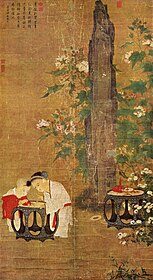
Other works of art show a wider range of people in them. For example, Zhang Zeduan's Along the River During the Qingming Festival shows a cross-section of society in the 12th century. All ranks of people are depicted, with over 800 people included in total. This painting, while a cherished belonging of the last emperor Puyin, was not destroyed in Maoist China but has been kept in the Palace Museum in Beijing since 1945. Most art from the Song Dynasty is not this sweeping in its panoramic portrayal of society, but many other paintings depict servants attending to their middle-class and upper-class masters. We even have paintings of children from the wealthier classes, such as this 12th century painting by Su Han Chen.
Another source for paintings is in books from the period, such as The Ladies' Classic of Filial Piety. This Confucian text, which women in affluent families would have studied, contains illustrations of Song women going about their daily lives. Although the activities depicted are idealized to an extent, the clothing depicted is likely to be quite accurate as the women were supposed to see themselves in the illustrations. Illustrations accompanying poetry are also in this vein, although sometimes those portrayed deliberately archaic scenes to evoke a historical setting.
Plenty of Chinese clothing from this period also survives in the archaeological record. Chinese silk was an incredibly high prestige trade good, so it made its way all over medieval Eurasia. The Viking Rus, for example, were sometimes buried wearing Chinese silk, such as in burial Ц-301 in Gnëzdovo in Russia, the tomb of a wealthy Scandinavian woman who died c. 970. This wide dispersal of Chinese textiles means that many examples survive in countries where the Chinese government has no authority to destroy archaeological remains, and they have clear similarities to clothing samples found within China itself.
Moving on from the Song Dynasty, there is also a lot of archaeological evidence of clothing in the Liao Dynasty (916-1125). The Liao Dynasty was a powerful polity ruled by the Khitan people in parts of modern-day China and Mongolia. There are some incredible burials from this period. The tombs include murals that show a variety of clothing, including that of haner women, or Han Chinese women living under Liao rule, as well as male Khitan warriors. Many of the burials also still have all their clothing intact, such as Princess Chen, who was buried with all of her riding gear. Some of the articles of clothing in the tomb such as her boots were made of silver and gold, meaning they were intended for funerary purposes only, but they mimic the shapes of the real clothing. You can explore these burials here.
The Liao are also likely depicted in some works of art by Han Chinese artists of the Song Dynasty. In the 12th century, Emperor Gaozong commissioned paintings to accompany the poem Eighteen Songs of a Nomad Flute. Although the original poem was set in the Han Dynasty, the clothing of the Xiongu is probably inspired by the contemporary clothing of the Khitan at the time the paintings were made. The Song had plenty of run-ins with the Liao, even being forced to pay them tribute in the early 11th century, so they would have been a lot more familiar with the Liao as a vision of "barbarian" clothing than with the Xiongu. A 14th century copy of this scroll is held in the Metropolitan Museum of Art, who host an online version you can browse, while fragments believed to be of the 12th century original are held in the Boston Museum of Fine Arts.
As I hope this post demonstrates, China as a nation covers a vast geographical area which incorporated many different cultures in the pre-Qing eras. Archaeological, art historical, and textual accounts of people's clothing from these cultures survive in museums all over the world. Chinese people's medieval clothing are some of the easiest to reconstruct in this period because of these records from the Song and Liao dynasties. This doesn't account for all of the cultures present in "China" at the time, but it certainly gives us a good idea of what thousands upon thousands of people would have been wearing in the 10th-12th centuries. I'm sure the same goes for other pre-Qing dynasties given the long history of representational art in what is currently China.
Yes, we know what people dressed like pre-Qing based on paintings in tombs, archeological evidence, etc. Even Qing era books and artwork depicted what people dressed like before the Qing era. The Terra Cotta Army archeological site discovered in the mid 1970s (and artifacts are still being dug up today) actually has many statutes of soldiers and civilians wearing Qin Dynasty/Warring States era clothing. Whenever they open up a new tomb, historians and archeologists can often see paintings of what people wore back then.
Here is an example of Qin statues with Qin era clothing: https://www.shine.cn/feature/art-culture/1904042504/
Example of Tang era tomb paintings: https://www.wsj.com/articles/on-the-road-to-paradise-1392757876
But lately, I have seen discourse from other Eastern Asian Communities that none of the clothing presented online is truly what the Chinese wore back then as it was all destroyed under Mao Zedong. Anything that says so, is propaganda by the Chinese Government.
That is basically nonsense based on an extremely superficial understanding of the events. The Communists didn't destroy everything (they didn't even try to), and even if they did, there are still plenty of tomb paintings, pre-Qing books, etc that were recorded by Chinese and foreign scholars before 1951 when the Communists took power. Even the Qing era books, paintings, etc still recorded what life was life before the Qing era. And there are plenty of artifacts being dug up after the destruction of the Cultural Revolution. Not to mention the KMT Taiwanese government managed to ship a lot of Chinese artifacts to Taiwan before the Communist takeover of mainland China.
The famous British Sinologist Joseph Needham wrote his "Science and Civilization in China" works in the mid 1950s, and these were based on his studies in China during the 1930s-1940s, long before the Chinese Communists took over. On the front cover of these books, you can actually see depictions of pre-Qing clothing.
To summarize:
The Communists didn't destroy everything and they actually preserved important artifacts deemed national treasures
The government of Taiwan shipped over plenty of artifacts from China before the Communist takeover, and they are now in Taiwanese museums
There are plenty of pre-Communist China historical & archeological works written (and illustrated) by Chinese and foreign/Western scholars that became popular outside of China
You have modern Chinese and modern foreign/Western scholars and academics still digging up artifacts in China today. For example, most of the currently dug up terra cotta warriors and statues weren't dug up until the 1980s-2000s, long after the destruction of the Cultural Revolution ended. More are still being dug up today because only a small fraction has been dug up.
See exhibits of Chinese artifacts and paintings in Taiwanese museums: https://www.npm.gov.tw/en/
See exhibits of pre-Qing artifacts and paintings in the museums of other countries: https://www.metmuseum.org/toah/hd/ming/hd_ming.htm
http://www.alaintruong.com/archives/2009/01/23/12191136.html
https://www.chinadaily.com.cn/culture/2014-09/17/content_18612759.htm