I suppose a sub-question would be as regards the British factions, which are of 'Celtic' culture, but can only confederate with each other and not continental 'Celtic' factions. Does including both British and continental 'Celtic' peoples under a broad 'Celtic' banner accurately reflect the cultural landscape of Europe at this time?
'Para-Classical' or 'Barbarian' Europe, that is societies living next the main Mediterranean civilisations and states that we know essentially thanks to Greek or Roman texts and archeological sources, could be sorted in various categories and distinctions : material culture, language, social complexity, regional and macro-regional relations, etc. that far from mirroring each other, overlapped so much it would have made John Venn call quits in disgust.
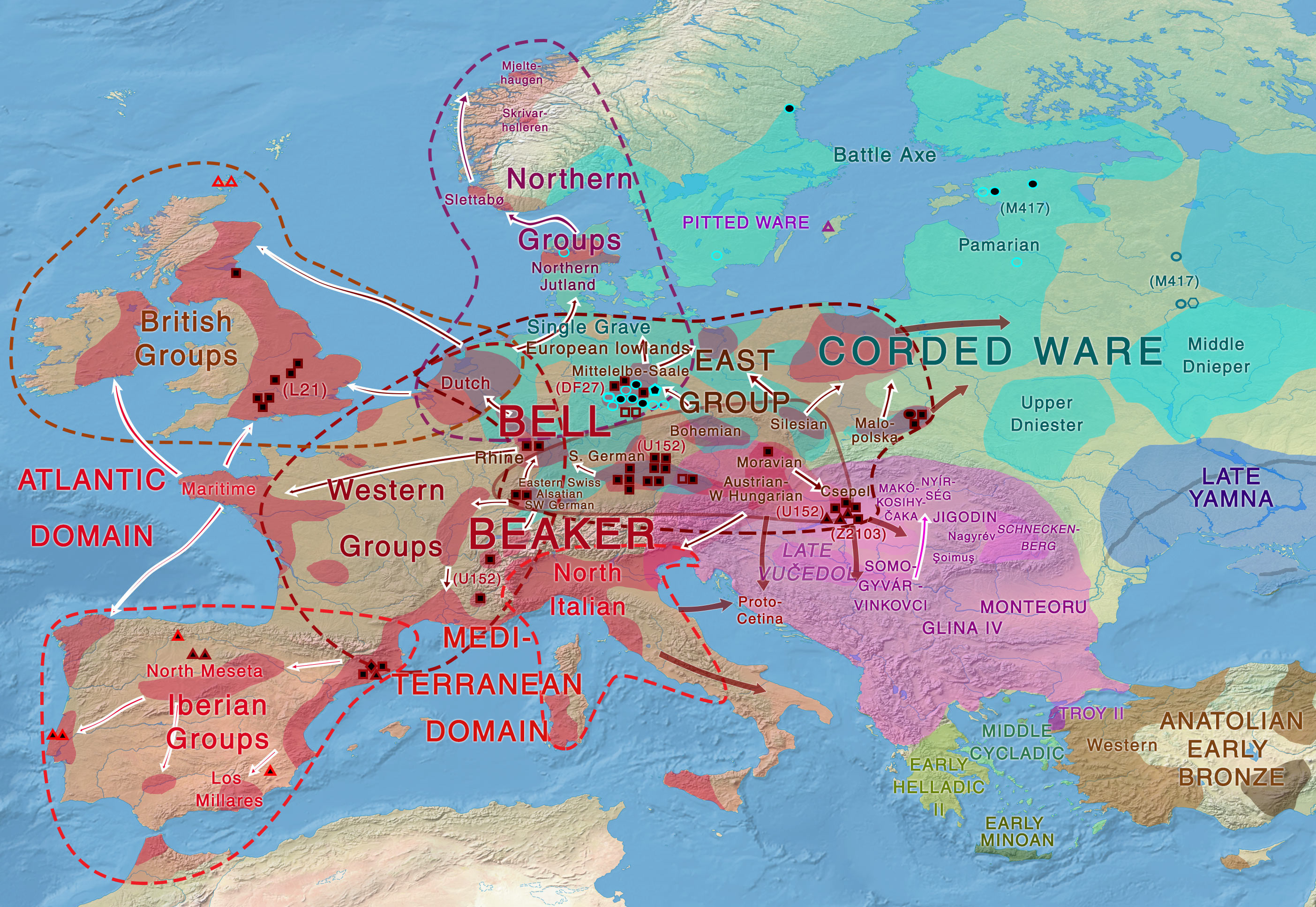
It doesn't mean that these regions weren't interconnected : the spread of exchange networks and material cultures since the Chalcolithic (Bell-Beakers, Urnfield and Atlantic Bronze Age, Hallstatt and La Tène, to speak only of the major ones) likely participated to the emergence of regional frameworks and linguistics (chiefly among them 'Celtic', but also Germanic or Italic) but this multi-layered material development also implies more or less important differences depending of each regional or micro-regional situations.
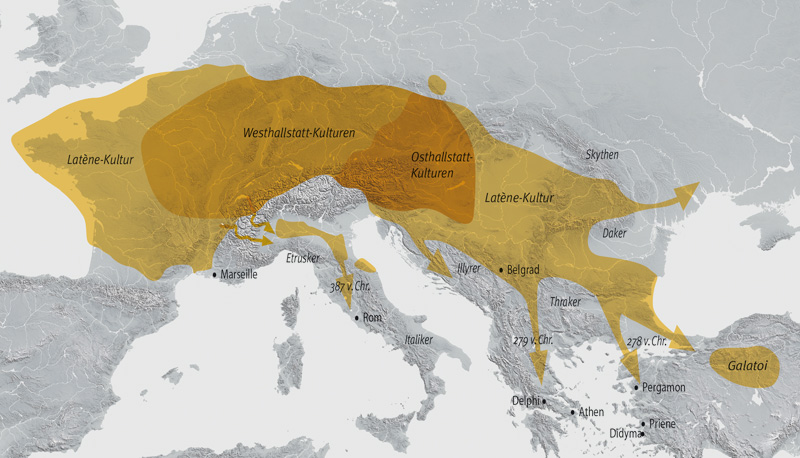
While we can be fairly confident that populations of the British Isles spoke a Celtic language fairly close to mainland Celtic, they were also living in the frames of a material culture that was essentially peripheral to mainland Iron Age; whereas Hispano-Celtic populations were part of the Hallstattian horizon (but not La Tène) speaking what appears to be a fairly distinct branch of Celtic compared to the others. In the same time, material influence from the main archeological horizons can be spotted in regions or other archeological cultures that are generally considered having been carried by non-Celtic speakers (e.g. Jastorf or Przeworsk cultures) in pretty much the same way it did for the former if not more. And that's not going into the subtelties of regional variations or peripheries of Hallstatt or La Tène horizons (Jogassien, Mailhacien or Marnien; Champenois, 'Eastern Style', Hunsruck-Effel, southern Gaul, etc.) and the relations each of these all together had with other cultures (notably, but not only, contact with Mediterranean civilizations).
On the other hand of the spectrum, we can point out several situations where differences between two proto-historical groupings are essentially minor in spite of these aformentioned variations.Iron Age Gaul and southern Germania were essentially part of the same archeological dynamics centered on the Alpine Arc : the Halstattian princely graves of Vix, Lavau, Hochdorf or Heuneburg belongs to a same civilization marked by the connection to the Mediterranean world and access to its products, with a same aristocratic display in chariot burial, and more than often a same association with political and social sophistication.Likewise, these regions underwent similar changes in the Vth century, in the general horizon of La Tène, both regions partaking in a same material culture, with similar or related cultural expressions, probably closely related languages (knowledge of 'Eastern Celtic' is fragmentary at best, but what we have seems to indicate their close proximity with Gaulish), same broad burial practices same practice of votive deposits and by the IInd century,a same movement of urbanization, the emergence of a more diffuse warring-aristocracy and the related context of Celtic mercenariate and migrations of the second Iron Age, etc.
These migrations in particular are quite interesting : although we traditionally get a greater interest on Gallic/Galatian raids and movements in central Italy, southern Balkans and Anatolia, these were only the tip of the iceberg as much of the movements seem to have happened inside the 'Celtic sphere' with, for instance, Gallic migrations on British shores, Gallic and Danubian migration in partly Celtic-speaking northern Italy, Danubian migrations in northern Gaul forming the Belgian supra-group, late migrations from Germania to northern Gaul, etc. ; or happening in its periphery along the trade and contact roads, for instance in non-Celtic northern Italy, Pannonia or Illyria where indigenous populations were 'gained over' La Tenian features and 'Celtic' social codes or even language. These creolizations in themselves were likely not a one-way event but rather non-linear events where greater familiarity (Fernández--Götz) trough trade, warfare, migrations, connections, returns or scouting could have cumulative effects on this regard even as the new groupings themselves indigenous features and connections (themeselves rippling back to the "old country") in the formation of new identities at a local or regional level (e.g. the Belgian identities , the Galatians in Anatolia, or the 'Danubian Celticity') paralleled with the formation of new identities in Central Europe as non-Celtic speakers moved south (probably, at least in a first time, together with their Celtic-speaking neighbours) in southern Germania : even by the turn of the millenium, the names of peoples (Usipetii, Tencterii, , rulers (Ariovist, Deudorix, Maraubodos ) or places on the right bank of the Rhine and southern Germania kept a strong Celtic aspect whereas new groupings emerged (e.g. Marcomanni and Suebi).
This collide with the perception ancient Greek and Roman authors had of the Barbarian lands, especially as their political and cultural make-up changed (sometimes significantly) between their first contacts in the archaic period and their own times : these sources tend to essentialize and categorise these peoples ('People' lives in 'Place' and have 'Characteristics') with changes being ascribed to translation of peoples moving out and settling in new places removing or dominating indigenous populations. Hence, Greeks made a distinction between the 'true Illyrians' they were familiar with, that is peoples at their direct contact with Greek petty-states and traders, and assumed to be the same than their own neighbours (in the "it's Celts/Illyrians/Scythians all the way up" ethno-geographic considerations and the other ("false") Illyrians as Iapodes or Scordisci that were more or less importantly Celticized and partaking to La Tenian civilization.
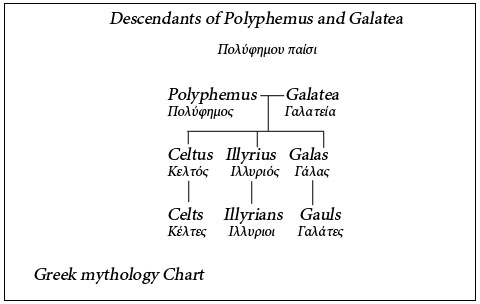
These authors were, nevertheless, aware of the relative complexity of these connections and tried to make sense of them, either by rational explanans as Strabo naming a given people 'Celti-Iberi' because they were a mix of 'Celts' (that is, what we'd call Gauls) and 'Iberi' or description as the same stating that either Brittons or Germani were distinct from Gauls but with similar customs^(1); either by integrating them into a posteriori explanative and legitimizing narratives with Barbarians being attributed founding ancestors (Illyrios, Keltos, Galas, etc.) often issued from a mythic Greek figure and an indigenous woman, or resorting to giving them related to the plethora of ad hoc refugees from Troy (in what became one of the most widespread ethographic cliché of Antiquity and Middle-Ages) Thus the relations between Greek and Barbarians were being symbolically set in genealogical basis (which was itself fitting indigenous conceptions of relations) but also explaining relations among Barbarians as, for instance, Illyrians, Celts and Gauls having related founders as much as being related themselves creating the ancient equivalent of "It's a small world after all", albeit more violent and less disturbing.