Relevant thread from /r/askhistorians featuring /u/bg-j38 and additional references on this topic.
There doesn't seem to be a good definitive answer to this
Radio Telegraph stations in the early 20th century started using codes of letters to identify themselves.
the Bureau of Navigation (part of the Department of Commerce) began assigning three-letter call signs to American ships in the early 1910s. Ships in the Atlantic and Gulf of Mexico got a K prefix; in the Pacific and the Great Lakes, a W. The precise reasons for choosing these two letters, if there were any, are unknown (bureaucracy works in mysterious ways). At the 1912 London International Radiotelegraphic Convention, ranges of letters were assigned to each of the participating nations and the U.S. was told to keep using the W and most of the K range.
The US was also allocated N (used by the Navy as early as Nov 1909, and by the coast guard) and later wound up with AAA to ALZ (Army, Air force, later) which was reserved for military use.
One article suggests that W and K were based on A and N, but this seems wrong/speculative to me since it was germany that was initially allocated 'A' and KAA to KCZ
The Morse Code for A is dot-dash (.-) and for N is dash-dot (-.). Add a dash to each, and you get W (dot-dash-dash, or .--) and K (dash-dot-dash, or -.-).
The 1912 international radiotelegraph conference was the first to actually allot call letter blocks, though this had been recommended in the 1906 conference Circular dated April 1913 with the actual allocation
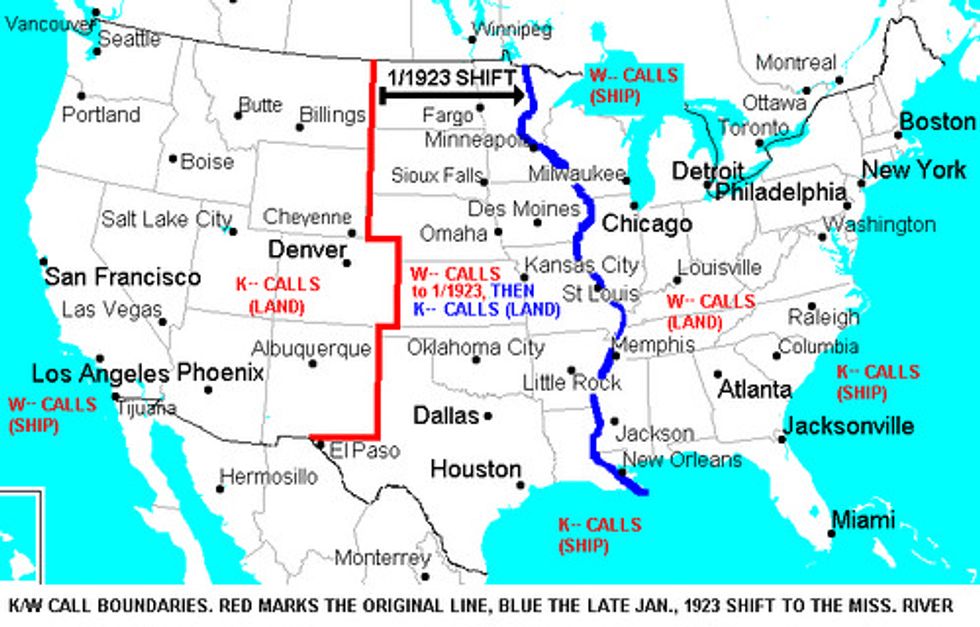
In any case, ships out east wound up with a K sign and out West with a W sign. Again for some unknown reason, the land station sign allocations seem to have been flipped from this (possibly to distinguish from the sea, but also possibly from miscommunication)
The line dividing west "K" from east "W" on land was further to the west till 1923 but was then shifted to the Mississippi.
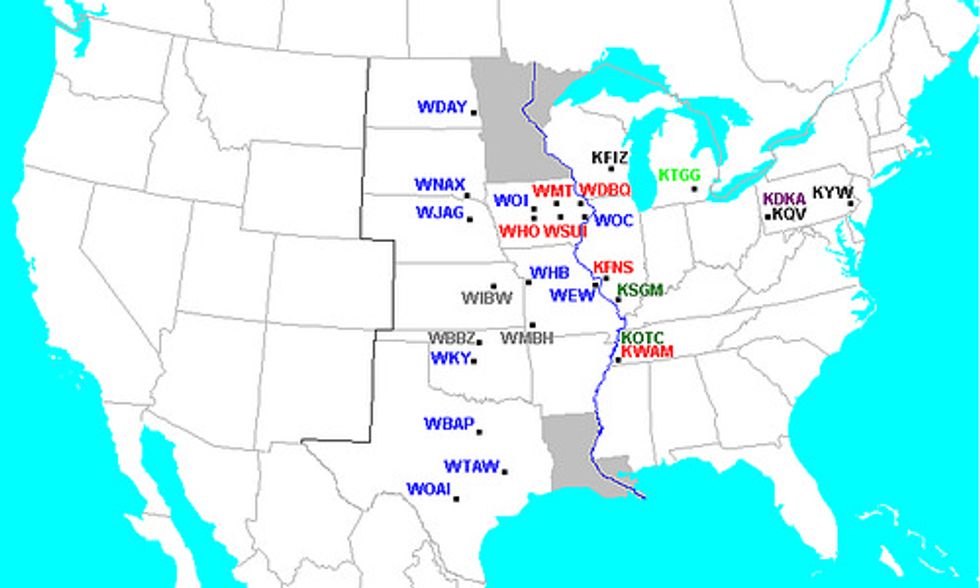
a grandfather clause provided that those radio stations in those states which already had a W call sign could keep it. This explains some of the anomalous call signs still in existence today, if not quite all of them. There are currently 27 exceptions to the general K/W divide - 9 Ks in W Country, and 18 Ws in K Land
Pic of exceptions ; the article by Frank Jacobs explains the color coding key.
Blue: .. [Remaining stations that retained their pre-1923 W call sign in the switchover zone per the grandfather clause] ....A total of 11 call sign 'fossils' remain: WBAP, WDAY, WEW, WHB, WJAG, WKY, WNAX, WOAI, WOC, WOI, WTAW. However, all newer stations were assigned K call signs.
- Purple: Anomalous assignment, in 1920-'21, of KD call sign to stations across the country - both east and west of the Mississippi. Only remaining station: KDKA in Pittsburgh, PA.
- Gray: Formerly 'portable' stations that got their call sign in one zone before taking root in the other one. Three extant examples, all having moved from W Country into K Land: WBBZ, WIBW, WMBH.
- Dark Green: Regular radio stations that originated on the western (K) bank of the Mississippi before moving over to the eastern (W) bank: KOTC, KSGM.
- Red: Exceptional grant of a request to deviate from the general rule. Two Ks in W Land (KFNS, KWAM) and four Ws in K Country (WDBQ, WHO, WMT, WSUI).
- Light Green: government assigned call - KTGG [suggested as someone mistaking MI as missouri]
- Black: reason unknown - KFIZ, KQV, KYW.
Edit: It appears the above list isn't exhaustive; there may be a few additional changes.
3 letter codes tend to have older origins; though issue and rules of issue of 3 and 4 letter codes has changed over time, the current practice for new stations is to allocate 4 letter codes.